Sermon: The importance of good biblical interpretation

Sermon for Williamstown
The third Sunday of Pentecost, 17th of June, 2018

1 Samuel 15:34 – 16:13

Last week, if you’ll remember, the Hebrew Scriptures told us about the desire of the people of Israel for a king to lead them. They wanted this king ‘that we also may be like other nations, and that our king may govern us and go out before us and fight our battles’ (1 Samuel 8:19-20). The prophet Samuel thought this was a bad idea, that YHWH should be Israel’s king, speaking through his prophets. Samuel consulted the Lord who told him to do as the people wanted – after first warning them of what a king would do to them.

The first king of Israel is Saul, one of the tribe of Benjamin. At first it seems that everything will go well but then Saul twice disobeys the Lord. First he offers the sacrifice in the place of Samuel. Then he doesn’t kill all the livestock of the Amalekites as the Lord ordered him to do. And so Samuel tells Saul that the Lord is going to replace him; that Saul’s family will not inherit the kingdom. This is despite Saul having a son, Jonathan, who is a great warrior and dearly loved by the people. In another story that the lectionary ignores Saul makes the sort of rash oath that always gets people in trouble in folktales. One day, while fighting the Philistines, Saul vows, ‘Cursed be anyone who eats food before it is evening and I have been avenged on my enemies.’ His son Jonathan doesn’t hear this and when he finds a honeycomb Jonathan eats the wild honey. In response to the breaking of Saul’s vow God withdraws, so Saul has lots drawn to find out who has sinned and caused God’s retreat. The lot falls on Jonathan, who confesses. Jonathan is willing to die and Saul to kill him, but ‘the people said to Saul, “Shall Jonathan die, who has accomplished this great victory in Israel? Perish the thought! As the Lord lives, not one hair of his head shall fall to the ground; for he has worked with God today.” So the people ransomed Jonathan, and he did not die. Then Saul withdrew from pursuing the Philistines; and the Philistines went to their own place.’ (1 Samuel 14:45-46.) It is this much-loved, great warrior, Jonathan, who is Saul’s heir. But he is apparently not God’s choice for the next king. Continue reading

Posted in Sermons | Tagged , , , , , , | Leave a comment

Sermon: So, you want to have a king …

Sermon for Williamstown Uniting Church
10th of June 2018

1 Samuel 8:4-20

This Wednesday I asked those at the Wednesday Worship what they thought about today’s reading from the Hebrew Scriptures; the story of ‘all the elders of Israel’ asking Samuel for a king. Why, I asked, is this story in the Bible? They talked about it as a story about tithing or about human stubbornness, but none of the answers satisfied me. If we read today’s story as the Lectionary provides it to us, in isolation, it does seem to be a story of the people of Israel once again rejecting God, as they have done so often before, in their desire to be like the other nations. It provides the basis for a sermon on the human propensity to turn away from God and replace our allegiance to God with an allegiance to human things; as Jesus was to rebuke Peter a millennia later, ‘you are setting your mind not on divine things but on human things’ (Mark 8:33). But if we look at this story in its biblical context it is much more confusing. Continue reading

Posted in Sermons | Tagged , , , , , , , | Leave a comment

Sermon: Jesus (mis)reads the scriptures

Sermon for Williamstown Uniting Church
Pentecost 2, 3rd of June

Mark 2:23-3:6

After all the many weeks of Lent and Easter, here we are in Ordinary Time; back with our gospel for the year, the Gospel according to Mark. Just as when we left him before the Transfiguration, Jesus is embroiled in controversy. The Pharisees are shocked at Jesus’ apparently cavalier attitude to the laws governing the Sabbath. Modern Christians are shocked at Jesus’ apparently cavalier attitude to biblical interpretation. Continue reading

Posted in Sermons | Tagged , , , , | Leave a comment

Women Celebrating Justice: Reflection for the Victorian Country Women’s Association

Reflection for the Conference of the Victorian CWA
Feast of the Visitation 

1 Samuel 2:1-10
Luke 1:39-56

You might not be aware (I certainly wasn’t) but today the Anglican, Lutheran and Roman Catholic churches celebrate the Visitation. This Feast remembers the story from the Gospel according to Luke in which Mary, the mother of Jesus, visits Elizabeth, the mother of John the Baptist, while both women are pregnant with their sons. The two women meet and talk free of any men, other than their unborn babies. The Bible is a male-dominated collection of writings, and it rarely includes scenes in which women appear together without men, so although the Uniting Church doesn’t officially celebrate the Visitation as a Feast it seemed suitable for a service of the Country Women’s Association to use the Bible passages that the Lutheran church has chosen for it, one from the Old Testament or Hebrew Scriptures, and one from the New.

Visitation Continue reading

Posted in Reflection | Tagged , , , , , , , , , , | 1 Comment

Sermon: Is Isaiah a role model for volunteers? (National Volunteer Week)

Sermon for Williamstown Uniting Church for National Volunteer Week
The 27th of May, 2018

Isaiah 6:1-13

Today is the last day of National Volunteer Week. So it’s providential that in today’s reading from the Hebrew Scriptures we meet the prophet Isaiah who, when God asks ‘Whom shall I send, and who will go for us?’ immediately responds with, ‘Here am I; send me!’ What a wonderful role model for volunteers! God asks and Isaiah answers. No quibbling about how busy he is, no suggestion that Isaiah has done his share of prophesising in the past and it’s now someone else’s turn. None of that. This Hebrew prophet could be the patron saint of volunteers!

(I checked and the actual patron saint of volunteers is St Vincent de Paul, a French saint who founded several groups to support the poor in the seventeenth century. Did you know that?)    Continue reading

Posted in Sermons | Tagged , , , | Leave a comment

Sermon: What is love? (Baby, don’t hurt me)

Sermon for Williamstown Uniting Church
May 6th, 2018

John 15:9-17

 “This is my commandment, that you love one another as I have loved you.”

The problem with songs, or their strength, is the way in which they can take up residence in our brains and just flatly refuse to leave. The Wesleys knew that; it’s why the Methodists became people who sang the faith. Numerous studies have found that our brains remember things better if we sing them, even if they weren’t things we necessarily wanted or needed to remember (commercial jingles, anyone?). Every week as I prepare Sunday’s service I find that a song has ‘ear-wormed’ me; decided to play itself on repeat in my head. It’s often one of the hymns I’ve chosen, which can be helpful when writing the week’s sermon. But frequently it’s some other sort of music that has only the most marginal connection to what I’m meant to be thinking about.

And so this week, while I was meant to be reflecting on chapter fifteen of the Gospel according to John, what I’ve found myself singing has been a 1993 dance hit by a Trinidadian-German musician called Haddaway:

What is love?
Baby don’t hurt me
Don’t hurt me
No more

(I had no idea who had sung the song or when it had come out until I looked up that incredibly irritating ear-worm this week.) Continue reading

Posted in Sermons | Tagged , , , , , | Leave a comment

Sermon: Forgiveness, not sacrifice

Sermon for Williamstown Uniting Church
ANZAC Service – 22nd of April, 2018

Have any of you seen the recent film Good-Bye Christopher Robin? It flashes forwards and backwards between the two World Wars and the period between them. It begins in 1941, when author A.A. Milne and his wife Daphne receive the news that their son Christopher is missing, presumed dead. We look back to 1916, when Milne is in the trenches himself; and then we suddenly flash-forwards to find ourselves with Milne in post-war London, celebrating the birth of his son, Christopher Robin, commonly known as ‘Billy Moon’, in 1920.

From 1920 to 1941 the film tells its story chronologically. In 1938 Milne, Daphne, and Christopher’s headmaster are standing outside his school waiting to see whether Christopher has been found to be fit enough to join the army.

A.A. Milne: I was in the last war. The War to end all wars.
Daphne: Yes, well, it didn’t work, it seems.
Christopher exits the school in civvies, rather than a uniform.
A.A. Milne (under his breath): Thank God. Continue reading

Posted in Sermons | Tagged , , , , , , , | Leave a comment

Sermon: Putting it all together

Sermon for Williamstown Uniting Church
15 April 2018

Luke 24:36b-48

For us, Easter, both Easter Sunday and the fifty days that follow it, is a season of great joy. But our celebration is based on our foreknowledge. When we remember Jesus’ crucifixion, we are already looking forward to his resurrection; we know that after his death comes life. But Jesus’ disciples didn’t. Jesus may have warned them of what was going to happen, but quite understandably they didn’t take it in. For them Jesus’ death was tragic and his resurrection terrifying. On Easter Sunday this year we heard Mark’s version of what happened at Jesus’ tomb, which ended with the women fleeing in terror and amazement and telling no one what they’d seen because they were afraid. Today we hear one of the three times that disciples experience the resurrection in the Gospel according to Luke, and again the immediate emotion is terror, not joy. Continue reading

Posted in Sermons | Tagged , , , , , , , | Leave a comment

Sermon: The story continues

Sermon for Williamstown Uniting Church
Easter Sunday, 1st of April, 2018

Mark 16:1-8

Today is April Fool’s Day. It’s still before noon, so we still have time to try to fool each other. It’s a perfect day on which to remember the resurrection, especially the resurrection as described by Mark. Today’s story sounds like the story of a prank going wrong. Women going to a tomb to anoint a dead body find the body gone. The explanation given is absolutely impossible, and so they run away in terror. Oops. The prank has miscarried.

(In fact, in the gospel according to Matthew we read the suggestion that Jesus’ disciples did hide his body: ‘While they were going, some of the guard went into the city and told the chief priests everything that had happened. After the priests had assembled with the elders, they devised a plan to give a large sum of money to the soldiers, telling them, ‘You must say, ‘His disciples came by night and stole him away while we were asleep.’ If this comes to the governor’s ears, we will satisfy him and keep you out of trouble.’ So they took the money and did as they were directed. And this story is still told among the Jews to this day.’)

In the gospel according to Luke the men think that the women who are telling a fool’s tale. Continue reading

Posted in Sermons | Tagged , , , , , , | Leave a comment

Sermon: How is Jesus like a bronze serpent?

Sermon for Williamstown Uniting Church
11th of March, 2018

John 3:14-21

Today’s gospel reading contains one of the most well-known and fundamental verses in the entire Bible, John 3:16: ‘For God so loved the world that he gave his only Son, so that everyone who believes in him may not perish but may have eternal life.’ It’s one of the very few Bible verses that even I know by chapter and verse: ask me what ‘John 3:16’ is and I can quote it verbatim. But today’s gospel reading also contains one of Jesus’ most enigmatic sayings: ‘And just as Moses lifted up the serpent in the wilderness, so must the Son of Man be lifted up, that whoever believes in him may have eternal life.’ The lectionary recognises that we might not remember Moses lifting up a serpent in the wilderness, it’s not one of the more memorable chapters in his biography, so we’re given the story as our first reading. As is their usual practice during the Exodus the people are whinging in the wilderness; and God responds by chastising them with poisonous snakes. The people repent; God forgives them; and ‘Moses made a serpent of bronze, and put it upon a pole; and whenever a serpent bit someone, that person would look at the serpent of bronze and live’. That is the story to which Jesus is referring, which raises the puzzling question: in what way is Jesus like a serpent of bronze on a pole?
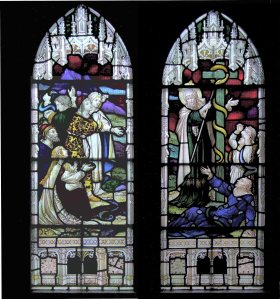
KONICA MINOLTA DIGITAL CAMERA

Today’s gospel reading is part of the conversation Jesus had with the Pharisee Nicodemus, who came to visit Jesus in the dark of night. Nicodemus was the teacher of Israel who couldn’t understand how one could be born again, and who mocked the idea of an adult re-entering the womb. In this, his first appearance in the Gospel, Nicodemus doesn’t make a particularly good impression. But later Nicodemus argues before the temple police, the priests and the Pharisees for Jesus to get a fair hearing, so vehemently that he is accused of also coming from Galilee (John 7:51-2). Finally Nicodemus assists Joseph of Arimathea in Jesus’ burial, when he brings a mixture of myrrh and aloes, weighing about a hundred pounds (John 19:39). Nicodemus’ story is an encouraging one of growth in courage and faith. It’s to Nicodemus that Jesus is speaking in today’s reading.

Immediately before today’s reading starts Jesus told Nicodemus that: ‘No one has ascended into heaven except the one who descended from heaven, the Son of Man’. Now today’s reading starts. Nicodemus is one of the people who have been impressed by Jesus’ miracles; he says, ‘no one can do these signs that you do apart from the presence of God’. It is in response to this faith by signs that Jesus talks about the only sign that will be given, his lifting up. Jesus, the one who descended from heaven, will ascend again, but his ascension will be on the cross, on an instrument of torture and death. It’s only those who are able to see the birth of new life on a device of death who will become ‘those who believe’.

This is, of course, the foolishness and offensiveness of Christianity – Christ crucified. How can a man whose life will end in judicial execution claim to be the one who comes from heaven? How can God’s love be seen in the torture of his beloved Son? How can John proclaim that Jesus’ scandalous death glorifies both himself and God? It is the cross’s strange conjunction of humiliation and glory that explains how Jesus can be compared to a bronze serpent.

Some commentators have argued that Jesus and the bronze serpent lifted up by Moses are opposites. Gregory Nazianzen, the fourth-century Archbishop of Constantinople, argued that Jesus should be contrasted with the snake; the serpent is dead and so its power to kill others is killed; Jesus is killed and his power to save the lives of others is born. But Augustine disagreed. He argued that the serpent and Jesus should be compared; a serpent on a pole is gazed at so that serpents have no power; a death on a cross is gazed at so that death will have no power. The death of Jesus on the cross ends death, just as the bronze serpent on the pole ends the ability of snakes to kill. The only difference is that the bronze serpent gives temporary life, while on the cross gives eternal life.

But it was Martin Luther who went most deeply into the relationship between Jesus and the serpent. Luther argues that both are disgusting, offensive, scandalous. He imagines the people bitten by poisonous serpents looking at a bronze serpent on a stick and saying, ‘We are so terrified that we cannot stand the sight of them! If only you would, instead, give us a drink, a cooling plaster, a cooling drink, to take away the venom and the fever! … How can that dead and lifeless object up there benefit us?’ (Quoted in Ronald F. Marshall, ‘Our Serpent of Salvation: The Offense of Jesus in John’s Gospel’ Word & World (2001), p. 388.) Exactly the same things can be said of Jesus on the cross. One of my favourite Good Friday hymns, by Brian Wren, starts ‘Here hangs a man discarded / a scarecrow hoisted high / a nonsense pointing nowhere / to all who hurry by’ (TIS 356). People bitten by serpents were confronted by another serpent; those of us who want to follow Jesus are confronted by a victim of torture, ‘a clown of sorrows’. We don’t like looking at the ugly, and the crucifixion is profoundly ugly. But then birth, too, is ugly. And the ugly death of Jesus on the cross enables us to be born again, born from above.

Fascinatingly, the second book of Kings tells us that the bronze serpent that Moses created became an idol. When Hezekiah became king, we’re told, ‘he removed the high places, broke down the pillars, and cut down the sacred pole. He broke in pieces the bronze serpent that Moses had made, for until those days the people of Israel had made offerings to it; it was called Nehushtan. He trusted in the Lord the God of Israel; so that there was no one like him among all the kings of Judah after him, or among those who were before him’. (2 Kings 18:1-5) The bronze serpent that God had used to save had become a replacement for God. And, of course, the same thing has happened to the cross. Jesus was crucified on an instrument of torture made of two random pieces of wood, and Christians throughout history have taken that instrument of torture and made it pretty. (I’m wearing quite an attractive silver cross at this very moment.) But the idolatry is not making literal crosses pretty, it is making Jesus’ pretty. In John’s gospel Jesus death on the cross is also his glorification, and the two, crucifixion and resurrection, need to be held together. That’s why after the light-filled theophany of the Transfiguration Jesus tells his closest disciples not to tell anyone about it until after his death. His glory cannot be separated from the horror of his death. Jesus is the Son of Man who is lifted up, but he is lifted up through the crucifixion. In Jesus we see the ‘Crucified God’ and so, as the theologian Jurgen Moltmann has written,:

There is no suffering which in this history of God is not God’s suffering; no death which has not been God’s death in the history on Golgotha. Therefore there is no life, no fortune and no joy which has not been integrated by his history into eternal life, the eternal joy of God.
Jurgen Moltmann, The Crucified God, London: SCM Press, 1974, p. 255

And as Dietrich Bonhoeffer wrote from a Nazi prison in 1944, ‘The Bible directs man to God’s powerlessness and suffering; only the suffering God can help’. (Dietrich Bonhoeffer, ‘Letter to Eberhard Bethge, 16 July 1944’ in Letters and Papers from Prison, London: SCM Press, 2002, p. 134.) If we pretty up the crucifixion we lose that solidarity between God and suffering humanity. If we make Jesus too pretty, we might think that suffering, ugly, humanity isn’t part of the world that God so loves.

Maybe we should occasionally think of Jesus as a bronze serpent, both terrifying and apparently useless. We are in Lent, heading towards the crucifixion, towards the cross that is both humiliation and glorification; death and life; ugly and the greatest beauty. The cross turns our ways of seeing the world upside down. God becomes powerless to defeat death; human suffering is taken up into the life of God. In light of that topsy-turviness, why should Jesus not compare himself to a metal snake stuck on a pole in the desert?

Posted in Sermons | Tagged , , , , , , , , | Leave a comment