Speech: #BustTheBudget

On the 7th of July I was one of the tens of thousands of Australians who took part in the #BustTheBudget, #OurCommunityCounts March for a Fairer Australia. I was honoured to be invited to speak to the rally as an “ordinary minister” of the Uniting Church, concerned about what the 2014 Budget will do to already vulnerable people. This is what I said. (More or less – I spoke without my notes.)    Bust The Budget Every week members of the Williamstown Uniting Church bring offerings of non-perishable food. Every week we bless the food, and pray for those who will receive it. Then it goes to an emergency relief program housed in another Uniting Church, managed by Anglicare, and staffed by volunteers from many different churches and from the community. And every week I’m torn. Christians love feeding the hungry; it’s one of the things that Jesus told us specifically to do. I’m proud of my people when they bring food and give it to those who need it. But I wonder why, in a rich country like Australia, there are people who would go hungry without charity. Why isn’t Australia’s wealth shared more equally? Continue reading

Posted in Political Activism, Random Musings | Leave a comment

Sermon: A test Abraham failed?

Sermon for Williamstown

Sunday the 29th of June, 2014

Genesis 22:1-14

What on earth can we do with today’s reading from the book of Genesis, the Akedah or binding of Isaac? The Revised Common Lectionary, which leaves out other stories in Genesis like the rape of Dinah and the revenge taken by her brothers;[1] the attempt by the men of Sodom to rape two of God’s messengers;[2] and the incest between a drunken Lot and his two daughters that was the origin of the people of Moab and Ammon;[3] includes this passage of attempted child sacrifice for our instruction. Genesis has many stories that are distinctly unedifying, it’s definitely not a safe book for children to read, but the lectionary passes over most of them in silence, and we never hear them read out in church. So why is this story part of the lectionary? Surely, child murder, even when prevented at the last minute, is at least as abhorrent as rape and incest. On this topic I could almost agree with Richard Dawkins, who uses the binding of Isaac as an example of the cruelty of religion. In The God Delusion he writes: “this disgraceful story is an example simultaneously of child abuse, bullying in two asymmetrical power relationships, and the first recorded use of the Nuremberg defence: ‘I was only obeying orders’. Yet the legend is one of the great foundational myths of all three monotheistic religions.”[4] But I differ from Dawkins in one important point. He implies that Jews, Christians and Muslims blithely read this story and accept it, thus accepting child abuse, bullying and blind obedience as part of our faith. The absolute opposite is true. Continue reading

Posted in Sermons | Tagged , , , , , , | 1 Comment

Sermon; When life is utterly unfair …

Sermon for Williamstown Uniting Church

15th of June, 2014

Genesis 1:1-2:4a

Psalm 8

One of the things that I love most about being a minister is that as part of that role people include me in the most important moments of their lives. We live in a society that is rapidly becoming more secular, but many people do still come to the Church for what are facetiously referred to as ‘hatching, matching and despatching’. So this past week I have spent time with the small boy, Eamonn, whom we will be baptising here next Sunday; and time with a young couple who are going to be married in this church in November. I have a role in people’s lives at their times of greatest joy. And I love it. Continue reading

Posted in Sermons | Tagged , , , , , , , | Leave a comment

Sermon: We’re all on a journey

I have lots and lots of books with maps inside the front cover. Maps of Middle-Earth, Pern, Britain in the time of King Arthur; maps of the kingdoms of the Alorns and Angaraks, of Narnia, of Discworld, of Earthsea and Westeros and Fionavar and the Peninsula of the Palm.

The late Diana Wynne Jones didn’t think much of these maps. In her Tough Guide to Fantasy Land, the ultimate guide for anyone planning a sojourn in Middle-Earth or the kingdoms of the Alorns, she said of such maps:

you will look in vain for inns, rest-stops or villages, or even roads. No-wait another minute – on closer examination, you will find the empty interior crossed by a few bird tracks. If you peer at these you will see they are (somewhere) labelled ‘Old Trade Road – Disused’ and ‘Imperial Way – Mostly Long Gone’. Some of these routes appear to lead (or have led) to small edifices enticingly titled ‘Ruin’, ‘Tower of Sorcery’ or ‘Dark Citadel’, but there is no scale of miles and no way of telling how long you might take on the way to see these places. In short, the Map is useless, but you are advised to keep consulting it, because it is the only one you will get. And, be warned.  If you take this Tour, you are going to have to visit every single place on this Map, whether it is marked or not. This is a Rule. Continue reading

Posted in Church of Latter-Day Geeks, Sermons | Tagged , , , , | Leave a comment

Sermon: God and gardens

Garden Sermon for Williamstown Uniting Church

11th of May, 2014

Genesis 2:4b-15
Jeremiah 29:4-7
Amos 9:13-15

“And the Lord God planted a garden in Eden, in the east; and there he put the man whom he had formed.”

The Book of Genesis gives us two versions of creation. The first story, which many scholars suspect is the later version, is a very balanced account of a creation by an extremely powerful god who creates through speech: “God said, ‘Let there be light’; and there was light.” In this story humanity, male and female, is created at the very end of the process, on the sixth day, the same day on which God created the animals. God creates everything and sees that it is very good, but it’s a somewhat ‘hands-off’ creation.

The second story, the one we heard today, possibly the older story, is a much more ‘hands-on’ creation. Here God creates a man from the dust of the ground, and gives the man life by breathing into his nostrils. At that time, according to the story-teller, there were no plants because “the Lord God had not caused it to rain upon the earth, and there was no one to till the ground”. It is only after humanity is created that God plants a garden. The man whom God created is then put in the Garden of Eden to till it and keep it. In this second, earlier, creation story, the connection between humanity and gardens is an interdependent and beneficial one.

Throughout history numerous writers have reminded us of this connection between God, humanity and gardens. For instance, the sixteenth-century philosopher and essayist, Francis Bacon wrote in his essay ‘On Gardens’: “God Almighty first planted a garden. And indeed it is the purest of human pleasures.” Some four hundred years’ later the author Rudyard Kipling wrote: “Adam was a gardener, and God, who made him, sees that half of all good gardening is done upon the knees.” Continue reading

Posted in Sermons | Tagged , , , , , , | Leave a comment

Sermon: Multiple Happy Endings

Sermon for Williamstown

Easter Sunday, the 20th of April, 2014

Matthew 28:1-10

Image

Christ is risen! He is risen indeed!

This is the message at the heart of Easter; the affirmation at the heart of the Christian faith; the eucatastrophe (one of my favourite words – the happy surprise) described by each of the four gospel writers. It’s the ultimate happy ending; the happy ending that makes all other happy endings possible, and each of the gospel writers describes it slightly differently. Let’s hear what Matthew has to say to us.

In Matthew’s story, we find ourselves accompanying two women, Mary Magdalene and the other Mary, as they go to see the tomb. These two women have followed Jesus from Galilee and been among those who provided for him. When he was crucified, they were watching from a distance. When Joseph of Arimathea laid Jesus’ body in his own new tomb they were there, sitting opposite it. They’ve watched every stage of Jesus’ journey, from life, to death, to burial. Now they come to sit in vigil. They haven’t brought anything with which to anoint the body – Jesus’ body had been anointed before his death, at Bethany, when an unnamed woman poured costly ointment from an alabaster jar over his head. They’ve come to see the tomb, that’s all. Continue reading

Posted in Sermons | Tagged , , , , , | Leave a comment

Sermon: Taking to the Streets

Sermon for Williamstown

13th of April 2014

Matthew 21:1-11

So, here we are at Palm Sunday. Jesus enters Jerusalem to choruses of praise and a crowd going wild. Rather than entering as most pilgrims do, on foot, Jesus enters riding a donkey. The people cut down branches and place them before him, spreading their cloaks on the road, one of the ways the people of Israel had traditionally acclaimed their kings. They greet him as the Son of David and the one who comes in the name of the Lord. They shout ‘Hosanna’, a cry previously addressed to King David. In all this the people welcome Jesus with euphoria as a prophet and king. Continue reading

Posted in Sermons | Tagged , , , , | Leave a comment

Sermon: Beware of Blind Faith

Sermon for Williamstown

30 March 2014

John 9:1-41

This morning we heard a wonderful tale of light and sight and blindness, in which faith is born and faith is lost. The story begins with a question of theodicy, of God’s justice. It’s a common problem for Jews and Christians. We believe that God created everything. But if everything is made by a good God, why do bad things happen? How can any baby be born blind? One explanation sometimes offered, not one that I subscribe to, is that such tragedies are the result of our sin. So the disciples ask Jesus, when they see a man born blind: ‘Rabbi, who sinned, this man or his parents, that he was born blind?’ Jesus says that it was neither, no one sinned, and he immediately begins to heal the man.

Image

Continue reading

Posted in Sermons | Tagged , , | Leave a comment

Sermon: Brothers and Sisters Together

Sermon for Williamstown

23 March 2014

John 4:5-42

Today’s reading from the Gospel according to John is one of my favourite stories in the entire Bible, with one of my favourite characters. The Samaritan woman has often got a bad press. She is, after all, a woman who has apparently had five husbands and is now living with a man to whom she’s not married. One commentator describes her as ‘mincing and coy’. (Raymond Brown) But that’s not the way that I see her. I read her as a seeker, looking for something and not sure what it is. I read her as an outsider, cut off from her community. And I read her as brave, extremely brave, running to share the amazing thing she’s found with the community that excludes her.

The story starts with Jesus sitting alone by a well, when a woman approaches to draw water. John tells us that it’s about noon. Immediately we know that there is something wrong in this woman’s life. She’s coming to the well in the heat of the day, rather than in the cool of the dawn or early evening. She’s coming alone, rather than with the other women of the village. This woman is an outsider, isolated from her community. And yet Jesus asks this woman for a drink. Continue reading

Posted in Sermons | Tagged , , , , , | Leave a comment

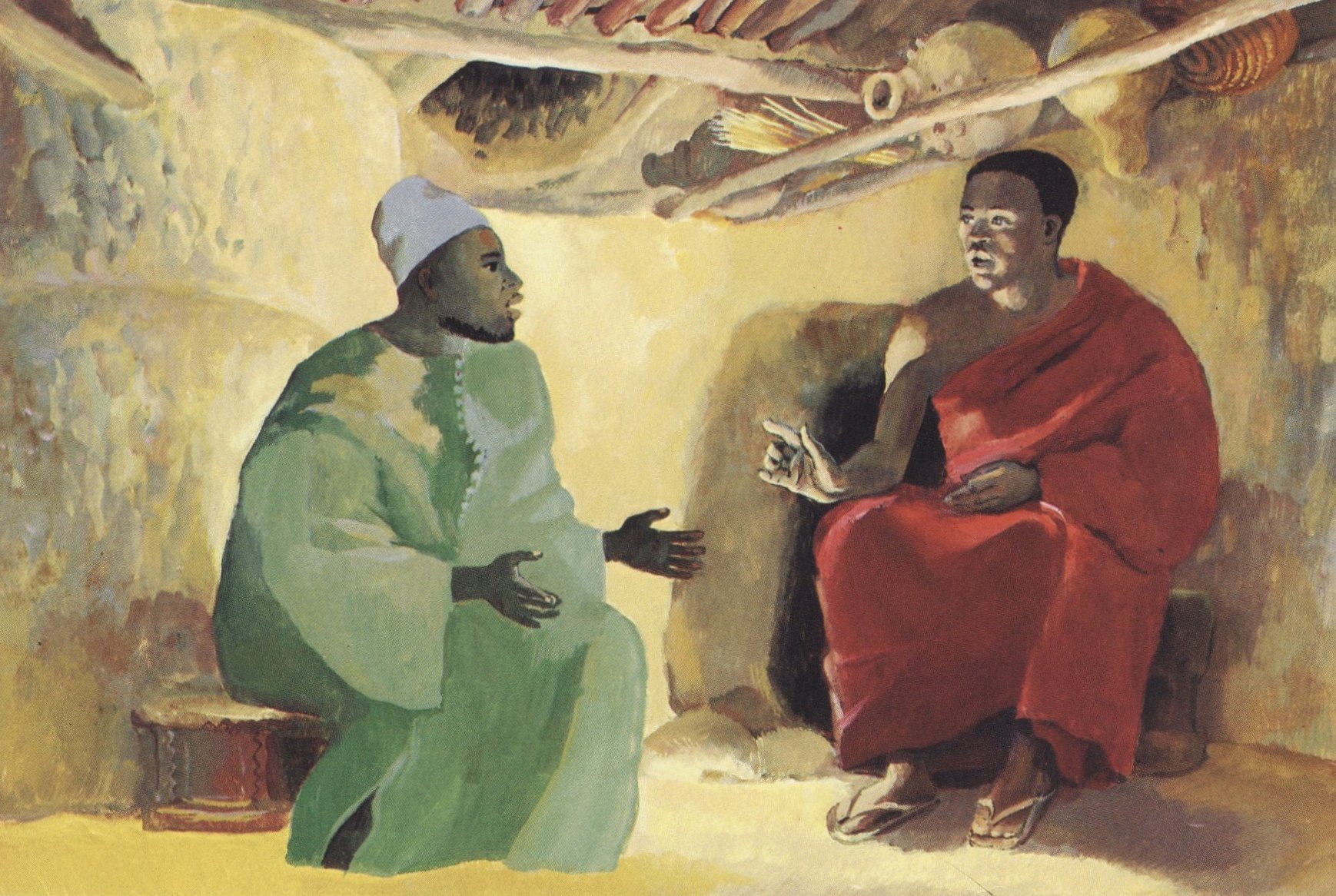
Sermon: It’s not enough just to be ‘born’ again

Sermon for Williamstown, 16th of March 2014

John 3:1-17

Image

Nicodemus by Jesus Mafa, Cameroon, 1973

John’s gospel starts with a bang. It begins with the wonderful Prologue, the hymn to the Word: ‘In the beginning was the Word and the Word was with God and the Word was God’. There’s no infancy story in John’s gospel, the narrative of Jesus’ life and ministry starts with the testimony of John the Baptist; the recognition by John of Jesus as the Lamb of God; and then Jesus’ calling of his first disciples. We have the first miracle at Cana, and then the cleansing of the Temple, which John places at the beginning of Jesus’ ministry rather than at the end. Continue reading

Posted in Sermons | Tagged , , , | Leave a comment