Sermon for Williamstown Uniting Church
4th Sunday after Pentecost, 16th of June 2013
Luke 7:36-8:3
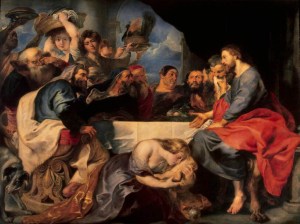
Did you experience déjà vu hearing today’s gospel reading? It’s only a couple of months since we heard another version of the story of a woman anointing Jesus with expensive perfume. On the fifth Sunday of Lent we heard John’s account, a story in which Mary of Bethany takes a pound of costly perfume, anoints Jesus’ feet, and wipes them* with her hair. In that story, Mary is anointing Jesus for his burial. As I said back then: ‘In less than a week, the man who is now sitting and eating with disciples and friends will be dying on a cross.’ That was central to that story. Today’s story is different. It occurs in the middle of Jesus’ ministry, long before his death. The woman anointing him isn’t one of Jesus’ disciples but an unnamed woman of the town. Like John’s version of the anointing, this story is a story of God’s love, but rather than that love being shown in Jesus’ death, it’s shown in forgiveness and hospitality.
We need to set the scene. Luke shows us Jesus dining, Greco-Roman style, in the home of a prominent religious leader named Simon. In Jesus’ day, there were no paved roads, no socks, and no running water. So it was expected that a host would provide guests with a servant to wash their feet on their arrival, as well as providing some scented ointment for their hair. We see this in John’s story of the Last Supper, when Jesus washes his disciples’ feet and tells Peter: ‘One who has bathed does not need to wash, except for the feet, but is entirely clean.’ Since Simon had invited Jesus to dine, he should have provided a servant to wash Jesus’ feet before Jesus came to the table so that Jesus would be entirely clean. It seems that Simon didn’t.
In Greco-Roman dining, cushions or couches were placed alongside low tables, with the guests reclining on them. This is why it was possible for the woman to come up behind Jesus and begin to anoint his feet and wipe them with her hair. We don’t need to imagine her crawling under a table. Nor do we need to imagine her breaking in, houses in Jesus’ culture was so constructed that the woman could have simply walked in. However, only men would eat together, while women would enter the room only to serve the food. They wouldn’t talk with the men and would never touch a man in public. So, while this woman hasn’t broken in to Simon’s house, she is violating social standards of respectable behaviour for a woman by simply being in the room.
Respectability probably wasn’t a big concern for this particular woman, who was a sinner. In the Jewish context, the description ‘sinner’ would indicate someone who was not faithful to God’s law – someone who transgressed the Torah. We don’t know anything specific about her particular sin. It’s routine for commentators to assume that she’s a prostitute, as if the only sin a Jewish woman of the first century could commit would be a sexual sin. We don’t know that! Luke doesn’t tell us what her sin is, just that her sin was well-known.
The shocking actions of this well-known sinner now go beyond her simple entrance into a room where men are eating, to something even more outrageous. She washes Jesus’ feet with her tears. She touches him with her hair. She anoints him with ointment. But then, she’s already a woman with a bad reputation. She has no ‘good name’ left to lose.
But what about Jesus? Any proper man would have reacted with outrage and anger at her behaviour. A respectable man would have rejected her for touching him in public. By allowing this behaviour Jesus is tainted by the woman’s sinful reputation and brings dishonour on his host. Simon the Pharisee, quite naturally, disapproves. Clearly Simon’s face reveals his thoughts, and Jesus responds by telling a parable about two debtors, both forgiven. The one who had been forgiven much, loved much. The implication is that Simon should have seen this notoriously sinful woman, who is showing so much love, as someone who has been forgiven much. But Simon didn’t see that, because he didn’t really see the woman. Rather than seeing a woman expressing love, Simon saw a ‘sinful woman’ who was a nonentity in his religious worldview. She was a known sinner, and so Simon dismissed her.
Now Jesus makes the message of this parable really pointed, by comparing the unnamed woman and Simon. ‘I entered your house; you gave me no water for my feet, but she has bathed my feet with her tears and dried them with her hair. You gave me no kiss, but from the time I came in she has not stopped kissing my feet. You did not anoint my head with oil, but she has anointed my feet with ointment.’ Even though Jesus was a guest in Simon’s house, it’s the woman who offers hospitality. The woman’s demonstrative and extravagant expression of devotion shows her acceptance of Jesus’ unconditional invitation to share the love and forgiveness of God. Simon’s conduct, in contrast, is merely formally correct and shows an unwillingness to embrace Jesus’ offer of the kingdom. In part, the difference between Simon and the woman may be connected to their different levels of awareness of their own need. The woman knew she was a sinner, and so responded to her forgiveness with great love. Simon the Pharisee didn’t seem to feel sinful at all, and so responded with little love to Jesus’ message.
One commentator I read this week, David Ewart, notes that Luke is the only gospel writer to include this particular version of this story. He writes: ‘Certainly Luke was from the same social class as the Pharisee in the story. I wonder if this story was particularly poignant for him? Reminding him – and causing him in turn to remind us – that God’s care, love and forgiveness is for all – without distinction. But not without inequality. All are forgiven, but not all are forgiven equally, because some have greater debts, and God’s forgiveness is never partial, never half way, never with a hidden catch. It is always total, whole, full and complete. It is good news that my debts are forgiven, but hard to hear that someone else’s much larger debt is also totally forgiven. And yet, it is exactly this good news of God’s hospitality being extended to all without distinction that was one of the marks of the new community of those who followed the Way of Jesus.’
We’re all sinners together and all our sins, big and small, are forgiven by God. This is the new community, where murderers and terrorists and drug-dealers are as welcome as gossips and those who fiddle their taxes. We’re all forgiven; we’re all able to start again and show great love.
Today’s story speaks not only about our forgiveness by God, but also about how we can forgive others. The parable suggests that God’s acceptance and forgiveness of the woman came first, and her response of love followed. She isn’t forgiven because she shows great love; she shows great love because she has been forgiven. As John Wesley wrote: ‘It should carefully be observed here, that her love is mentioned as the effect and evidence, not the cause of her pardon. She knew that much had been forgiven her, and therefore she loved much.’ In God’s kingdom, forgiveness precedes signs of love. It’s not something to be earned.
I’ve had lots of discussions with people about forgiveness over my years in ministry, because forgiving others is one of the most difficult parts of living as Christians. It’s central to our faith; every time we pray together we ask God to forgive us our sins, as we forgive those who sin against us. Is it possible for us to forgive others as God forgives us? We’d better hope so, or never pray the Lord’s Prayer again. But it’s hard.
One of my favourite theologians, Miroslav Volf, explains how forgiveness is possible. He writes: ‘Because God has forgiven, we also have the power to forgive. We don’t forgive in our own right. We forgive by making God’s forgiveness our own. And even then, we don’t forgive the fact of someone’s guilt, the so-called objective guilt. God has already done that. We help remove the offender’s feeling of guilt in regard to us, the so-called subjective guilt. What do I do when I say to someone, “I forgive you”? In effect I tell her, “Because God in Christ doesn’t count your trespasses against you and because God has removed your guilt from you, I, too, don’t count against you the fact that you’ve wronged me, and I don’t consider you guilty. God has made you innocent, and therefore I consider you innocent.” Because God has taken away the burden of guilt, I, too, in my own way, can lift the burden of guilt the offender rightly feels toward me, even after God has forgiven her … When we forgive we make God’s forgiveness our own; God forgives, and we take that divine forgiving and, in a sense, put our own signature underneath God’s. When we forgive it is Christ who forgives through us.’
What today’s story tells us is that God’s forgiveness, to which we add our own signature, happens even before a sinner seeks repentance. People talking to me about forgiveness have told me that it’s hardest when the person who has sinned against them doesn’t acknowledge their sinning; doesn’t express remorse or repentance. In those circumstances forgiveness might seem impossible. But it’s not; because God has already forgiven and we are able to make God’s forgiveness our own. We’re able to forgive, and experience the relief and freedom that comes from that, even before the person who has sinned against us and against God seeks repentance. Remorse isn’t necessary; although we can hope that everyone who is forgiven responds with great love!
I want to end today with a prayer from Christina Rossetti, the 19th century poet, asking God for help in forgiving. Let’s pray, remembering that our sins have been forgiven and so knowing that we can show great love by forgiving the sins of others:
O Lord Jesus,
because, being full of foolishness,
we often sin and have to ask pardon,
help us to forgive as we would be forgiven;
neither mentioning old offences committed against us,
nor dwelling upon them in thought,
nor being influenced by them in heart;
but loving our brother freely,
as you freely loved us.
For your name’s sake.
Amen.