Synod: What I would have said … Education

On the first day of the 2013 meeting of the Uniting Church Synod of Victoria and Tasmania, the Synod heard about the mistakes that led to the closure of Acacia College and left the Church tens of millions of dollars in debt. ACA College Logo Final

A great deal of the discussion was about the failures in governance that happen when there is no single point of accountability. Many suggestions for improving these were made. What wasn’t mentioned in the report from the consultants with which the Synod was presented was whether any of the problems were caused by trying to set up a highly-resourced private school on a low-fee basis, or indeed whether the Uniting Church should be setting up private schools at all. Continue reading

Posted in Random Musings | Tagged , , , , , , | 3 Comments

Sermon with mandatory mention of same-sex marriage

Sermon for Williamstown
Easter 5, 28 April 2013

John 13:31-35
Acts 11:1-18
Revelation 21:1-6

The Christian faith has a dual personality. On the one hand, the church is an ancient institution, drawing on thousands of years of history. At the beginning of every service the Scriptures are solemnly carried into the worship space, in recognition that it’s through them, words written thousands of years ago, that we hear the Word of God. We draw on prayers prayed by Jews and Christians throughout the centuries when making our own prayers, and we repeat rituals established by the first Christians when we celebrate the Eucharist. We do all this because we know that God has been present in human history from the very beginning, and that in Jesus God decisively intervened in human history in one particular time and place. We live in a culture that values the new over the old, that demands innovation and finds repetition boring. And yet the church persists in telling the same old stories and following the same old liturgical cycle year-in and year-out, as Advent leads to Christmas, and Lent prepares us for Easter, and the same stories of Jesus’ life are told throughout Ordinary Time. The church knows the value of memory and tradition. Continue reading

Posted in Sermons | Tagged , , , , , , | Leave a comment

Reflection: Problems of identity

This has been a bad week for me, mental health-wise. Such a bad week, that I want to write it as BAAAAAAAAAAAAAD. That’s how bad it has felt. In one way it’s not a surprise. My experience of clinical depression is that no matter how well I look after myself: how healthily I eat; how much I walk; how carefully I take my medication – there are days when my brain rebels, the fog descends, and life becomes temporarily unbearable. Fortunately, my experience of clinical depression is that if I wait my brain will re-balance, the fog will lift, and I can keep going. But the pain is hell while it lasts. Continue reading

Posted in Random Musings | Tagged , , , , | 2 Comments

A couple of book reviews: Prester John and The Setons

I’ve been having a bit of a Buchan-fest, reading the works of John Buchan and his sister Anna, who wrote as O. Douglas. They were writing a century ago, and I’ve been pondering the ‘datedness’ of their books. I had decided that Buchan’s books seem more dated than Douglas’, because he wrote about race, attitudes to which have changed enormously, while she wrote about class, and 21st-century readers aren’t as shocked by class prejudice as we are by racial prejudice. But then I read The Setons, and realised that O. Douglas’ attitudes to war are as dated as Buchan’s attitudes to race. Continue reading

Posted in Random Musings | Tagged , , , , , , | Leave a comment

Reflection for the ANZAC Service: The Possibility of Reconciliation

Sermon for Williamstown Uniting Church

ANZAC Service – 21st of April, 2013

On the 25th of April, 1915, some 20,000 Australian, New Zealand, other British, and French servicemen landed at the Gallipoli Peninsula in Turkey. Russia, which was under attack by Turkey, had called for help from its allies, and it was also thought that attacking Turkey would help protect Egypt and the Suez Canal. But the strategy failed. In November 1915 one young woman, writing to her soldier fiancé who was overseas, said: ‘Things about the Dardanelles are coming out now and it is openly acknowledged a failure. And the details of the failure are appalling.’[1] In December 1915 the invading forces withdrew. About 120,000 men had died: more than 80,000 Turkish soldiers; roughly 8700 Australians; and approximately 2700 New Zealanders. Controversy has raged ever since over whether the soldiers were landed in the right place and whether the invasion at Gallipoli ever had a chance. But one thing is certain; the landing at the Gallipoli Peninsula was not a great military victory. Continue reading

Posted in Random Musings, Sermons | Tagged , , , , | 3 Comments

Living a privileged life – and abusing that privilege

This morning I took two small children to child care. They hadn’t known that the person coming from church to collect them from their house would be me, and so I was greeted with exuberant bouncing. Their mother asked: ‘Are you a bit excited because Avril’s going to take you?’ and they eagerly agreed. Apparently driving with me in my funny car (which doesn’t have back doors so getting into the back seat means crawling over the front seat) and getting to talk to me all the way was extremely exciting. And me driving past the child care centre, so we had to go up round the round-about and come back, was very humorous. Continue reading

Posted in Uncategorized | Tagged , , , , , | Leave a comment

Sermon: Following in the fisherman’s footsteps

Image

Sermon for Williamstown

The Third Sunday of Easter, 14th of April 2013

John 21:1-19

Whenever you feel downhearted or discouraged at your performance as a follower of Jesus, think of Peter, the rock on whom Jesus built the Christian church. Peter is quite possibly the most encouraging biblical role model Christians can have. The gospels tell us many stories of people who met Jesus, repented, and changed their lives around: tax collectors and prostitutes; the Samaritan woman at the well and the short-in-stature Zacchaeus. But possibly no one committed to Jesus as completely; betrayed him so utterly; and was forgiven by him so abundantly as the Apostle Peter. Continue reading

Posted in Sermons | Tagged , , , , | Leave a comment

Speaking ill of the dead?

Margaret Thatcher has died of a stroke at the age of 87. She was a human being, made in the image of God; a mother, grandmother and friend who is now being mourned by those who loved her.

She was also a world leader who gave her name to a particularly regressive economic system. ‘Thatcherism’, together with ‘Reaganomics’, influenced Australia in the guise of ‘Economic Rationalism’. As a minister in a Church that continues to try to pick up the pieces of the lives shattered by these philosophies (and even in wealthy, healthy Australia there are such lives) it’s hard to hear Thatcher eulogised as a great statesperson. Under her leadership the gap between rich and poor grew and so for the poor (and those who are required by God to care for them) her leadership was a failure.

On the other hand, she was only one person, and she has been out of power for decades. The British can’t blame her as the onlie begetter of the social inequality within which they live, any more than we in Australia can blame everything on John Howard/Peter Costello. We all need to take some responsibility.

But as a second-generation Australian with relatives on the west coast of Scotland, who heard from them about the impact of the Poll Tax, I can understand why there are people dancing in Glasgow today. I wouldn’t do it myself, but then she only affected me from a distance and at second or third-hand.

According to the BBC Thatcher “will not have a state funeral but will be accorded the same status as Princess Diana and the Queen Mother. The ceremony, with full military honours, will take place at London’s St Paul’s Cathedral.” Given the pomp and ceremony with which she’ll be buried, it’s possible that Thatcher’s failings will be glossed over by the sentimentality accorded the illustrious dead. It’s important that this not happen. This is a time when ‘speaking ill of the dead’ is a historical necessity. Image

Posted in Random Musings | Tagged , , | 2 Comments

Reflection: The Good News according to Luke

Image

I’m not really preaching a sermon tomorrow. Instead I’m just retelling the story. Sometimes I think that the simple story is all that we need to hear.

Sermon for Williamstown

Easter Sunday, the 31st of March 2013

Luke 24:1-12

Isaiah 65:17-25

Some two thousand years’ ago, a decree went out from Emperor Augustus that all the world should be registered. This was the first registration and was taken while Quirinius was governor of Syria. Everyone went back to the towns their families had come from to be registered. The Romans were in power. What they demanded, happened. Even if meant a young couple travelling while the woman was heavily pregnant. Even if it meant that she gave birth far from home. After all, the Romans ruled the world. Continue reading

Posted in Sermons | Tagged , , | Leave a comment

Sermon: You will always have the poor with you

Sermon for Williamstown

5th Sunday of Lent, 17th of March 2013

Image

John 12:1-8

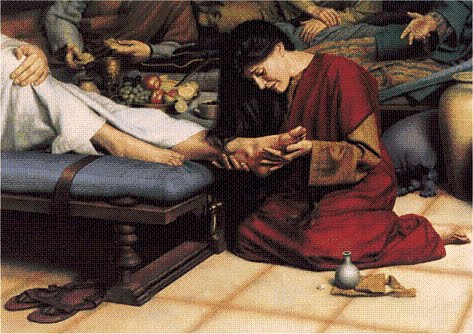
There are some things that I wish Jesus hadn’t said or, at least, that I wish the evangelists had explained more fully when quoting him. John, chapter 12, verse 8a – ‘You always have the poor with you’ is one of those sayings. One of the things that my brother does to get me really annoyed is to quote this half-verse; and depending how I’m feeling I either respond by saying ‘that phrase needs to be read in context’, or by throwing something at him. Usually something soft, I hasten to add. Read out of context, it’s a dangerous verse! Jesus was quoting from Deuteronomy, where the people of Israel are instructed: ‘Since there will never cease to be some in need on the earth, I therefore command you, “Open your hand to the poor and needy neighbour in your land.”’[1]  In that context, it is advice on how we should respond to the poor – with open hands. In today’s context, in the story of the anointing of Jesus by Mary of Bethany, it has nothing to do with how to treat the poor and everything to do with the new thing that God is about to do in Jesus – the extravagant love of God that will be seen in Jesus’ rapidly approaching death and resurrection. Continue reading

Posted in Sermons | Tagged , , , | 1 Comment