Reflection for North Balwyn Uniting Church
20th of September 2026, anticipating the International Day of Peace & Prayer for Peace
1 Samuel 25:2-42
“Now then, my lord, as the Lord lives and as you yourself live, since the Lord has restrained you from bloodguilt and from taking vengeance with your own hand, now let your enemies and those who seek to do evil to my lord be like Nabal.”
Today’s reading is a story that we do not hear in the lectionary. It is a story of practical peace-making, and a lesson both for those who govern and those who try to convince governments to choose non-violence over war. Incidentally, it contains the longest speech that a woman makes in the Hebrew Scriptures.
David and his men are on the run from King Saul, and they ask a very wealthy man, Nabal, for food. Nabal’s name means ‘fool,’ and he responds to David’s request foolishly. He refuses, breaking the hospitality code fundamental to desert peoples. This is doubly wrong because it is a time of festival. What Nabal says and does is the equivalent of challenging warriors to a fight; maybe Nabal is being sincere when he says, ‘Who is David? Who is the son of Jesse?’ Perhaps he honestly does not know that David defeated Goliath. Or maybe he believes his wealth will protect him. At any rate, when he hears of Nabal’s insult, David responds as any warrior of the time would; he tells his men to strap on their swords. Four hundred men will punish Nabal.
Foreseeing what will happen, an unnamed servant speaks to Nabal’s wife Abigail on behalf of the household. The servants know that to refuse hospitality to those who have given you protection and safe passage in open country is stupidly rash. While Nabal’s name means ‘fool,’ Abigail’s name means ‘my father’s joy’ or ‘joy of my father,’ and she will certainly bring joy to this situation.
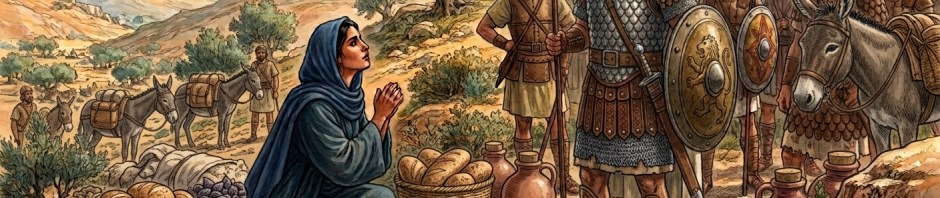
Abigail knows exactly what she must do. She is a wise judge of people and the situation, and she is nonviolent, a peacemaker. Without consulting her fool of a husband, she bravely goes to meet David face to face before the army arrives at the house. Although David has God’s favour and is a future king, and Abigail is merely the wife of a fool, they are in many ways equals. Abigail is described as ‘clever and beautiful;’ when David was brought in as a court musician for Saul the reference he is given by one of Saul’s men (in the NRSV translation) is that he is: ‘skilful in playing, a man of valour, a warrior, prudent in speech, and a man of good presence, and the Lord is with him.’ (1 Samuel 16:18) ‘A man of good presence’ would better be translated as ‘a man of beautiful form,’[1] so, like Abigail, David is clever and beautiful.
Abigail gives David and his men gifts and humbles herself before him, calling herself his handmaid. She prays for David, blesses him and his future dynasty, and assumes responsibility for Nabal’s transgression and breach of hospitality. Then Abigail reminds David of God’s power and argues that David’s God is not an avenging God, but a just one. She pre-emptively gives thanks that David has been saved from bloodguilt and from taking vengeance with his own hand. One commentator that I read this week says that these are two separate things.[2] David would have incurred bloodguilt if he had done what he threatened and murdered every male of Nabal’s house, the innocent with the guilty. He would have taken vengeance with his own hand had he killed Nabal, who deserves death because he refused hospitality and humiliated David in an honour society. Abigail is trying to save David from both charges.
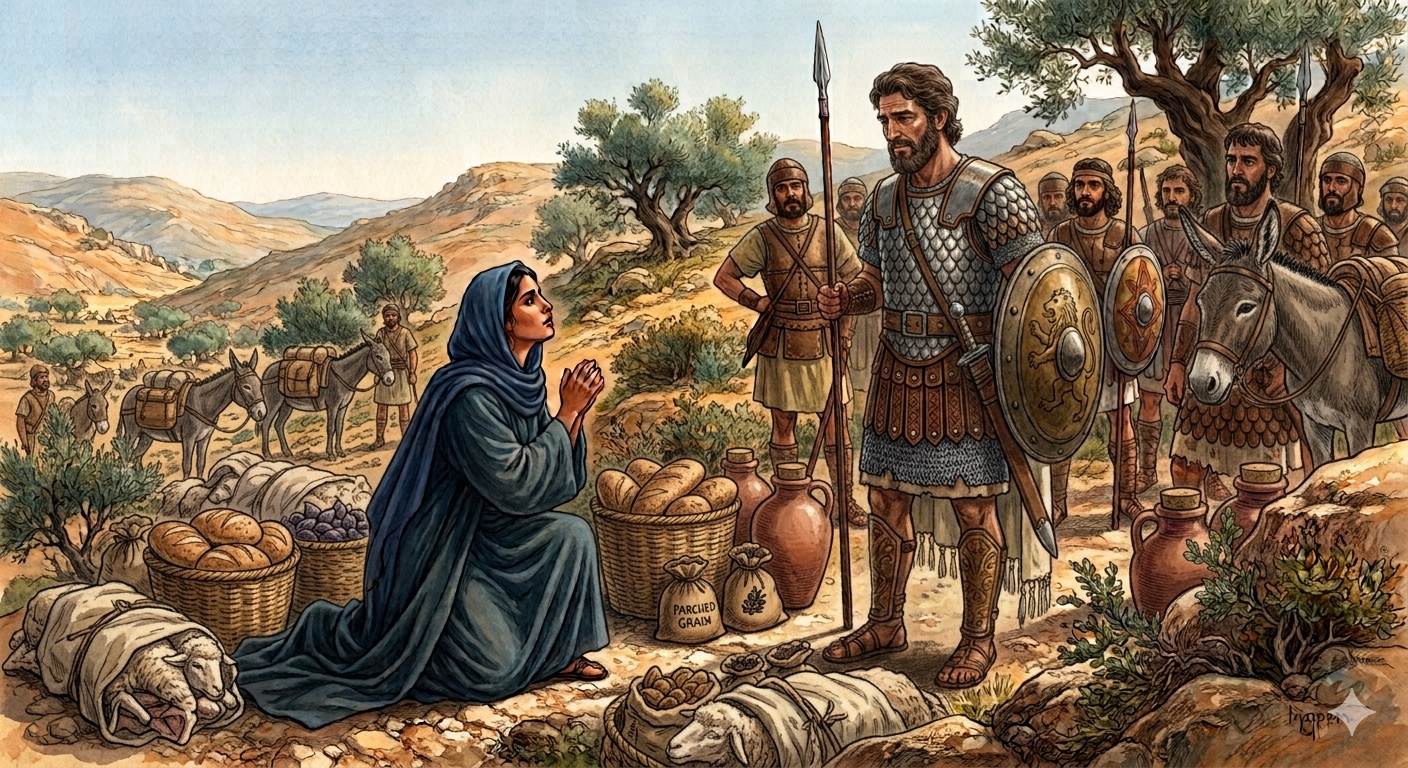
Abigail’s actions and words teach David, the future king, mercy and nonviolence in imitation of God. David recognises that she is wiser than he has been, and that God has sent her to him to stop him from shedding blood. From being an enemy, he becomes a friend who tells her that she can, ‘Go up to your house in peace.’
The Lord then strikes down Nabal. When David hears of Nabal’s death, he gives thanks that he did not kill Nabal, that God punished him for his evil deeds. Abigail was right; God is the judge and provider of justice, not David. David sends to Abigail to marry her, taking up the possible suggestion she made when she told him, ‘And when the Lord has dealt well with my lord, then remember your servant.’
Abigail is a teacher of peace, a truth-teller. She is a wise woman, wiser by far than David, the one who will be king in Israel. She interrupts the bloody history of Israel with an act of peacemaking. Megan McKenna writes that, ‘Her idea of God is more developed, more mature, and more in line with Jesus’ God than David’s,’ and that ‘She knows something of Jesus’ Father even in the harshness of war and the early experiences of Israel and God.’[3] ‘She is a woman of courage, of heart, who brings joy to many. For the product of peace and justice is joy!’[4]
Another commentator I read this week compared Abigail’s story to the Book of Esther, arguing that Esther’s story mines and undermines Abigail’s.[5] The author makes various comparisons between the two, but ignores what I think is the greatest difference between them. In this story, only one guilty man dies, killed by God. In the story of Esther, 75,000 Persians die at the hands of the Jews: men, women, and children; the innocent with the guilty. (Esther 9:6-16) In today’s story, King David, whose overall body count is estimated to be 140,000 people, with fifteen individuals said to have been killed by his own hand,[6] kills no one. Would the world be different if we remembered Abigail, instead of Esther?
Today we are acknowledging the World Council of Churches’ World Week of Peace in Palestine and Israel. Christians do not prioritise the needs of our fellow Christians over the needs of other people. We work for peace and justice for all, regardless of religion or nationality. But I do want to talk to you about Palestinian Christians. Christians made up about ten per cent of the Palestinian population in 1922, and 7.9% of the total population in 1946. Now they only make up about two per cent of the population in both Israel and the Palestinian territories, but there are still thousands of Palestinian Christians trying to stay on their land.
Taybeh in the Ramallah area of the West Bank is the only remaining Christian village in the Palestinian territories, containing Christian archaeology dating back to the Roman era. During the 1980s, the population was around 3,000 people, but now it has dwindled to 1,200 people, all of them Christian. It is surrounded by four settlements and tens of settler outposts in all directions. Taybeh has been subjected to numerous attacks by Israeli settlers, including shootings, arson that damaged an ancient church, and the destruction of trees. Video footage shows settlers riding through the properties of Christian families on all-terrain vehicles, shouting at, and harassing the residents. This especially frightens children.
Father Bashar Fawadleh, the Latin Parish priest, says that twenty years ago no one infringed on the land and there were no checkpoints in Taybeh. ‘It was normal life in Taybeh with peace and quiet.’ He reminds us that, ‘Expressions of solidarity, while much appreciated, are not enough, and action is needed to stop settler violence against Taybeh … My call to the world is to help us in Taybeh raise the children in peace and security. I am not asking for too much.’[7]
Recently, Canada, Denmark, Finland, France, Iceland, Ireland, Norway, Poland, Portugal, Spain, Sweden, and the UK agreed to sanction the illegal settlements in the West Bank. Australia did not. One thing we can do is ask our government to join these sanctions.
Abigail convinces David not to act against her household by telling him that if he refrains, he will have no cause of grief or pangs of conscience for shedding blood without cause when he becomes king. The government of Israel needed an Abigail after October 7. There was so much goodwill towards Israel after the Hamas attacks. If Israel had conducted limited actions in Gaza or tried something like taking Hamas to the International Criminal Court, that goodwill would have continued. Instead, attitudes to Israel are now widely unfavourable. The Pew Research Centre reports that in the USA, attitudes to Israel in 2022 were 55% favourable and 41% unfavourable. By 2025, they were only 45% favourable and 53% unfavourable, and by this year, only 37% of Americans looked favourably on Israel, while 60% of them were unfavourable towards it. In Australia, the numbers are even worse: by 2025, 74% of Australians looked on Israel unfavourably and only 25% favourably, and this year 79% of Australians say they feel unfavourable towards Israel and only 19% are favourable. The longer the attacks on Gaza and the settlement violence in the West Bank continue, the worse the world’s attitudes to Israel. So far, there seem to be too few Israeli Davids willing to be converted by the Abigails of Israel, groups like Breaking the Silence and B’Tselem.
Let us be Abigails. As Megan McKenna writes:
Nabal is selfish and rude, disregarding courtesy and hospitality. David is rash, selfish, and violent, thinking only of his own ego and pride. It is Abigail and the servants who see what the effects of such actions will be and move to stop the violence. Abigail works with others to demilitarise her small piece of the promised land and to offer solutions to enmity, even offering her life as ransom so that others might live.[8]
We do not even need to risk our lives when we seek peace; we simply need to speak up. Let us be Abigails. Amen.
[1] David J. A. Clines, Play the Man: Biblical Imperatives to Masculinity (Sheffield Phoenix Press, 2023), p. 23.
[2] Sarah Schwartz, ‘A New Look at Abigail’s Wisdom,’ Vetus Testamentum, 74 (2024), pp. 392-414.
[3] Megan McKenna, Not Counting Women and Children: Neglected Stories from the Bible (Maryknoll, New York: Orbis Books, 1994), pp. 201-202.
[4] Megan McKenna, Not Counting Women and Children, p. 203.
[5] David J. Zucker, ‘Reading Esther as Abigail Redux,’ Biblical Theology Bulletin, 52 (2022), pp. 131-135.
[6] David J. A. Clines, Play the Man, p. 19.
[7] Another story: The Tent of Nations stands on a 100-acre family farm about ten kilometres southwest of Bethlehem in the West Bank. The Nassar family purchased the land more than one hundred years ago, and the family holds original registrations and deed documents dating from the British Mandate. In 1991, the Israeli authorities declared the Nassar family farm (and surrounding lands) to be ‘state land.’ Around the farm, the Nassar family continue to witness the expansion of settlements and the creation of new facts on the ground. A new outpost established a few months ago, directly beside their fence, continues to expand, bringing more pressure, uncertainty, isolation, and fear to the Tent of Nations. Today, there are four gates between the farm and Bethlehem, making movement increasingly difficult and limiting the Tent of Nations’ connection with surrounding communities. The family ask the churches and faith communities around the world not only to pray for justice and peace, but to act for justice. They write, ‘The story of the Good Samaritan reminds us that faith cannot be expressed fully by words or prayers.” The Samaritan did not simply see the wounded man, offer a prayer, and continue on his way. He allowed compassion to move him to action. He responded to the suffering and became a neighbour to someone in need. This is the kind of faith that gives us the courage to speak when others are silent. We call churches to raise their prophetic voices, to stand with those who are suffering, and to challenge the structures and policies that allow injustice to continue.’
[8] Megan McKenna, Not Counting Women and Children, p. 204.


Pingback: Sermon: Two dis/obedient children | Rev Doc Geek