Reflection for North Balwyn Uniting Church
15th of November 2026
1 Thessalonians 5:1-11
Matthew 25:14-30
We are coming to the end of the church year, and the end of our reading of the Gospel according to Matthew. In the Gospel readings, Jesus is coming to the end of his life on earth. He has spent much of his time in Matthew’s telling of the gospel teaching, in imitation of Moses, who was thought to have written the first five books of the Hebrew Scriptures. Now, as his time with his disciples nears its end, Jesus tells them parables about the coming of the Son of Man at the end of time. We are also coming to the end of Paul’s first Letter to the Thessalonians, and Paul, too, is talking about the end of time, the eschaton, when the day of the Lord will come like a thief in the night. Both Jesus and Paul warn of the judgement that will be made on that day between the children of light and day, and the children of the night or of darkness, between the good and trustworthy slaves and the wicked, lazy, and worthless slaves.
The Last Judgement is not something that we members of the Uniting Church particularly embrace. I think that, paradoxically, one of the reasons that we find the idea of it so challenging, even destructive, is because we trust the Australian legal system. People like us, well educated, well resourced, well spoken, well thought of, do not expect the legal system to mistreat us. We have never been arrested for something we did not do. We can only imagine facing a judge as a defendant if we deserve punishment. So when we hear Jesus or Paul talk about a last judgement, with the Son of Man as the judge, we worry that in the courtroom we will receive the just deserts for our sin.
But the Scriptures were not written in the context of the Australian legal system. The Prophet Isaiah described the coming Messiah as one who ‘shall not judge by what his eyes see or decide by what his ears hear, but with righteousness he shall judge for the poor and decide with equity for the oppressed of the earth.’ (Isaiah 11:3-4) The idea of a judge not judging by what his eyes see or his ears hear is bizarre to us, but Isaiah was writing at a time when the legal system was misused to attack the poor and marginalised; when those with power could falsely accuse others, lawyers could be bribed, and human judges made decisions based on what someone looked like, whether or not they were a foreigner, how wealthy or poor they were. When the author of the Gospel according to Matthew and the Apostle Paul talk about the Son of Man giving judgement, they are talking about a judge who will intervene to vindicate the falsely accused. We are not to imagine an Australian courtroom presided over by an impartial judge; we are to imagine a deeply partial judge freeing the falsely imprisoned.
If we do find the concept of the Last Judgement negative and off-putting, we share our concerns with the worthless slave in today’s parable. The worthless slave believes that his master is ’a harsh man, reaping where you did not sow, and gathering where you did not scatter seed.’ But as I said last time we heard today’s parable, that is not who the master is. Were the master such a harsh man, then, as he tells the slave, ‘You ought to have invested my money with the bankers, and on my return, I would have received what was my own with interest.’ But the master is instead astoundingly generous. He gives the first two slaves enormous fortunes; they are to keep all the money, not merely the extra they had made but also the original capital they were given. The third slave is worthless because he did not understand or trust in the master’s generosity; he saw the talent he had been given as a burden, rather than a gift. As I have said before, this is a parable about getting God wrong; seeing God as a harsh master to be feared rather than a generous master who gives us gifts and the freedom to use them. We can look forward to this master returning after a long time, because when he does, ‘to all those who have, more will be given, and they will have an abundance.’
While the gospel reading comforts those that Jesus is soon about to leave with the promise that he will reward them when he returns, Paul in his letter encourages the Thessalonians to behave as those whose master is already with them. His letter urges them to be who they already are: people who belong to the day, not the night. Paul’s language draws on Jewish apocalyptic imagery: the day of the Lord, the thief in the night, the labour pains of a pregnant woman. But he also draws on Roman descriptions of the deified Emperor Augustus, who ended the civil wars of the first century BCE and brought ‘peace and prosperity’ to all the parts of the world that mattered. At the time that Paul was writing, Augustus was thought to be in heaven, ensuring the continuation of Rome’s political and social status quo. But Paul writes that true salvation has come not through the Roman Emperor but ‘through our Lord Jesus Christ, who died for us.’ The Thessalonians who chose to follow Jesus might seem like unimportant labourers on the periphery of the Roman Empire, but Paul assures them they are at the centre of history.
A decade or so later, the author of the Gospel according to Mark makes the same claim. Mark takes the word euangelion, gospel, which Greek writers used to describe a military victory, a royal birth, or a political triumph, and applies it to a convicted criminal executed by the Roman state. The Romans do not yet know it, but in this small group of people to whom Paul is writing, and in similar groups in other cities throughout the Empire, a movement to challenge Rome has begun.
The Thessalonians are not in darkness, so what does it mean to belong to the day? Paul tells the Thessalonians to live as those who know what is really going on, those who are waiting for the day of the Lord rather than mouthing the Roman slogan: ‘There is peace and security.’ They are not to behave like those who worship gods like Dionysus with drunkenness and nighttime revelry. Instead, they are to be sober, putting on the breastplate of faith and love and taking as their helmet the hope of salvation. Here we have the trio of faith, hope, and love, which Paul will detail further when writing to the church in Corinth: ‘And now faith, hope, and love remain, these three, and the greatest of these is love.’ (1 Corinthians 13:13) It is noteworthy that in a world in which Christians are rejected or endangered because they refuse to participate in the imperial cult, Paul tells them to provide themselves only with defensive gear: a breastplate and a helmet, but no weapons. Even when the military equipment is metaphorical, it is not aggressive.
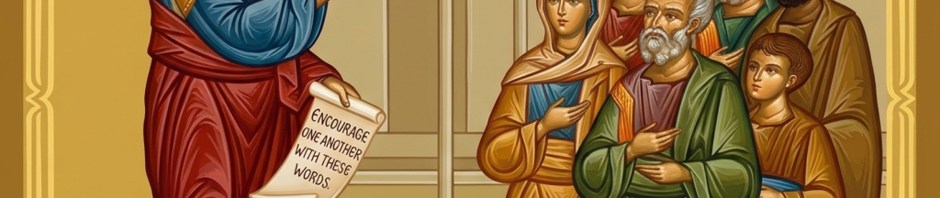
Paul distinguishes between the children of the night or of darkness, and the children of light and children of the day, but only to reassure the Thessalonians that they are already living in the light. As I said two weeks ago, Paul is not a Puritan preacher trying to scare the Thessalonians into belief. His letter does what he tells them to do: encourage one another. He writes to build them up, and now, having experienced this, they can imitate him and build each other up. Imagine if we understood mutual encouragement as a sign of the church’s holiness, if we could tell that a congregation was full of people of the day by its freedom from gossip, infighting, and competitiveness. Congregations are human institutions full of human beings, and sometimes even the best rub each other the wrong way. But imagine if, before complaining about another church member, we stopped and asked ourselves whether our words were encouraging. Today is definitely an occasion when I need to listen to the words I am preaching and commit myself to living them out.
As I have said before, sadly many people worship a harsh and ungenerous God, a God obsessed with ‘thou shalt nots.’ This is the image of his master that the wicked and lazy slave has in today’s parable; it is not the God that Jesus and Paul proclaim. After all his discussion about the distinction between those who live in the light and those who live in darkness, between those who are awake and those who are asleep, Paul makes the outrageous statement that even that distinction does not matter, that it does not matter whether we are awake or asleep because God has destined us not for wrath but for obtaining salvation through our Lord Jesus Christ, who died for us, so that we may live with him. God’s love and acceptance, revealed in Jesus’ death, are so overwhelming, so abundant, that they are available to everyone.
This is the comfort offered to those who worry that the Last Judgement might find them on the wrong side; among the goats rather than the sheep, in terms of the parable we will hear next week. The God we worship is not like a harsh master who reaps where he did not sow and gathers where he did not scatter seed. Our God is the epitome of generosity. Knowing this, we can live bravely, in the full light of day, because we know that even when we fail and fall short, God loves us. We can look toward the end of time, the eschaton, or even the individual, personal, end of time that will come with our death, because we know we will be received by the God who will welcome us to ‘enter into the joy of your master.’ We can live as the children of light and children of the day because Christ’s death has utterly vanquished the night and the darkness. ‘Therefore, encourage one another and build up each other, as indeed you are doing.’ Amen.


