Reflection for North Balwyn Uniting Church
Palm Sunday, 29 March 2026
Matthew 21:1-17
‘Then Jesus entered the temple and drove out all who were selling and buying in the temple, and he overturned the tables of the moneychangers and the seats of those who sold doves.’
Today, Palm Sunday, we remember Jesus entering Jerusalem to choruses of praise and a crowd going wild. Rather than entering as most pilgrims do, on foot, Jesus enters riding a donkey, and the people cut down branches and place them before him, spreading their cloaks on the road. They greet him as the Son of David and the one who comes in the name of the Lord. They acclaim him as a prophet. They shout ‘Hosanna.’
As I have said before on this Sunday, Jesus’ entrance into Jerusalem is an acted parable, an act of political street theatre. He is carefully stage-managing the entry to signal the Messiah he is. The beginning of today’s reading is taken up with the mechanics of Jesus’ entrance: Jesus sending two disciples to the village ahead of him to find a donkey and a colt; telling the disciples to untie them and bring them to him, and to answer any questions by saying ‘The Lord needs them.’ The disciples do as Jesus tells them, and with the donkey and the colt, Jesus is ready to fulfil prophecies from the prophets Isaiah and Zechariah in his own way.
Zechariah had prophesied that the king of Jerusalem would enter the city ‘humble and riding on a donkey, on a colt, the foal of a donkey.’ When Zechariah said that he was using semitic parallelism, saying the same thing in two different ways, the equivalent of ‘your kingdom come, your will be done’ in the Lord’s Prayer. But Matthew describes two animals: ‘they brought the donkey and the colt, and put their cloaks on them, and he sat on them.’ It almost sounds as though Jesus is trying to ride both at once. Some commentators suggest that Matthew is being a biblical literalist and misinterpreting Zechariah’s parallelism. But I prefer the interpretation of John Dominic Crossan, who suggests instead that in telling this story, Matthew wants us to picture the two animals as a mother donkey with her little colt beside her. Jesus is not riding a stallion or a mare, a mule or a male donkey, not even just a female donkey. He is riding the most unmilitary mount imaginable: a female nursing donkey with her offspring trotting along beside her.
This is not the only way that Matthew rewrites Zechariah. The prophet had said that the king would enter ‘triumphant and victorious’. Matthew deliberately edits the prophecy to emphasise the sort of king that Jesus is, gentle and peaceful. Jesus enters the city as its ruler, to acclamation. But he enters it humbly, not as a warrior. This acted parable is a parody of a Roman imperial procession, with its war chariots and blaring trumpets, its great generals and accompanying slaves. The true king shows an alternate vision, a different way of exercising power, with humility and gentleness. And on this day the crowds respond to that vision – no wonder the powers that be are threatened.
Jesus is going to die on the cross as ‘King of the Jews’. The excitement of Palm Sunday makes his royal status public. This is the King, the Son of David, the one who comes in the name of the Lord, entering the city of David. Joy and jubilation greet Jesus the king. But the only throne he will find in royal David’s city will be the cross. The city that welcomes him will refuse to accept Jesus as king. The crowds will turn: from crying out ‘save now’ they will call out ‘Let him be crucified’.
Even at the triumphant entrance, there are hints that all will not be well. Matthew tells us that ‘the whole city was in turmoil’ and the word he uses means stirred or shaken, as by an earthquake. This is the same reaction that the city had to the news of the birth of the king of the Jews that the magi brought so many years ago. Then, the news that shook the city led to the death of all the baby boys under two and the flight of Joseph and his family from Herod. Then, the baby King of the Jews escaped death. Now, the news that stirs the city will lead to the death of the king. And yet Jesus still enters Jerusalem, making his claim upon it, willingly going towards his death.
Why did the crowds turn? Jesus’ entrance into the city was as a messiah offering gentleness, humility and peace. The crowds, except for the zealots who wanted to overthrow Rome by force, could not object to that. But it was not just Rome that Jesus was challenging. It was also the temple authorities and even the economy. If Jesus had entered the temple simply to worship, the crowds may have remained on his side. But he entered and drove out all who were selling and buying in the temple, and he overturned the tables of the moneychangers and the seats of those who sold doves. The role of those buying and selling in the temple was necessary and natural. Worshippers needed to change money with the head of the Roman emperor on it for money without it to make offerings; the poor and lepers and women needed to buy doves to be sacrificed. More than that, the entire economy of Jerusalem depended on pilgrims coming to the temple at festivals and spending their money in the city. Modern politicians know that nothing can get the people offside faster than a cost-of-living crisis; that it is always ‘the economy, stupid,’ to quote Bill Clinton’s campaign. Jesus is challenging the religious and economic status quo. Within the week, those who found the status quo comfortable fought back.
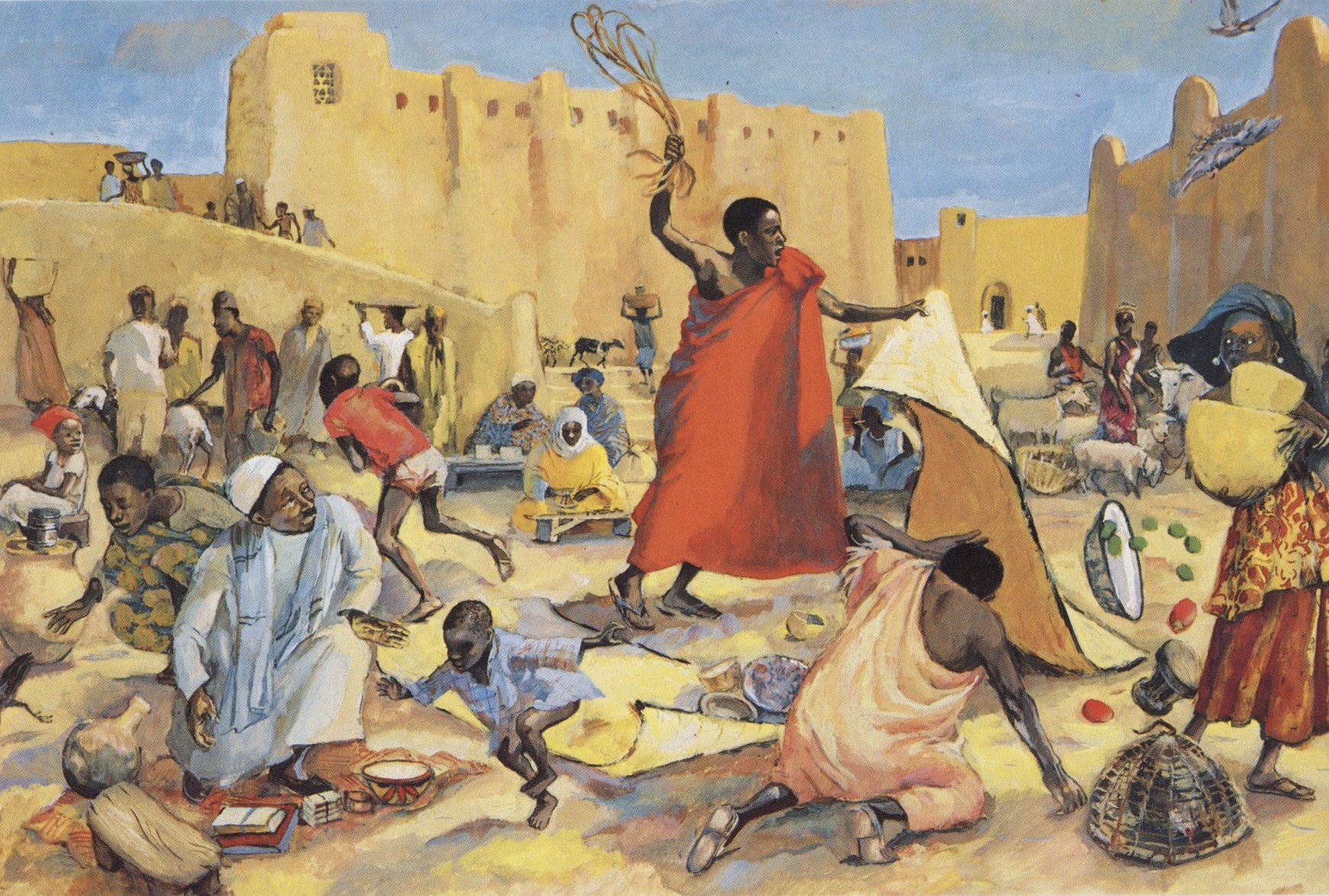
Jesus drives out the merchants
Were Jesus’ actions in the temple peaceful? Is he a role model for Christian protest? This week, on behalf of the Victorian Council of Churches, I attended a round table of lawyers and academics examining the state of protest laws and policing in Victoria. There have apparently been some fifty new protest laws over the past two decades, partly because the number of protests has increased. Members of Melbourne Activist Legal Support (MALS), legal observers, said that attending twenty protests used to mean a busy year for them; now they attend a couple of protests a week.
Maybe because of this frequency, we see police, politicians, and the mainstream media combining to create a narrative that most protesters are violent and hateful, possibly even terrorists. On quite a few of my non-preaching Sundays I have attended antigenocide protests in Melbourne. They have been remarkable: weekly protests for over two years in which there has been no violence and no attacks on property. But that is not the news that those who do not attend them have received. Were you just to read The Age, you would believe that these marches were filled with anti-Jewish rhetoric, rather than with anti-Zionist Jews. The Prime Minister’s Special Envoy to Combat Antisemitism even described the March for Humanity over the Sydney Harbour Bridge as antisemitic, although when challenged, she conceded that the protest itself was not antisemitic but argued that it undermined ‘social cohesion’. The round table I attended discussed how to change this narrative, and I offered to find them more people like 97-year-old Uniting Church minister Alan Stuart, arrested at an environmental blockade at the Newcastle Port and liked by the media.
Peaceful protesting is protected under the International Covenant on Civil and Political Rights, and an advisory note on that right has said that having a few violent individuals at a protest does not render the whole protest violent. The lawyers around the table also said that disruptive protests are not by definition not peaceful, but we pondered whether violence against property made a protest violent. Undoubtedly, Jesus would have been charged under Victorian legislation for driving out all who were selling and buying in the temple, if not for overturning their tables. (Personally, had I been organising Jesus’ actions, I would have had a peaceful sit-in of the outer court of the temple, but then I am not the Messiah.)
Palm Sunday, the political street theatre of Jesus’ entrance and his actions in the temple, is something Christians draw on when engaging in protest. There is a tradition of street marches for peace and justice on Palm Sunday, including today’s Walk for Refugees. As I pondered today’s service this week, the Holy Spirit not only had me participating in a protest roundtable, She also brought my attention to one of the many books I have inherited from the library of Ian and Dorothy Hansen. It is a collection of sermons delivered to students and academics at Great St Mary’s Church in Cambridge, and it contains a sermon titled ‘Witness, Protest, Discipleship’ by Canon Eric James, Precentor of Southwark Cathedral. I am going to read to you his opening paragraphs:
I want to speak to you this morning on ‘Protest’. To Milton and to Shakespeare to protest meant to proclaim, to affirm, to vow, to witness. I believe that this linguistic connection should never entirely be severed. ‘Seeing we are compassed about with so great a cloud of witnesses’; the Greek word there for witness is very much akin to our word martyr. Martyrs, witnesses, proclaimers, protesters, they all have, should have, much in common.
And there really is my first point: that protest for the Christian is fundamentally positive, not negative. It is always fundamentally affirmation at cost, at risk, grounded in the great and central truths of the Christian faith, that all men are equally valuable in the sight of God; equally loved by him, be they Vietnamese, Viet Cong, Russian, Chinese, American, British, white Rhodesian, black Rhodesian, Israeli, Egyptian. In his love God created us all. In his love he was made man. In his love he revealed in his life and death and triumphant suffering the nature and destiny of man, the nature of that love which is the origin, sustenance, completion and goal of all men.
The motive of protest for the Christian is always grounded in him whose nature and whose name is love.[1]
Take away the gender-specific language, change the groups mentioned to Russian, Ukrainian, American, Iranian, Israeli, Palestinian, and I could preach this today.
The Canon went further. He pointed out that what claims to be ‘law and order’ may actually be disorder: ‘The established disorder in Hitler’s Germany, in South Africa and Greece and South America and Northern Ireland and many another place today, often parade as law and order.’[2] And he said that the intellectual modesty of knowing that we do not know everything should not prevent us from acting: ‘In South Africa, for instance, you can be aware that you haven’t all the truth, but it would be lily-livered to treat apartheid as something towards which you can be apathetic.’[3] Canon Eric James died in 2012, after roles that included being chaplain to the Queen and Preacher to Gray’s Inn, one of the four Inns of Court for barristers and judges in London. I wish I had had the chance to meet him.
As comfortable and privileged Australians, we may find protesters annoying or even threatening. As Christians, we must support protest that is ‘fundamentally positive, not negative,’ even if it is also disruptive. Because, as we seek to follow Jesus’ example, we may find him leading us into the temple to overturn tables. Amen.
[1] Hugh Montefiore (ed), More Sermons from Great St Mary’s (London: Hodder & Stoughton, 1971), p. 170.
[2] Canon Eric James, ‘Witness, Protest, Discipleship,’ p. 171.
[3] Canon Eric James, ‘Witness, Protest, Discipleship,’ p. 176.

 Rev Doc Geek