Sermon: Holy Spirit and evil spirits

Reflection for North Balwyn Uniting Church
9th of June 2024

Mark 3:20-35

Every liturgical ‘Year of Mark’ I remind the congregation that of all the canonical gospels of Jesus Christ, Mark’s version is the shortest, the earliest, and the most terrifying. Today we see that scariness up close, as Jesus is accused of being in league with demons and his family tries to restrain him because they believe he is out of his mind. It is a story that includes Jesus being attacked by the representatives of the Powers That Be in Jerusalem, while he attacks his biological family in favour of the outsiders gathered around him. Perhaps most difficult is Jesus’ saying: ‘Truly I tell you, people will be forgiven for their sins and whatever blasphemies they utter; but whoever blasphemes against the Holy Spirit can never have forgiveness, but is guilty of an eternal sin’. Today’s reading is not for the faint of heart, nor for those who are relaxed and comfortable with the status quo. Continue reading

Posted in Sermons | Tagged , , , , , , , , , , , , , , , , | 1 Comment

Review: David Cronin, Balfour’s Shadow (2017)

Balfour’s Shadow: A Century of British Support for Zionism and Israel by David Cronin

My rating: 5 of 5 stars


Extremely well-researched and bloody depressing, this book explains exactly how culpable the UK is in the human rights horror show that is the State of Israel. From the Balfour Declaration, which was opposed by the only Jewish member of the British Cabinet, to the joint manufacture of weapons tested on Palestinians with Israeli companies and the stifling of peaceful actions of Palestinian solidarity, successive UK governments have enabled Israel’s Occupation and Ethnic Cleansing of Palestine.

Chaim Weizmann repeatedly told the British that a Jewish Palestine would be a British Palestine and, apparently, the British believed it, possibly because they saw Jewish immigrants to what became Israel as the equivalent of Protestant immigrants to Ireland. The connection between the colonisation and mistreatment of Ireland, and the colonisation and mistreatment of Palestine, was so strong that members of the notorious Black and Tans went from ‘policing’ Ireland to ‘policing’ Palestine, with violence, collective punishment, and concentration camps.

The hope in this book is that despite the rampant Zionism of politicians, the general population of the UK is anti-Zionist, to the point that Israel sees the UK as the centre of the BDS campaign.

The horror is that this is a book published in 2017 and no matter how awful the actions of the British and the Israelis it documents, no one could have imagined the extent of the genocidal campaign Israel is currently carrying out, in 2024. God forgive us.


View all my reviews

Posted in Books | Tagged , , , , , , , , , | Leave a comment

Sermon: Ending in Darkness

Reflection for North Balwyn Uniting Church
2nd of June, 2024

Psalm 88

Bruce and I, with the help of our cantor, Tom, are being a bit cheeky today. The psalm that Tom led us in this morning, Psalm 88, is not in the lectionary. There is no Sunday in the three-year cycle when we are advised to use Psalm 88 in worship. This is probably because, of all the psalms in the Psalter, Psalm 88 is the only lament that does not include praise of God. The last words Tom sang were ‘You have caused my friend and neighbour to shun me; my companions are in darkness’. There was no, ‘But let all who take refuge in you rejoice; let them ever sing for joy’ (Psalm 5:11) or ‘From you comes my praise in the great congregation; my vows I will pay before those who fear him’ (Psalm 22:25) or ‘The righteous will surround me, for you will deal bountifully with me’ (Psalm 142:7). Psalms of lament make up forty per cent of the psalms in the Psalter, but all the other laments end with praise at what God has done in the past, or with confidence that God has heard and will save the psalmist in the future. What do we do with a psalm which begins and ends in lament? Continue reading

Posted in Sermons | Tagged , , , , , | 1 Comment

Sermon: Sadly without unicorns

Reflection for North Balwyn Uniting Church
Trinity Sunday, 26th of May, 2024

Psalm 29

Psalm 29 initially seems like a strange choice of Scripture for Trinity Sunday. There does not seem to be much that is trinitarian in a hymn about the God of glory who thunders over mighty waters, breaking the cedars and making Lebanon skip like a calf. The explanation may be that Psalm 29 is also allocated for the Sunday on which the Baptism of Jesus is celebrated in all three years of the lectionary. On that Sunday this psalm of mighty waters and flood connects with the waters of baptism. Since Jesus’ baptism is a very trinitarian event, as Jesus is baptised the Father identifies him as beloved Son and the Spirit descends on him like a dove, it is possible that the psalm gains trinitarian resonance simply from proximity. Continue reading

Posted in Sermons | Tagged , , , , , , | Leave a comment

Sermon: “with warm breast and with ah! bright wings”

Reflection for North Balwyn Uniting Church
Pentecost, 19th of May, 2024

Ezekiel 37:1-14
John 15:26-27 16:4b-15

I have been reading a lot of poetry this year, and apparently the historian in me is not satisfied to simply enjoy poetry. I seem to need to analyse and contextualise poems in the same way I do Bible readings. So, since I am currently reading a collection of poems by the nineteenth-century English poet Christina Rossetti, I have also just finished a biography of her. (You all know at least one of Christina’s poems, because ‘Love came down at Christmas’ is hymn 317 in Together in Song.) Christina was a deeply committed high church Anglican and in her poetry she often looks forward to death, as a time when she would be reunited with those she loved, would receive in fullness the love she had been unable to experience while alive, and would be united with Jesus. So I was sad to discover that apparently her actual death was unpeaceful; she was depressed, ‘hysterical,’ heard by neighbours to scream, and on her last night needed to be tied to her bed. Her brother William blamed Christina’s confessor, the Reverend Charles Gutch, who visited her as she was dying. William wrote that Gutch ‘took it upon himself to be austere where all the conditions of the case called him to be solacing and soothing’. In the last month of her life William thought that her mind was ‘always now possessed by gloomy thoughts as to the world of spirits,’ and he recorded that she once said, ‘How dreadful to be eternally wicked! For in Hell you must be so eternally!’ Watching his faith-filled sister’s death confirmed William’s own agnosticism.[1] Continue reading

Posted in Sermons | Tagged , , , , , , , , , , , , | Leave a comment

Book Review: Yet in the Dark Streets Shining: A Palestinian Story of Hope and Resilience in Bethlehem

Bishara Awad and Mercy Aiken, Yet in the Dark Streets Shining: A Palestinian Story of Hope and Resilience in Bethlehem, Cliffrose Press, 2021, paperback, 217 pp.

The death of one man is a tragedy; the death of millions is a statistic, as Josef Stalin probably did not say. When it comes to the Israel-Palestine conflict the attitude of the Western world seems to be that the death of a single Jewish Israeli is a tragedy; the deaths of thousands of Palestinians are the unfortunate results of a necessary war.

This story of the family of Elias Awad, descended from Maronite Christians, and his wife Huda Kuttab, born into a Greek Orthodox family but supported by evangelical Protestant missionaries after the death of her father, gives human faces to Palestinian statistics. Bishara Awad, the founder of the Bethlehem Bible College, was born on the day World War Two began. He was eight when an Israeli sniper shot his father during the violence that Jewish Israelis call the War of Independence and Palestinians call the Nakba, the Catastrophe. After Elias’ death, the Awad family fled their home in West Jerusalem, assuming that it was only for a little time. Seventy-six years later they are still unable to return.
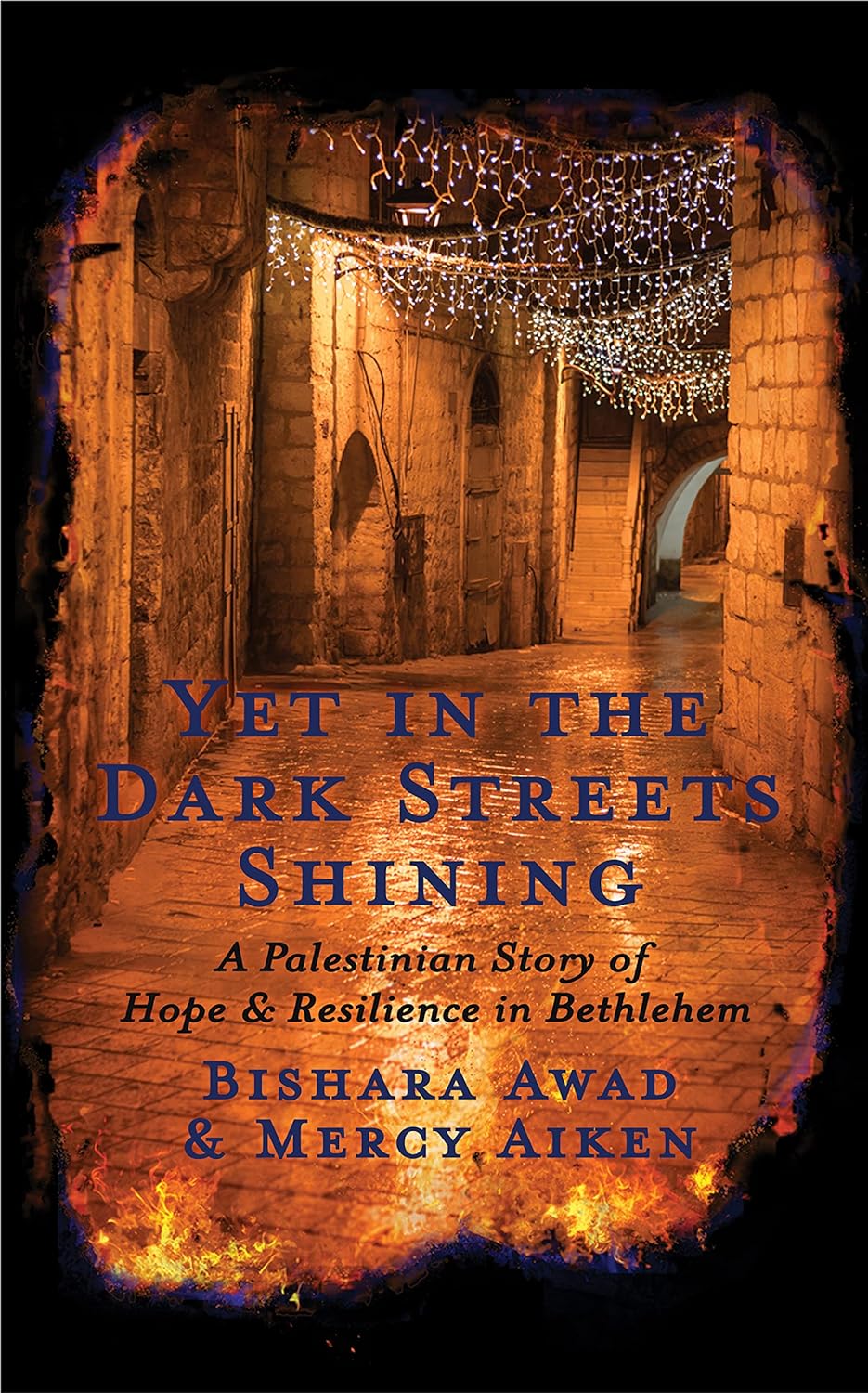
Yet in the Dark Streets Shining

Since his saintly mother forgave her husband’s killers, Bishara pretended to do the same. ‘Wanting to be a good Christian, I would spend the first half of my life unconscious of my anger, putting a smile on my face that would hide my wound even from myself.’ It took years for Bishara to recognize his own rage, his hatred of Israelis, and his deep sorrow that the world’s Christians ignored the oppression of Palestinians. Only after acknowledging the truth of his trauma was Bishara able to experience the compassion of Christ for both Palestinians and Jewish Israelis. Daily Bishara now chooses to forgive, to look into the darkness with hope and love, desiring God’s best for Palestinians and Israelis alike.

Bishara writes that three issues make it difficult for Western Christians to listen to Palestinians: guilt over Christian antisemitism; belief in Israel as an ally of the West; and, most potently, Christian Zionism, the belief that the State of Israel is the fulfilment of prophecy and a harbinger of the eschaton. Of the three, it is probably the first that keeps members of the Uniting Church silent on the question of Palestine. Bishara’s story makes it clear that Western Christians must not assuage our own guilt at the expense of Palestinians.

Parts of this story are profoundly hard to read while watching the destruction of Gaza. Bishara has a lyrical description of falling in love with his wife Salwa there, in a rich agricultural land filled with groves of citrus and other fruit trees, where flowers climbed on buildings and jasmine scented the air. Bishara’s description of his family’s situation during the Nakba mirrors the images we now see of Gazans desperately seeking safety in Rafah. Most members of the  Awad family now live overseas; will this happen to today’s internally displaced Gazans?

Bishara ends his book with a plea to Christians around the world to help Palestinians work for justice, to help end the suffering of both Palestinian and Israeli people. Will we have the courage to do so?

Posted in Books, Random Musings | Tagged , , , , , , , , , | Leave a comment

Sermon: Advice from Julian of Norwich

Reflection for North Balwyn Uniting Church
The Seventh Sunday of Easter, 12th of May, 2024

John 17:6-19

It is late in the evening. The meal is long over. Earlier, as the meal ended, Jesus knelt and washed his disciples’ feet. He then began to prepare them for life without him. He gave them the new commandment, that they love one another. He prepared them for the coming of the Holy Spirit, the Advocate, the Spirit of Truth. He shared with them the mutual indwelling of the Father and the Son. And he spoke of his betrayal and death. He gave them his final teachings, the wisdom that they would hold onto during the horrors of his crucifixion and the overwhelming joy and shock of his resurrection. Continue reading

Posted in Sermons | Tagged , , , , , , , , | Leave a comment

Sermon: The Ethiopian Eunuch

Reflection for North Balwyn Uniting Church
The Fifth Sunday of Easter, 28th of April, 2023

Acts 8:26-40

I adore today’s story from The Acts of the Apostles. When Luise condoled with me for having to write a Reflection on ANZAC Day I replied, ‘Yes, but I’m writing about the Ethiopian Eunuch!’ And I meant it. You know that I love biblical stories in which gender and sexual outcasts are welcomed into the faith and family of Jesus Christ, and that is the story that we hear today. Continue reading

Posted in Sermons | Tagged , , , , , , , , , | 1 Comment

Sermon: To be Christian is to be in community

Reflection for North Balwyn Uniting Church
The Third Sunday of Easter, 14th of April 2024

Luke 24:36b-48

This may be sad news for those of you who are, like me, massive introverts, but following Jesus is always a communal activity. No Christian is a Christian in isolation; even those who are imprisoned in solitary confinement, hermits in the desert or the mountains, or living in a single room walled into the side of a church as an anchorite, participate in the one holy catholic and apostolic church. Even if you prefer walking alone, like Fox in the picture book I just read,[1] by seeking to follow Jesus you have become part of the community of all the people throughout time and space who have also sought to follow him. In today’s story from the Gospel according to Luke we see why. It is only as each of us brings our experiences of God to share with others that the good news of Jesus Christ can be fully seen and understood. And it is only as a community, the church, that we can share that good news with the world. Continue reading

Posted in Sermons | Tagged , , , , , , , | Leave a comment

Sermon: Easter Sunday

Reflection for North Balwyn Uniting Church
Easter Sunday, 31st of March, 2024

Acts 10:34-43
Psalm 118:1-2, 14-24
1 Corinthians 5:6b-8
Mark 16:1-8

I wonder whether, amid their sorrow, and their horror at the cruelty of Jesus’ death, the women coming to anoint his body feel some relief. They are on their way to do their very last service for the one they have followed and provided for since his ministry began in Galilee. Mary Magdalene, and Mary the mother of James, and Salome had been among the many women who had come with Jesus to Jerusalem. They had stood at a distance watching as he died and as his body was quickly laid in a tomb before the Sabbath began. They had shown themselves to be true disciples, in comparison with Peter and James and John who could not even stay awake in the Garden of Gethsemane. Unable to care for his body on the Sabbath, the three women now bring spices to anoint him. After the body has been so long in the tomb the spices will not do much to ameliorate the smell of decay, but they come anyway, because this is the last thing they can do for someone they have loved. Continue reading

Posted in Sermons | Tagged , , , , , , , , , , , , , | 2 Comments