
Sermon: Murder is not a biblical value

Reflection for North Balwyn Uniting Church
The Third Sunday after Pentecost, 29th of June 2025

Galatians 5:1, 13-25
Luke 9:51-62

I am going to begin this week’s Reflection with a very radical and controversial statement. Faith should not be imposed by violence. No one should be killed for worshipping the wrong god, or the right God in the wrong way.

For us, twenty-first-century Australians, these are not radical sentiments. We are much more likely to be horrified when religion does lead to violence. But for most of human civilisation, it would have seemed quite normal to kill those who seemed not to follow the same God. I referred last week to the Cistercian Abbot who is reported to have said of a French town in which heretics lived side by side with good Catholics, ‘Kill them all, for the Lord knows those that are His’. For millennia, many people, not just Christians, would have considered this an admirable saying.

The Hebrew Scriptures are certainly full of occasions upon which the Lord of Israel is said to have instructed his people to murder those who did not worship him. When the people of Israel first began to occupy the land that had previously been occupied by ‘Canaanites, Hittites, Hivites, Perizzites, Girgashites, Amorites, and Jebusites’ (Joshua 3:10) it was seen as praiseworthy that under Joshua the people ‘devoted to destruction by the edge of the sword all in [Jericho], both men and women, young and old, oxen, sheep, and donkeys’. (Joshua 6:21) Later, once the people of Israel had claimed a king for themselves, King Saul lost the Lord’s favour because when the Lord told him to ‘go and attack Amalek and utterly destroy all that they have; do not spare them, but kill both man and woman, child and infant, ox and sheep, camel and donkey,’ Saul instead spared ‘King Agag of the Amalekites’ and ‘the best of the sheep and of the cattle and of the fatted calves, and the lambs, and all that was valuable and would not utterly destroy them’. The Lord wanted the genocide of the Amalekites, and because Saul failed to do that, we are told, ‘the Lord was sorry that he had made Saul king over Israel’. (1 Samuel 15)

One side of the Hebrew Scriptures worships a violent and vicious tribal god. But throughout the Hebrew Scriptures is a second stream, with a God who cares as much for the stranger as for the Israelite. At the very time that the people of Israel are told to ethnically-cleanse the land that becomes Israel, they are also told ‘You shall not wrong or oppress a resident alien, for you were aliens in the land of Egypt,’ (Exodus 22:21) and ‘You shall not oppress a resident alien; you know the heart of an alien, for you were aliens in the land of Egypt,’ (Exodus 23:9) and, most amazingly, ‘The alien who resides with you shall be to you as the native-born among you; you shall love the alien as yourself, for you were aliens in the land of Egypt: I am the Lord your God’. (Leviticus 19:34)

Jesus, brought up on the Law and the Prophets, learned and taught from this second stream. Everything Jesus preached came from the Hebrew Scriptures, but as we see today, he also challenged the Hebrew Scriptures. Today’s gospel reading comes from the beginning of the journey that takes up about a third of the Gospel according to Luke, when Jesus has ‘set his face to go to Jerusalem’ to his death. Jesus has just spoken with Moses and Elijah on the mountain about his departure, his ‘exodus’. Now he shows how he differs from Elijah. One of the things that Elijah did during his prophetic career was to destroy Samaritans with fire. The king of Samaria had sent messengers to consult with Baal, and God had sent Elijah to ask the messengers why: was there no God in Israel? When the king heard Elijah’s question, he sent a captain and fifty men to ask Elijah to come to him. The second Book of Kings reads: ‘But Elijah answered the captain of fifty, “If I am a man of God, let fire come down from heaven and consume you and your fifty.” Then fire came down from heaven and consumed him and his fifty.’ (2 Kings 1:10) This happened twice, but when the third captain approached Elijah on his knees, God told Elijah to go with him to see the king. Elijah visited and prophesied the king’s death. Earlier, Elijah had had four hundred and fifty prophets of Baal killed after a competition over which of them could call down fire from heaven: ‘Elijah said to them, “Seize the prophets of Baal; do not let one of them escape.” Then they seized them, and Elijah brought them down to the Wadi Kishon and killed them there.’ (1 Kings 18:20-40) Astonishingly enough, neither of these stories makes it into the Lectionary.

These are the precedents that James and John want to follow. We are told that the reason the Samaritans reject Jesus is ‘because his face was set toward Jerusalem’. The Samaritans were descended from the people left behind during the Assyrian Exile, and they believed that God was to be worshipped on Mount Gerizim, rather than in Jerusalem. To them, Jesus is going to worship God on the wrong mountain. To the Jewish James and John, the Samaritans are once again rejecting the Word of God. Elijah had killed the Samaritans of his time; surely Jesus has just as much reason to call down fire.

What James and John are suggesting is in perfect accord with one part of the Hebrew Scriptures. Jesus, however, is drawing on the other part. Throughout his ministry, Jesus has been preaching a message of love and forgiveness and rejecting violence as a solution to religious problems. It does not matter how right the disciples are; their theological correctness is not to be demonstrated, as Elijah demonstrated his, with murder.

Luke then shows another way in which Jesus differs from Elijah. In the story of Elijah’s calling of Elisha, Elijah found Elisha ploughing. Elisha left the oxen, ran after Elijah, and said, ‘Let me kiss my father and my mother, and then I will follow you.’ Elisha then returned to his home, slaughtered and cooked the oxen, and gave them to his people before following Elijah and becoming his servant. Every one of the three hard sayings in today’s reading: ‘foxes have holes, and birds of the air have nests; but the Son of Man has nowhere to lay his head’; ‘let the dead bury their own dead; but as for you, go and proclaim the kingdom of God’; and ‘no one who puts a hand to the plough and looks back is fit for the kingdom of God’ can be seen in reference to the story of Elisha joining Elijah, with Jesus demanding more of his followers than Elijah demanded of Elisha. For those who follow Jesus, there is to be no satisfying killing of God’s enemies, and no turning back to farewell their families. Following Jesus is much more difficult than following Elijah, because Jesus is much more than a prophet.

‘For freedom Christ has set us free,’ writes the Apostle Paul to the Galatians. He is telling the Galatians that they do not need to be circumcised to belong to the people of God; they are not required to follow the Law. Indeed, Paul argues, for Gentiles to follow the Jewish Law would be to deny what Christ has done for them. But Paul quickly goes on to remind these Gentiles who must not follow the Jewish Law that their freedom from the Law must not become license. We Gentiles cannot behave in any way we wish. We are to avoid all the works of the flesh, many of which are things that divide human beings one from another: enmities, strife, jealousy, anger, quarrels, dissensions, and factions. Christ has set us free, says Paul, to freely demonstrate love, joy, peace, patience, kindness, generosity, faithfulness, gentleness, and self-control. Fortunately for those of us who are not naturally peaceful, patient, or gentle, the ability to live in love is a gift from God. Christian virtues are fruits of the Spirit rather than works.

Faith should not be imposed by violence. No one should be killed for worshipping the wrong god, or the right God in the wrong way. I do not think that anyone here would argue with that – at least I hope not. But God demands more of us than a refusal to command fire to come down from heaven and consume those with whom we disagree. As the Apostle Paul writes, the whole law is summed up in a single commandment, ‘You shall love your neighbour as yourself.’ He promises that those of us who seek to live by the Spirit will be guided by the Spirit into love, joy, peace, patience, kindness, generosity, faithfulness, gentleness, and self-control. If we do this, we will be worshipping the God revealed both in the Hebrew Scriptures and by Jesus, the one who told the people of Israel millennia ago, ‘you shall love the alien as yourself … I am the Lord your God’. This is the God in whose way we are called to walk. Amen.
Posted in Sermons | Tagged , , , , , , , , , , , | Leave a comment

Sermon: Dear God, we pray for unity and peace

Reflection for North Balwyn Uniting Church
Anniversary of Church Union, 22nd of June 2025

Ephesians 2:19-22
John 17:1-11

Today is the 48th anniversary of Union, the day when, after seventy-five years of faithful work, the Congregational Union of Australia, the Methodist Church of Australasia, and the Presbyterian Church of Australia became the Uniting Church in Australia. Today’s suggested Scripture readings are both frequently used to encourage ecumenism, Christian unity; as I have mentioned before Rowan Williams, theologian and former Archbishop of Canterbury, has said of today’s reading from the Letter to the Ephesians that it is ‘used rather too frequently in the Week of Prayer for Christian Unity and on other occasions when we are being urged to be conciliatory to each other’.[1] But as I write this Reflection, Israel and Iran are dropping bombs on each other, and there seems every likelihood that President Trump wants the USA to be involved. So today these readings seem to me to speak less about the need for unity among Christians, and more about the need for unity among human beings. Continue reading

Posted in Sermons | Tagged , , , , , , , | Leave a comment

Sermon: International, multicultural, multilingual communities

Reflection for North Balwyn Uniting Church
Pentecost, 8th of June 2025

Acts 2:1-21

Scripture constantly surprises. Earlier this week, I talked with Dorothy Hansen about today being the nineteenth time I would preach at Pentecost. Could I possibly have anything new to say after eighteen Pentecost sermons, I wondered, and Dorothy very kindly sent me a Pentecost sermon by one of my favourite preachers, Barbara Brown Taylor, to offer me inspiration. The inspiration I received this week, though, was not Barbara Brown Taylor’s wonderful note that ‘to conspire’ means to breathe together, although that is certainly something I am glad to now know. This week’s inspiration was about the community created by the Pentecost event. I have always thought of this event as the birthday of the church. But Pentecost is the story of the renewal of Israel, and God’s faithfulness to it. Continue reading

Posted in Sermons | Tagged , , , , , , | Leave a comment

Sermon: Universalism means universal love

Reflection for North Balwyn Uniting Church
The Seventh Sunday of Easter, 1st of June 2025

Revelation 22:12-14, 16-17, 20-21

Today, the last Sunday of the Easter season, as we listen to our final reading from the Book of Revelation, we are hearing the very last words of the Bible. The Bible is not to be read, as I thought it was to be read when I was given my first grown-up version at the age of eight, from Genesis chapter one verse one, to Revelation, chapter twenty-two verse twenty-one; from ‘In the beginning when God created the heavens and the earth,’ to ‘The grace of the Lord Jesus be with all the saints. Amen.’ But the final verse from Revelation is not a bad ending for the entire biblical canon. There are variants in the original Greek that make this last blessing even more expansive, so in the King James and the New English Versions we read ‘The grace of our Lord Jesus Christ be with you all’ and in the Good News translation we read, ‘May the grace of the Lord Jesus be with everyone.’ However we translate it, the last verse of the last chapter of the last book of the Bible reminds us that the gospel is meant to be good news for the whole wide world. Continue reading

Posted in Sermons | Tagged , , , , , , , , | Leave a comment

“First they came …” the progressive Australian version

First they came for First Nations people, so we march on Invasion Day, advocate for Treaty, and ask governments to Raise the Age.

Then they came for the LGBTIQ+ community, so we marched, and advocated, got homosexuality decriminalised and marriage equality legalised, but realised the fight against neo-Nazis would never end. Continue reading

Posted in Political Activism | Tagged , , , , , , , , , , , , | Leave a comment

Sermon: Building Jerusalem in Australia’s dry and dusty land

Reflection for North Balwyn Uniting Church
The Fifth Sunday of Easter, 18th of May 2025

Revelation 21:1-6

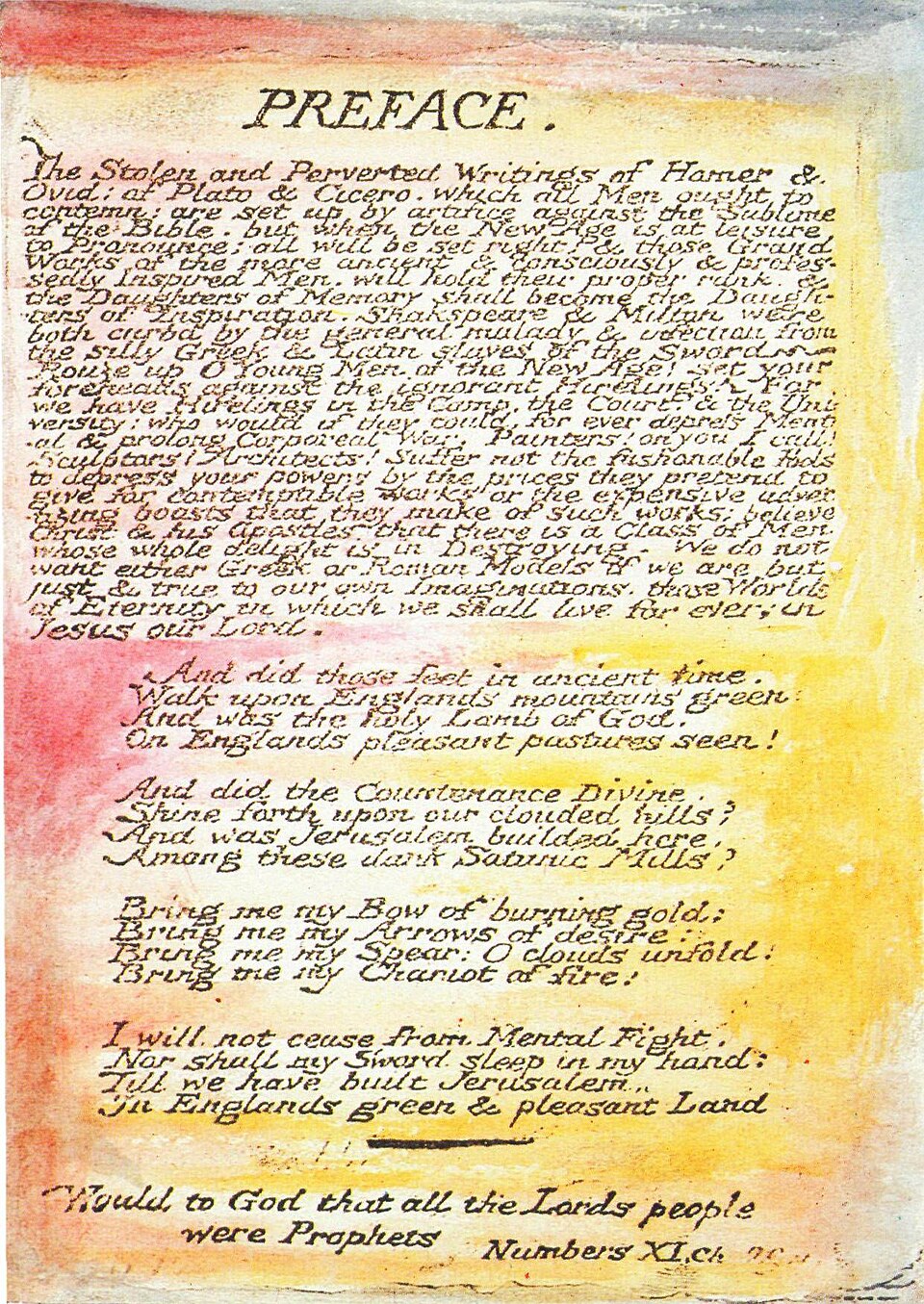
I have a confession to make. Although I am Scottish Australian, I absolutely adore the song ‘Jerusalem,’ the early nineteenth-century poem by William Blake that Sir Hubert Parry put to music in the early twentieth century. I blame the joy I take in hearing about ‘England’s green and pleasant land’ on the film Chariots of Fire, which was released when I was eight years old and in which my cousin had a role playing Eric Liddell’s brother Rob. If you have not seen Chariots of Fire, and you do not know who Eric Liddell was, that is your homework for the week. The soundtrack of Chariots of Fire, including ‘Jerusalem,’ is carved into my memory.

Blake's hand-lettered preface to his epic poem Milton, which contains the words to what became the song 'Jerusalem'

Continue reading

Posted in Political Activism, Sermons | Tagged , , , , , , , , | 1 Comment

Sermon: The Book of Revelation – not that terrifying!

Reflection for North Balwyn Uniting Church
The Third Sunday of Easter, 4th of May, 2025

Revelation 5:11-14

Today I am going to do something that I have never done before. I am going to preach on the lection from Revelation.

The Revised Common Lectionary gives us only a few readings from Revelation, mostly limiting them to this season of Easter in the liturgical year of Luke, and mostly giving us descriptions of worship and praise. If we follow the lectionary readings we never hear about the plagues, wars, and famines that Revelation describes as occurring when angels blow trumpets and pour out bowls of God’s wrath, even though it is probably those plagues, wars, and famines that first spring to mind when thinking about this part of the Bible. Beyond the lectionary, we are most likely to use elements of Revelation in song. ‘Love divine, all loves excelling’ (TIS 217), the Battle Hymn of the Republic (TIS 315), ‘Shall we gather at the river?’ and ‘When the saints go marching in’ all use images from the Book of Revelation. (If St Kilda ever wins an AFL Grand Final we will most definitely be singing ‘When the saints …’ even though the football theme song makes no mention of stars falling from the sky, the sun refusing to shine, or the moon turning red with blood.) But there is more to Revelation than us casting our crowns before God or the grapes of wrath being trampled. Continue reading

Posted in Sermons | Tagged , , , , , | Leave a comment

Easter Sunday: Joining Mary Magdalene in joy and sorrow

Reflection for North Balwyn Uniting Church
Easter Sunday, April 20, 2025

1 Corinthians 15:19-26
John 20:1-18

“I am ascending to my Father and your Father, to my God and your God.”

There are two things of which we can be sure about the events of that first day of the week. The first is that Jesus’ body was missing from the tomb. If the corpse had been quietly lying where Joseph of Arimathea had placed it, the Romans would have displayed it as soon as rumours began to spread that an executed man was appearing to his followers. In the Gospel according to Matthew there is a story of the priests bribing soldiers to say that Jesus’ disciples had stolen the body to explain its absence (Matthew 28:11-15) and another Jewish story had a gardener named Judas removing the body and later returning it. Whatever else we believe, we can be sure that the tomb was empty. Continue reading

Posted in Sermons | Tagged , , , , , , , , , | Leave a comment

Sermon: Until warring powers cry ‘Enough!’

Reflection for North Balwyn Uniting Church
‘Palm’ Sunday, 13th of April, 2025

Luke 19:28-48

Today we celebrate Jesus’ triumphant entry into Jerusalem for the Passover. Like pilgrims throughout time, Jesus’ disciples rejoice as they enter the holy city, praising God for God’s mighty deeds. But Jesus is not simply another pilgrim. Luke’s telling of the story makes it clear that Jesus is entering Jerusalem as its king. He sits on a colt that has never been ridden, one that is suitable for sacred purposes. Jesus’ disciples set him on it, an act of homage, and the spreading of cloaks on the road before the colt is another act of homage to a ruler. The psalm that the crowd sings as they come into sight of Jerusalem has one small but significant change from the version in the psalter. Rather than singing ‘Blessed is the one who comes in the name of the Lord,’ the people sing, ‘Blessed is the king …’. Continue reading

Posted in Sermons | Tagged , , , , , | Leave a comment

Sermon: Martha, Lazarus, and Mary

Reflection for North Balwyn Uniting Church
Lent 5, 6th of April, 2025

John 12:1-8

‘The chief priests and the Pharisees called a meeting of the council, and said, “What are we to do? This man is performing many signs. If we let him go on like this, everyone will believe in him, and the Romans will come and destroy both our holy place and our nation.” But one of them, Caiaphas, who was high priest that year, said to them, “You know nothing at all! You do not understand that it is better for you to have one man die for the people than to have the whole nation destroyed.”’ (John 11:47-50) Continue reading

Posted in Sermons | Tagged , , , , , , , | 1 Comment