Reflection for North Balwyn Uniting Church
1st of February 2026
Deuteronomy 28:1-14
Matthew 5:1-16
Did you watch or listen to the address given by Canadian Prime Minister Mark Carney at the World Economic Forum in Davos, Switzerland? The part I have seen replayed most often is his statement: ‘It seems that every day we’re reminded that we live in an era of great power rivalry, that the rules-based order is fading, that the strong can do what they can, and the weak must suffer what they must. And this aphorism of Thucydides is presented as inevitable, as the natural logic of international relations reasserting itself.’ He went on to say, ‘We knew the story of the international rules-based order was partially false; that the strongest would exempt themselves when convenient, that trade rules were enforced asymmetrically. And we knew that international law applied with varying rigour depending on the identity of the accused or the victim.’ His solution is that rather than simply relying on the ‘international rules-based order,’ middle powers like Canada should be ‘pragmatic’ and pursue ‘different coalitions for different issues based on common values and interests.’
After reading Carney’s speech, I listened to a response from Allan Behm, who spent thirty years in the Australian Public Service specialising in international relations. Behm says of Carney’s Thucydides’ quote:
There was a measure of truth in that in Thucydides’ time, but it’s not true now for the one simple reason that in the last two and a half thousand years, we’ve discovered law. The power of law is to regulate the relationship between the strong and the weak … We should also remember that the journey to that position has been hard and there’s been a lot of suffering to get there. And so when Doc Evatt and [Edward Reilly] Stettinius [Jr] and the others were negotiating and drafting the UN Charter and particularly its preamble in San Francisco in 1945, they understood, I think much better than we do now, the significance of that statement in the preamble about the value and dignity of people essentially by virtue of our shared humanity, because that is the foundation of the international rule of law. That is a massive development beyond the age of Thucydides.
As someone who believes in the possibilities of international law, particularly international humanitarian law, I am with Behm. I agree with him partly because I believe that it has been Christianity that has made the greatest difference in the two and a half thousand years between Thucydides and us. The UN Charter says that its aim is to ‘reaffirm faith in fundamental human rights, in the dignity and worth of the human person, in the equal rights of men and women and of nations large and small’. But as historian Tom Holland points out: ‘That human beings have rights; that they are born equal; that they are owed sustenance, and shelter and refuge from persecution: these were never self-evident truths.’[1] They are Christian truths. They are the truths we see in the Sermon on the Mount.
In the Sermon on the Mount, the author of the Gospel according to Matthew presents Jesus as the one greater than Moses, someone who does not simply receive the law from God on a mountain, but who gives it. In the sight and hearing of the crowds Jesus gives the authoritative interpretation of the law and the prophets. While Jesus is surrounded by his disciples, and is probably speaking particularly to them when he says ‘Blessed are you … You are the salt of the earth … You are the light of the world,’ his words are addressed to all Israel. The Sermon on the Mount is not meant for a special Christian elite, nor are its demands so impossible as to remind us of our need for grace. Those of us who follow Jesus are called to live out the Sermon on the Mount in the same way that observant Jews obey the Torah.
The Sermon begins with the beatitudes, describing the people who are ‘blessed’. I have paired today’s section of the Sermon with a reading from the Book of Deuteronomy that reflects the way the world often understands ‘blessing’. Those who use #Blessing on social media or who talk about ‘being blessed to be a blessing’ are usually describing the modern equivalent of being blessed in the city and the field; blessed with fruitfulness and food; abounding in prosperity. But according to the beatitudes, the blessed are not the rich, the healthy, the happy, the successful, the famous. Quite the opposite: they are the poor in spirit; those who mourn; the meek; those who hunger and thirst for righteousness.
One question often asked about the beatitudes is whether they make ethical demands or describe eschatological rewards. When Jesus says, ‘Blessed are those who mourn, for they will be comforted,’ is he telling us to mourn, with the promise that we will be comforted, or is he saying that those who do mourn will be comforted in the great reversal at the end of time when the kingdom of heaven comes? The answer is both. The beatitudes are both promises and commands. The first four beatitudes describe the reversal that the coming of the kingdom of heaven will bring. When the kingdom comes, the poor in spirit, those who mourn, the meek, and those who hunger and thirst for righteousness will find their situation reversed. When God’s will is done on earth as it is in heaven, the oppressed will receive justice. These first four blessings promise end-time ‘reversals for the unfortunate’.[2]
The second four beatitudes, in contrast, describe end-time ‘rewards for the virtuous,’ they do make ethical demands. We are called to be merciful, pure in heart, peacemakers, and to be willing to be persecuted for righteousness here and now, in this life. True justice can only be established by God and will only be fully established at the end of time itself, but if we truly seek to follow Jesus, then we must play our part by striving for that justice here and now. If we do, if we are, all these things, then at the coming of the kingdom we will be rewarded.
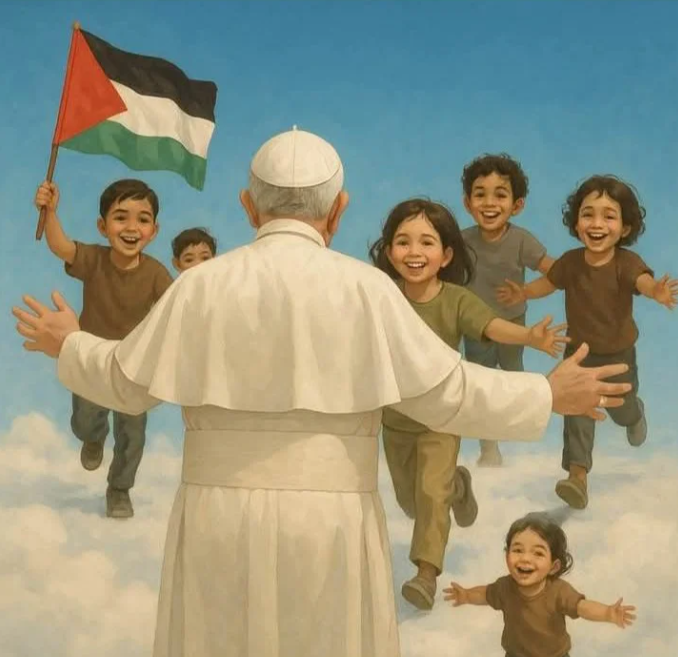
If we try to live out the latter four beatitudes, we may find ourselves in the category of the former. If we seek to be pure in heart, that is, if we seek to live with integrity, with our actions matching our words and our words revealing the truth of our hearts, we may find ourselves mourning and hungering and thirsting for righteousness. There was a picture that did the rounds online after Pope Francis died that showed him being welcomed into heaven by Palestinian children. Normally, I would find a picture like this a bit too cute, but it seems to me to show the relationship between the two groups of beatitudes. The thousands upon thousands of Palestinian children who have been slaughtered in the past few years are ‘the least of these’ whose situation is reversed in the kingdom of heaven. Pope Francis spoke up for them and rang the Holy Family Church in Gaza every day, even while hospitalised, because he was merciful, pure in heart, a peacemaker, and willing to be persecuted for righteousness. Because of this, he was reviled and had all kinds of evil uttered against him falsely, including that he was an antisemite. Israel’s Minister for Diaspora Affairs and Combating Antisemitism even accused him of perpetuating a ‘dangerous blood libel’ against Israel, but Francis did not stop. And so, when the Pope died, people around the world imagined murdered Gazan children welcoming him into the kingdom.
I have said that the Sermon on the Mount and other Christian teachings are the basis of the international legal order that Australia helped develop after the Second World War. That does not mean that Christians will be praised when we seek to live the Sermon out. Jesus was clear that those who seek to follow him risk being reviled and persecuted and having all kinds of evil uttered against them. In the United States the Episcopal (Anglican) bishop of New Hampshire has told the clergy of his diocese ‘to get their affairs in order, to make sure they have their wills written’ in the wake of the killing of Renee Good by federal officers, because he believes that the time has come for the clergy to place their bodies ‘between the powers of this world and the most vulnerable’. We do not face that danger here in Australia. But supporting the poor in spirit, those who mourn, the meek, and those who hunger and thirst for righteousness is unlikely to make us many friends.
Just in case we might think that we can hunker down and be quietly poor in spirit and meek, awaiting our heavenly reward, Jesus reminds us that we are to be the salt of the earth and the light of the world here and now. We are to be the city built on a hill and the lamp on the lampstand, not so that people will praise us but so that they will praise God. Our lives are to show the world God’s love and justice and mercy. We are to share the saltiness of God’s justice and the light of God’s mercy with everyone we encounter. This is what it means to be citizens of the kingdom of heaven.
In his speech, Prime Minister Carney talked of ‘a rupture in the world order, the end of a pleasant fiction and the beginning of a harsh reality.’ But our role as Christians remains the same. We are to follow in the footsteps of Jesus and fulfil our call as his disciples, even as that becomes more difficult, even if it becomes dangerous. And we know that Jesus will be with us always, to the end of the age. Thanks be to God. Amen.
[1] Tom Holland: Dominion: The Making of the Western Mind (London: Abacus, 2020), p. 524.
[2] Mark Allan Powell, ‘Matthew’s beatitudes: Reversals and Rewards of the Kingdom’ The Catholic Biblical Quarterly 58 (1996): p. 460.

 Rev Doc Geek