Reflection for North Balwyn Uniting Church
18th of June, 2023
Genesis 18:1-15, 21:1-7
Matthew 9:35-10:8
‘Is anything too wonderful for the Lord?’ It is the question that the three visitors ask Abraham after his wife Sarah laughs at the promise that she and Abraham will have a son in their extreme old age. Today’s Scripture readings tells us that nothing is too wonderful for the Lord, not even the birth of a son to a woman and her husband who have grown old. Nothing is too wonderful for the Lord, but that does not mean that God’s actions and the coming of the kingdom of heaven will happen as we want them.
Jews, Christians and Muslims all claim to be the descendants of Abraham, the outstanding man of faith. Both he and his wife Sarah, at the command of God, leave their country and their family and their people and set out for an unknown land, because God has promised that they will become the parents of a great nation. Paul argues that Abraham is the ancestor of all those who believe in the promises of God, that Abraham believed God and it was reckoned to him as righteousness. (Romans 4:3) As the author of the Letter to the Hebrews writes:
By faith Abraham obeyed when he was called to set out for a place that he was to receive as an inheritance; and he set out, not knowing where he was going. By faith he stayed for a time in the land he had been promised, as in a foreign land, living in tents … By faith he received power of procreation, even though he was too old—and Sarah herself was barren—because he considered him faithful who had promised. Therefore from one person, and this one as good as dead, descendants were born, ‘as many as the stars of heaven and as the innumerable grains of sand by the seashore.’ (Hebrews 11:8-12)
Yet among the important stories we are told about these exemplary faithful ancestors is the one we hear today, a story of doubt and disbelief.
The story begins with the Lord appearing to Abraham in the heat of the day. When Abraham lifts his eyes, he sees three men. Since these three men are all and each somehow the Lord, this story prompted Rublev’s famous icon of the Trinity, the image of the Father, Son and Holy Spirit sitting together around the table that Abraham prepares for them. If we are ever tempted to reject Christianity’s Jewish roots we are reminded that the most beloved image of the Christian Trinity comes from a story in the Hebrew Scriptures.
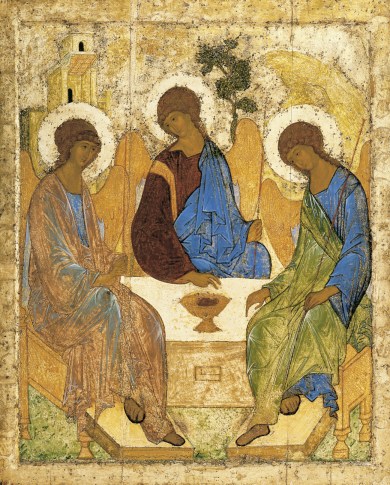
This story shows us the importance of hospitality. The men appear to Abraham in the heat of the day, yet he runs from his tent to greet them. He begs them, as a favour, to allow him to offer them hospitality. He offers them a little bread, to refresh themselves, but then asks Sarah to make cakes of choice flour, and has his servant prepare a tender and good calf. He himself offers the calf with curds and milk and stands by the men as they eat. All is haste and bustle as Abraham’s family offer hospitality to these three strangers, who are also the Lord. As the author of the Letter to the Hebrews later reminds Christians, in offering hospitality ‘some have entertained angels without knowing it’. (Hebrews 13:2)
While the food is being prepared, the Lord reiterates to Abraham the promise that has been made several times before, that Abraham and Sarah will have a son. The author of the Letter to the Hebrews writes that Abraham and Sarah believed in the promise that they would become parents in their old age. According to today’s story, that is not exactly how it goes. Hospitality is not just about providing refreshment and welcome, it is also about making room for the word of God to be spoken and heard – and Sarah and Abraham fail that particular demand of hospitality.
The promise that Sarah and Abraham will have a son together, and through that son become a great nation, has been made several times before this meeting. And yet Abraham and Sarah are old. Abraham has had a son, Ishamael, by Hagar, but the son of Sarah has not appeared. So when the Lord, having first made sure that Sarah is within earshot, promises a son to Abraham, Sarah laughs. Not the laughter of joy, the laughter prompted by faith that the promise will come true. Sarah laughs disbelievingly, derisively: ‘After I have grown old, and my husband is old, shall I have pleasure?’ Sexual pleasure? The pleasure of a child of her own? Whatever pleasure Sarah is referring to, she does not believe that it will come to her. And she is not alone in her disbelief. The last time the Lord made this promise, to Abraham, when instituting the covenant marked by circumcision, Abraham also mocked the idea: ‘Can a child be born to a man who is a hundred years old? Can Sarah, who is ninety years old, bear a child?’ (Genesis 17:17) Abraham asked that instead Ishmael might live in the Lord’s sight.
The Lord knows what Sarah is thinking. He asks Abraham, ‘Why did Sarah laugh, and say, ‘Shall I indeed bear a child, now that I am old?’’ And Sarah, hearing this, does what any of us would do, and denies it, ‘I did not laugh’. But she did. She and Abraham, our ancestors in the faith, our role models of faithful trust in the promises of God – neither of them believes that the Lord will give them a son. And who can blame them? The Lord tells Abraham that he will give Sarah a son ‘in due season’ but surely the due season is long past. Abraham is more than a century old; Sarah is well and truly menopausal. And yet the Lord asks them, ‘Is anything too wonderful for the Lord?’

‘Woman and Child’ (2010) by Australian sculptor, Sam Jinks.
Sarah and Abraham do have a son, and he is named Isaac, which means ‘he laughs’. His name will always remind them of their derisive laughter at the promise of God. But ‘Isaac’ also refers to the joy, the wonder, the elation and happy laughter that come with his birth. God is gracious and has kept his promise. In this case, indeed, nothing has been too wonderful for God to do.
Do we believe that nothing is too wonderful for the Lord to do? In today’s reading from the Gospel according to Matthew, we see more divine wonders. We have heard from Matthew stories of Jesus teaching in synagogues, proclaiming the good news of the kingdom, and curing every disease and every sickness. Last week we even saw him raise the dead. Now we discover that twelve of his disciples, his apostles or ‘sent ones’, have also been given the power to ‘cure the sick, raise the dead, cleanse the lepers, cast out demons’. As he sends them out Jesus gives the second of his five teaching discourses, the ‘Mission Discourse,’ and like the Sermon on the Mount it is intended both for the disciples immediately around Jesus and for all those who have followed him down the generations. Like the Sermon on the Mount, it is somewhat terrifying. If this is what it means to be about God’s work in the world, how can we be anything by failures? When was the last time we raised the dead or cast out demons? If indeed nothing is too wonderful for the Lord, why do those of us who seek to follow Jesus today not have the same abilities that the early apostles had?
Nothing is too wonderful for the Lord, but that does not mean that those who follow the Lord will always be successful. The ‘Mission Discourse’ itself tells us that the coming of God’s reign cannot be measured by the success of a mission. The very list of the Twelve ends with ‘Judas Iscariot, the one who betrayed him’. Jesus tells the Twelve to go only to the lost sheep of the house of Israel, not to Gentiles, and yet by the time Matthew was writing it was obvious that most Jews did not see authentic Judaism in the Jesus Movement. Judaism and Christianity were well on the way to becoming two separate religions. Jesus warns his disciples, in words that must refer to the situation of Matthew’s own community as he wrote, ‘Beware of them, [Jewish leaders] for they will hand you over to councils and flog you in their synagogues; and you will be dragged before governors and kings because of me, as a testimony to them and the Gentiles’. (Matthew 10:17-18) When we worry that our own mission is a failure, we must also remember the failures of these very first missionaries, those who walked with Jesus himself. Judas betrayed Jesus, the rest deserted him, and they later failed to convince most Jews that Christian Judaism was the best way to carry on the Jewish tradition after the destruction of the Temple. The question, ‘Is anything too wonderful for the Lord?’ does not mean the Lord is promising us acceptance, admiration, and success. In fact, Jesus promises the exact opposite: ‘A disciple is not above the teacher, nor a slave above the master; it is enough for the disciple to be like the teacher, and the slave like the master. If they have called the master of the house Beelzebul, how much more will they malign those of his household!’ (Matthew 10:24-25)
‘The kingdom of heaven has come near.’ We live and pray in constant hope that God’s reign will come on earth as in heaven. We contribute to its coming by following Jesus in word and deed, even if our ways are less spectacular than those of the Twelve. If we ever worry that not being dramatically successful Christians means that we are failures as followers, we can remember what today’s readings reveal. Heroes of the faith like Abraham and Sarah, and the twelve apostles, were not always faithful and successful, but God was always with them. And God is always with us, too. We are never alone. Amen.

 Rev Doc Geek