Reflection for North Balwyn Uniting Church
15th of February 2026
Leviticus 19:17-18, 24:17-21
Deuteronomy 24:1-4
Matthew 5:27-48
‘Be perfect, therefore, as your heavenly Father is perfect.’
Today, in the third extract from the Sermon on the Mount, Jesus is still fulfilling the sweetness of the law and the saltiness of the prophets. We have the final five ‘antitheses,’ all versions of: ‘You have heard that it was said … But I say to you.’ Matthew never shows Jesus as the one who replaces the Torah; instead, Jesus is the one who gets to the roots of the Torah so that Matthew’s community of Jewish Christians can live out the law’s weightier matters of love, justice, and mercy.
‘You have heard that it was said, “An eye for an eye and a tooth for a tooth.”’ This sounds barbaric to us as twenty-first-century Australians. After all, as Mahatma Gandhi probably did not say, ‘an eye for an eye makes the whole world blind.’ We live in a country with a functioning legal system; no matter how much we might wish that we could injure someone who has injured us, the judiciary will never give us that option. Australia as a nation has also tried, mostly, to replace the law of retaliation with the rule of international law. When the Bali bombings happened, for instance, the Australian government did not bomb Indonesia or demand the right to kill eighty-eight random Indonesians; instead, we sent over the federal police to help the investigation. But the Torah was not written for twenty-first-century Australians, the product of two thousand years of Christianity. It was written for people who believed that wiping out an entire nation or tribe could be a virtuous response to an injury. Limiting retaliation to ‘an eye for an eye’ was intended to prevent the escalation of violence. We know that there are still many nations, some even claiming to be Christian, that respond to violence against them with more violence. Their retaliation would kill many fewer innocents if they were limited to ‘life for life.’
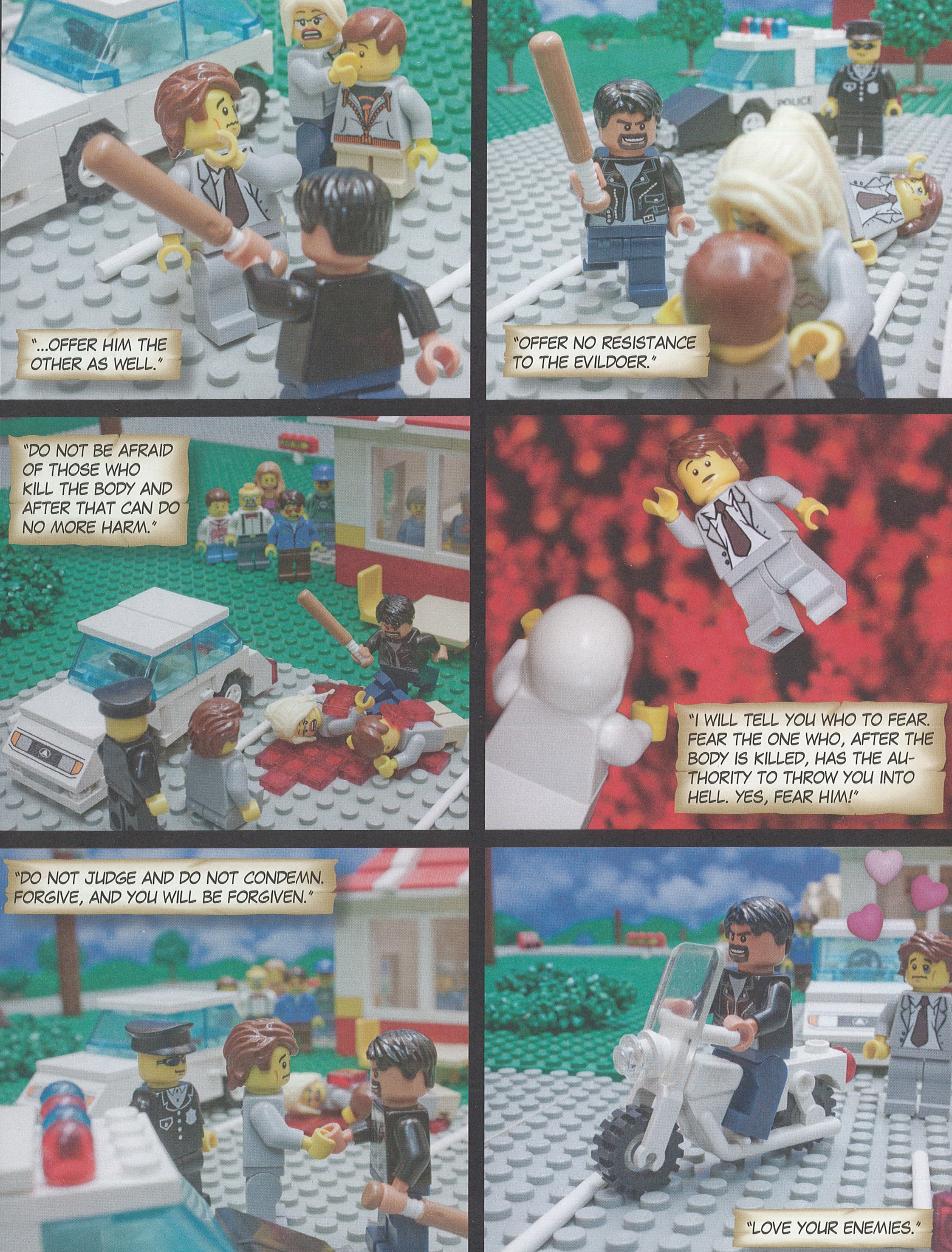
The teaching, ‘Do not resist an evildoer … Love your enemies and pray for those who persecute you,’ can be misinterpreted, and I want to show you one of the funniest misinterpretations I have come across. This is from The Brick Testament by Brendan Powell Smith[1] and shows the Sermon on the Mount in Lego bricks. A Lego criminal, in a black jacket, presumably leather, and with a frowning bearded face, attacks a mild-mannered Lego minifig in a grey suit. He not only hits the suited minifig, he kills the suited minifig’s minifig wife and minifig son. The mild-mannered minifig forgives the criminal, invites him home for cake, helps him steal his possessions, and gives him the key to his red Lego sports car. That does illustrate what Jesus is saying, but it is certainly not what Jesus meant. Some misinterpretations are less amusing. For a couple of days this week, I attended a conference on Gendered Violence held by The Wesley Centre, so I want to make it clear that these antitheses do not mean that the Christian response to family violence is to forgive the attacker, endure the suffering, and pray harder.
Jesus was living in a land under Roman occupation, where Roman soldiers had the right to press civilians into service, as Simon of Cyrene is made to carry Jesus’ cross. One thing Jesus is doing here is telling his followers how to respond to their Roman overlords, rather than encouraging them to help thieves. As one commentator I read this week says, ‘Scripture holds up well when read by powerless people under the thumb of an empire as mighty as Rome’s.’[2] Jesus is telling his followers not to respond to fire with fire, but to respond to fire with water.
These teachings are the basis of the non-violent civil resistance that has won so many campaigns. The peace-making organisation Pace e Bene, whose name means Peace and All Good in Latin, was created in 1989 by Franciscan Friars to work for peace. It describes three common ways of resisting violence. The first way is to avoid violence: to decide that it is not our problem; to leave it up to the police or the military; to simply deny that violence is happening. The second way is to make an accommodation with violence: to accept that it exists but decide that violence is just the way it is, or that it is not so bad, or that there is nothing we can do about it. The third way is to meet violence with violence: with physical violence; with violent rhetoric; by wielding financial or political power.
Pace e Bene suggests another way, responding to violence with active non-violence. This fourth way says to the evil doer: ‘We will not co-operate with your violence and injustice; we will resist it with everything we are.’ It simultaneously says to that evildoer, ‘But we will never forget that you are a human being, and we are open to you as a fellow human being.’ As I was taught when taking part in training for active non-violence, we hold one hand up to say ‘Stop’ and one hand out to say, ‘We are part of one another.’
Political scientists Erica Chenoweth and Maria J. Stephens claim that this sort of civil resistance, non-violent conflict, succeeds more often than violent conflict. They argue that nonviolent campaigns attract more participants than violent insurgencies, and that it is ultimately the sheer number of participants that determines whether the regimes being resisted keep control.[3] As Pace e Bene says, civil resistance is active, not passive; its tactics include protest marches, boycotts, education campaigns, strikes, non-cooperation, and sit-ins. Often, authorities will respond to nonviolent resistance with state violence, and if those resisting refuse to meet violence with violence, instead turning the other cheek or going the extra mile, then their moral authority can increase their numbers. Chenoweth and Stephens have done a statistical analysis and argue that nonviolent resistance is more successful than violent resistance regardless of the regime type, although violent repression can reduce the success rate of both violent and nonviolent resistance.
Because Christians are committed to God’s justice, we have often been involved in campaigns of civil resistance. These campaigns always begin with small numbers, with most people wishing that the troublesome minority engaged in marches, boycotts, strikes, and sit-ins would stop disturbing them. Politicians who praise the outcomes of previous campaigns, and even erect monuments to them, tend not to support campaigns aimed at their own governments. Most people do not want to believe that their police force or security service can be violent without cause; it is too frightening to believe that those with the monopoly on violence might misuse their power. So, we see people justifying acts of state violence against others, arguing that those others brought the violence upon themselves. We have recently seen this very clearly in the USA, where half the country can watch the shootings of Renee Good and Alex Pretti, filmed from multiple angles, and argue that Good and Pretti provoked the violence. But eventually, the disruption is too much, the lies of the powerful are exposed, and the minority becomes a majority: voting rights and equal pay are won; East Timor becomes a nation; apartheid ends in South Africa.
We know a campaign has truly succeeded when those who had nothing to do with it, and even those who condemned it, pretend that they were on the right side all along. The campaign against apartheid in South Africa is a perfect example. Few people nowadays will boast that they opposed boycotts of all-white sporting teams, but, at the time, most people condemned those annoying, unwashed professional protesters interfering with the God-given right of Australians to watch a good game of rugby. A Uniting Church leader once talked to me about being at the ecumenical service at Sydney’s St Mary’s Cathedral in 1990, when Nelson Mandela visited Sydney after being released, and seeing the heads of churches that had accused the Uniting Church of communism for supporting the ANC pretending that they had been on Mandela’s side all along. The leader was amused. If you have been involved in a campaign of civil resistance that has succeeded, do not expect those who opposed you to admit that they were wrong.
Jesus ends this section of the Sermon on the Mount with the command: ‘Be perfect, therefore, as your heavenly Father is perfect.’ The Greek word teleios does mean perfect, but it also means complete, whole, mature. ‘Perfect’ people are complete and whole people, people who demonstrate integrity and maturity. This is who we are called to be: complete, whole, and mature. In the Sermon on the Mount, Jesus commands us to live as God’s beloved children, loving as the God who ‘makes his sun rise on the evil and on the good, and sends rain on the righteous and on the unrighteous’ loves. God’s love is like a flooding rain. It turns things upside down. It challenges the plans we make for our lives. It destroys things we value and think are important. It can take us out to the streets. Can we really love as God loves? Can we really be perfect, as God is perfect? Not, of course, by ourselves. As John Wesley wrote: ‘God knew well how ready our unbelief would be to cry out, This is impossible! And therefore stakes upon it all the power, truth, and faithfulness of God, to whom all things are possible.’[4]
[1] Brendan Powell Smith, The Brick Bible: The New Testament, a new spin on the story of Jesus (New York: Skyhorse Publishing, 2012).
[2] Jason Ryassee in Feasting on the Word, Year A, Volume 1 (Louisville: Westminster John Knox Press, 2010), p. 384.
[3] Erica Chenoweth and Maria J. Stephen, Why Civil Resistance Works: The Strategic Logic of Nonviolent Conflict (New York: Columbia University Press, 2011)
[4] John Wesley, Explanatory Notes on the New Testament.

 Rev Doc Geek
Pingback: Sermon: Lead us not into the temptation of violence | Rev Doc Geek