Reflection for North Balwyn Uniting Church
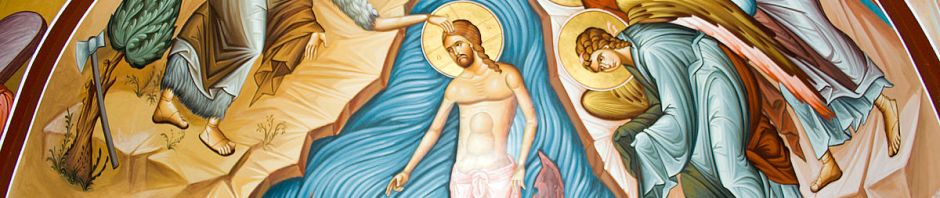
The Baptism of Jesus, 11 January 2026
Isaiah 42:1-9
Matthew 3:13-17
A decade ago, I was lucky enough to visit the Holy Land, and one Sunday I attended worship at Christmas Lutheran Church in Bethlehem, a church established in 1854 by German missionaries. I was a little surprised and disappointed by its stained-glass windows, which show Jesus with pale skin. The windows were made in Germany and shipped from Europe with the church’s organ, altar, and bells, before they were carried to Bethlehem by donkey, and so, in the very place of Jesus’ birth, they portray a European Jesus, not the Palestinian Jew who was Jesus of Nazareth.
But as I have thought further about the incarnation, I have realised that there is a good theological reason for Europeans to picture a European Jesus. The Nativity stories tell us that God chose to enter the world through an unmarried teenage mother, born into a Palestinian family in a land under occupation, placed in a manger and greeted by lowly shepherds, according to Luke; or recognised only by Gentiles and forced to flee for asylum to a foreign country, according to Matthew. All of that is important. But even more important than these details of the incarnation is the simple fact of the incarnation. In Jesus, God became one of us. In Jesus, God embraced humanity – all humanity. In the Holy Land, I also visited the Church of the Annunciation in Nazareth, which features images of Mary and the baby Jesus from all around the world. Each image depicts Mary and Jesus in the style of their nation of origin, as Christians from around the world recognise that Mary and Jesus are members of our own family.
This explains the event we are celebrating this morning: the baptism of Jesus. In Advent, we hear the beginning of today’s story, with John coming as the Prophet Isaiah had foretold, ‘proclaiming a baptism of repentance for the forgiveness of sins’. Sin is separation from God. Repentance is turning around, returning to God, behaving like the prodigal son and going home to the Father who runs to meet us. Since Jesus, Emmanuel, God-with-us, lived his life in full relationship with God, he has no sins to be forgiven and so no need for a baptism of repentance. So, why does Jesus seek baptism from John? This is a question that obviously worried Matthew, because in his version of the gospel we hear a dialogue between Jesus and John on the subject. John points out that things are happening the wrong way round; that it is he, John, who should be baptised by Jesus. Jesus answers: ‘Let it be so for now; for it is proper for us in this way to fulfil all righteousness’.
Righteousness means doing what God wants. When John baptises Jesus, both are doing what God wants. Why does God want Jesus to be baptised? The answer is, as I have said on this Sunday in previous years, that Jesus, God-with-us, is acting out the solidarity with humanity that we see in the incarnation. In Jesus, God has become one of us, one with us, all of us, as we see in the pictures in the Church of the Annunciation in Nazareth. In baptism, Jesus demonstrates that he truly is one of us, by submitting to John, plunging into the waters of the Jordan, modelling for us our own baptism. We other humans do need everything that baptism means; we do need to go through the waters, to die to our old lives, to be reborn to new lives, to repent and return to God. Now, when we do this, we do it in imitation of Jesus who did it before us.
In response to Jesus’ baptism, to his righteous action, to his willingness to submit in humility to John the Baptiser, the heavens open and the barriers between God and humanity are withdrawn. The Spirit descends upon Jesus and the voice from heaven says, ‘This is my Son, the Beloved, with whom I am well pleased’. Jesus’ identity is confirmed in words from the Hebrew Scriptures.
A mistake we twenty-first-century Christians commonly make is to think of Judaism and Christianity as sequential, with Judaism coming first and Christianity born from it. In fact, both Judaism as it exists today and Christianity developed out of Second Temple Judaism and particularly out of the trauma that occurred in 70 AD when the Romans destroyed the Temple in Jerusalem. Without the Temple, sacrifices could no longer be made, priests no longer had any political power, and a great deal of the Hebrew Scriptures, all the instructions about how and when sacrifices were to be made and the purity required of the priests who made them, apparently no longer applied. How could God’s people continue to worship God?
Two groups successfully created post-Temple religions. The first replaced the Temple with the study of the Torah, made the Temple-based purity laws relevant to the home, and turned all Israel into a ‘kingdom of priests and a holy nation.’ In the gospel according to Matthew, the leaders of this group are referred to as the ‘scribes and Pharisees’, and the reason that the gospel according to Matthew repeatedly attacks them is that the other group that successfully created a post-Temple religion was made up of the followers of Jesus for whom the gospels were written. If we do not see Jesus’ conflict with the scribes and Pharisees as an intra-Jewish conflict, we will read the Gospel according to Matthew antisemitically.
The post-Temple religion created by the Jewish followers of Jesus was an inclusive Israel gathered from all the nations of the world, following Jesus’ command: ‘All authority in heaven and on earth has been given to me. Go therefore and make disciples of all nations, baptising them in the name of the Father and of the Son and of the Holy Spirit and teaching them to obey everything that I have commanded you.’ (Matthew 28:18-20) Its universalism can already be seen in the words heard at Jesus’ baptism. The voice from the heavens quotes from the Hebrew Scriptures. ‘This is my Son’ comes from one of the royal psalms, in which the Lord tells Israel’s king, ‘You are my son; today I have begotten you’. In the psalm, the Lord then says, ‘Ask of me, and I will make the nations your heritage and the ends of the earth your possession. You shall break them with a rod of iron and dash them in pieces like a potter’s vessel’. (Psalm 2:7-9) To make it clear that God is not calling Jesus to break the nations, the last part of the voice’s words, ‘with whom I am well pleased,’ comes from the first of the ‘Suffering Servant’ songs of Second Isaiah, today’s reading from the Hebrew Scriptures, where we hear it as ‘in whom my soul delights.’ The use of this quote reveals Jesus to be the one chosen by God to bring forth universal justice, not by dashing the nations to pieces like a potter’s vessel, but with astounding gentleness: ‘He will not cry or lift up his voice, or make it heard in the street; a bruised reed he will not break, and a dimly burning wick he will not quench.’
By quoting Second Isaiah’s description of the one who has been given as ‘a light to the nations,’ the author of the gospel according to Matthew is arguing that God has always intended the nations, those beyond Israel, to receive justice: sight for the blind and freedom for the prisoners and those who sit in darkness. Later in the Gospel, when Jesus is in conflict with the Pharisees, Matthew will quote more of this Song, making it clear that Jesus’ mission is to ‘proclaim justice to the Gentiles’ and that ‘in his name the Gentiles will hope.’ (Matthew 12:18-21) And so in the Church of the Annunciation, Gentile Christians from all around the world portray Jesus and his mother as our own kin. Through Jesus, we have been welcomed into God’s family.
We are recipients of the gift of an inclusive Israel. We exist as a Christian community, worshipping the God described in the Hebrew Scriptures, the One who created the heavens and stretched them out, who spread out the earth and what comes from it, who gives breath to the people upon it and spirit to those who walk in it, because a small group of Jews invited Gentiles to join them in walking the way of Jesus. Because we have been so welcomed, God calls us, who have been baptised with water as John baptised Jesus, to imitate Jesus in the breadth of our welcome of others. Invited by God to walk the way of Jesus, we are to do our part in bringing forth God’s justice for the entire world. And God commands that we do this with the astounding gentleness of the Servant. Especially in our relationship with people of other faiths, we Gentile Christians, welcomed into God’s people by Jewish Christians, must not break bruised reeds or quench dimly burning wicks. May our servanthood contribute to peace between those of different faiths in this deeply conflicted world.

 Rev Doc Geek
‘We are recipients of the gift of an inclusive Israel.’ Thank you!
Pingback: Sermon: When warnings from history are being ignored | Rev Doc Geek
Pingback: Sermon: Calling and character | Rev Doc Geek