Reflection for North Balwyn Uniting Church
Christmas Day 2025
Luke 2:1-20
A few weeks ago, I was at a service of Lessons and Carols where I heard a new Christmas Song. This does not often happen to me, at least not in churches, but the choir sang the 2025 hymn ‘This child shall be our peace’ by Eileen Berry and Molly James, which is based on Micah 5:2-5a. It contains the lines: ‘He stills our raging anger, He heals our hopeless grief/He calms our frantic worry, He helps our unbelief/Beneath His righteous sceptre He makes all wars to cease/Come bow the knee before him. This child shall be our peace.’ I found this so moving that I almost wept. This is the Jesus I worship; the one whose birth I celebrate at Christmas; the one who stills our raging anger and heals our hopeless grief.
But because I can only be emotional for about 30 seconds before my analytical brain switches back on, I almost immediately found myself thinking, Hmm. Does Jesus’ righteous sceptre make all wars cease? Has no Christian nation ever invaded another? What about the Crusades? A millennium after the birth of Jesus, European Christians decided that because their faith began in the Holy Land, they should rule the Holy Land. So began several centuries of war as European Christians tried to conquer the lands around Jerusalem. What about the various European Empires’ use of Christianity to justify colonisation? Dear Desmond Tutu once said, ‘When the missionaries came to Africa, they had the Bible, and we had the land. They said, “Let us pray.” We closed our eyes. When we opened them, we had the Bible, and they had the land.’
I love the idea that Jesus is our peace, but through the centuries too many Christians seem to have forgotten that at his trial Jesus told the Roman Governor, ‘My kingdom does not belong to this world. If my kingdom belonged to this world, my followers would be fighting to keep me from being handed over … But as it is, my kingdom is not from here.’ (John 18:36)
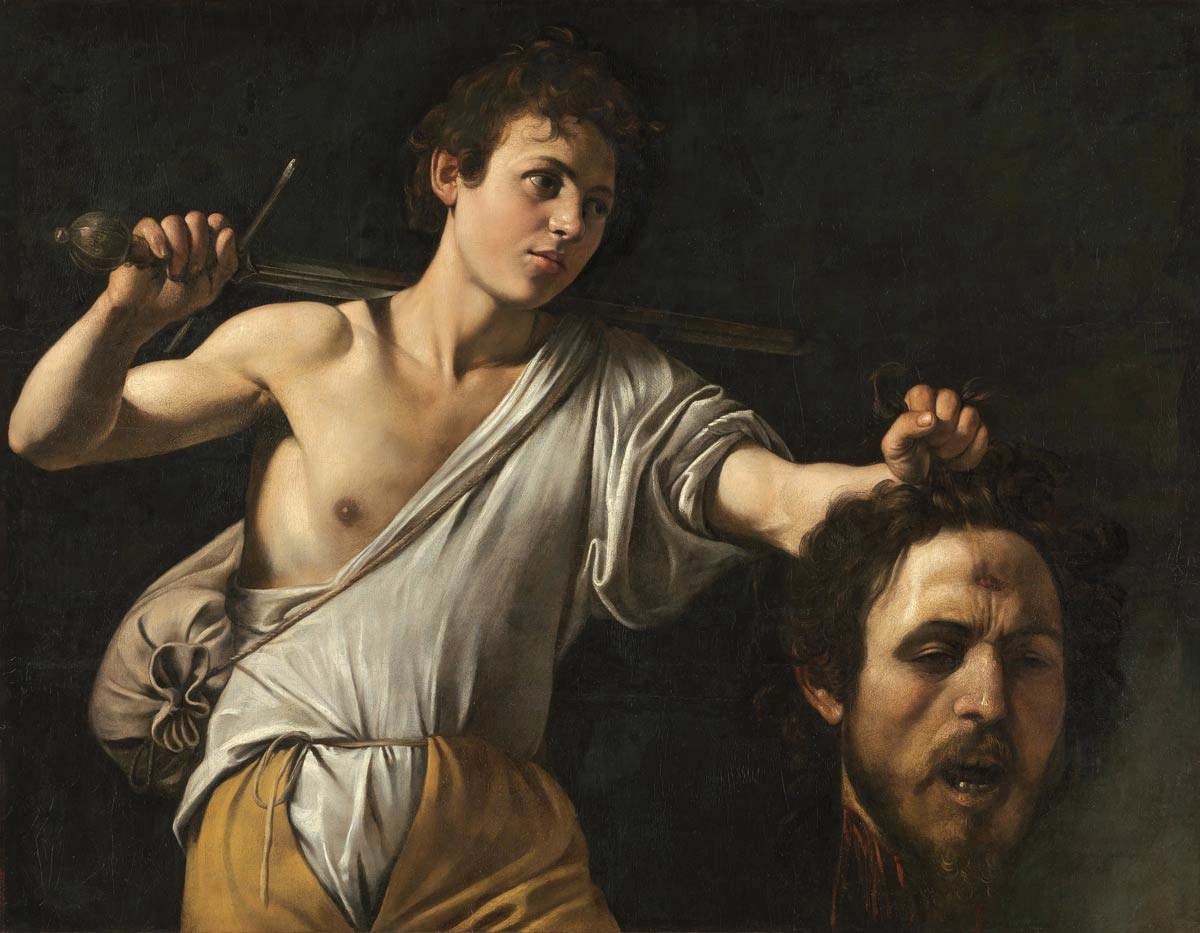
From the moment of his birth, from the stories we retell at Christmas, we see that Jesus is a new kind of king with a kingdom unlike those of the world. Jesus, through his adoption by Joseph, is descended from the house and family of David, but he is in many ways the anti-David. David is a warrior king; even as a boy, he is already killing and beheading his enemies (1 Samuel 17), and his followers sang of him that he had killed his ten thousands. (1 Samuel 18:7) In contrast, when Jesus was being arrested, one of his followers cut off the ear of the slave of the high priest, and Jesus said, ‘Put your sword back into its place, for all who take the sword will die by the sword.’ (Matthew 26:51) Jesus is born in the city of David called Bethlehem, but he will be nothing like David. And so, the first time we see Jesus, we see him as the most vulnerable and fragile of human beings, a child wrapped in bands of cloth and lying in a manger.

You may have noticed, and been surprised, that the Scripture translation read today said that there was no place for the Holy Family in the guest room. The idea that Mary and Joseph were turned away from an inn, that there was no place for God when God entered the world, that Jesus was born in a ‘lowly cattle shed’ among ‘the poor, despised and lowly,’ is a wonderful rhetorical flourish. Numerous campaigns for refugees and the homeless have used the line ‘no room at the inn’. But it is unfair to the people of Bethlehem. When I visited the City of Peace, a Christian there showed me the sort of home in which Mary and Joseph would have been lodged: a house with three levels. The bottom level was for the animals, the middle for the family, and the top for guests. If the family had to make room for Mary and Joseph in the bottom level, it would only be because the guest room was full, and Mary and Joseph would still have been in the family home. No grumpy innkeeper was sending them round the back to a shed; then, as they do now, the people of Bethlehem would have made room for strangers.
That, of course, is what Christmas calls us to do. We, too, are to make room for Jesus in our lives and in our hearts. We do this not only by celebrating his birth but by following his teachings. The Apostle Matthew tells us that those who do not identify as Christians make room for Jesus in their hearts by feeding the hungry, giving the thirsty something to drink, welcoming the stranger, clothing the naked and visiting the sick and those in prison. Many of the people I grew up with, those with whom I attended church youth camps, do these things today without ever darkening a church door, and I am certain that Jesus welcomes them into his kingdom. (Matthew 25:31-46) But for those of us who do claim to be Christian, making room for Jesus as the people of Bethlehem made room for him demands more.
If we truly want to follow Jesus, then we need to take seriously the commands of the Sermon on the Mount (Matthew 5-7) and the Sermon on the Plain (Luke 6:17-49) As Jesus tells his disciples, ‘Not everyone who says to me, “Lord, Lord,” will enter the kingdom of heaven, but only the one who does the will of my Father in heaven.’ I would say that the Crusaders who went into battle crying ‘Deus vult,’ ‘God wills it,’ were among those who historically have said ‘Lord, Lord’ but have not done the will of Jesus’ Father. I would say that, if Jesus had not also said, ‘Do not judge, so that you may not be judged.’ (Matthew 7:1) So, rather than talking about the Crusaders, I will talk about us.
If we wish Jesus to be born in our hearts, we need to at least be willing to love our enemies and pray for those who persecute us. Jesus was born at a time when Herod ruled as Rome’s puppet, and yet he taught, ‘You have heard that it was said, “An eye for an eye and a tooth for a tooth.” But I say to you: Do not resist an evildoer. But if anyone strikes you on the right cheek, turn the other also.’ (Matthew 5:38-39) Jesus grew up under Roman occupation, a time when Roman soldiers could press civilians into service, and yet he told his followers, ‘If anyone forces you to go one mile, go also the second mile’. (Matthew 5:42) The majority community rejected Jesus and his followers, and yet Jesus taught his disciples to pray, ‘And forgive us our debts, as we also have forgiven our debtors.’ (Matthew 6:9)
We still pray a version of that today, ‘Forgive us our sins, as we forgive those who sin against us’, and that is not meant to be mere lip-service. I remember the story I heard of a Christian couple whose child was murdered in the World Trade Center on 9/11, who did not go to church on the Sunday immediately afterwards, because they were not yet ready to be reminded of the imperative to forgive. But they knew that one day they would have to ask God for the grace to forgive their child’s murderers, because that is what it means to follow Jesus. I am deeply grateful that I have not been tested in that way, and that the most I have had to forgive someone is them driving through a stop sign and destroying my car.
Loving our enemies, praying for those who persecute us, forgiving those who sin against us, sounds almost superhuman. It is certainly counter-cultural: many people today seem to think that hating their enemies is a virtue. It is not something that most of us can do in our own strength; it is something we can only do through God’s grace. But if we do it, if we respond to evil with good and to hatred with love, then the words that so moved me this year will be true: ‘He stills our raging anger, He heals our hopeless grief/He calms our frantic worry, He helps our unbelief/Beneath His righteous scepter He makes all wars to cease/Come bow the knee before him. This child shall be our peace.’ Amen.

 Rev Doc Geek