Reflection for North Balwyn Uniting Church
24th of December, 2023
Luke 1:26-38
Luke 1:46-55
It may have become apparent to those who regularly attend services here at North Balwyn Uniting Church that I have an inordinate number of picture books. These tell stories of everything from two boy penguins who adopt an egg and raise a chick to a pigeon who wants to drive a bus and, should you ask, I can explain the excellent theological points made by all my books. So it will not surprise you that I have many, many picture books telling the story of the birth of Jesus. This week I looked through that extensive collection for pictures of Mary visiting her pregnant cousin Elizabeth and was shocked to discover that not a single one of my Christmas books illustrates this important event. Elizabeth is hardly even mentioned, although her late-in-life pregnancy is the sign the Angel Gabriel gives Mary to prove that nothing is impossible with God. The greeting between Elizabeth and Mary, when John the Baptizer leapt in Elizabeth’s womb, is certainly never illustrated. The closest I could come to the two women encountering each other was on two separate pages of a book called Voices of Christmas, and even then their stories were separated by the story of Joseph. Apparently in the version of the Nativity that we tell children the encounter between Elizabeth and Mary is of little importance.


To the author of the Gospel according to Luke, on the other hand, Elizabeth, Mary, and John’s greeting of Jesus when both were still in the womb, were of such importance that he started the gospel with their story. The gospel is addressed to an educated Gentile official, the ‘most excellent Theophilus,’ and locates Jesus’ Nativity in what could be called ‘official’ time, the time used by rulers and priests: ‘In the days of King Herod of Judea, there was a priest named Zechariah, who belonged to the priestly order of Abijah.’ (Luke 1:1-5) But almost immediately all this officialdom is overturned. Zechariah is serving as priest before God, and has been chosen to enter the sanctuary of the Lord and offer incense, when an angel appears and tells him that he and his wife Elizabeth will have a child despite their old age. Zechariah the priest does not believe the angel’s words and so is made mute. When he leaves the temple he returns to his wife, she conceives, and ‘for five months she remained in seclusion’. (Luke 1:24) When today’s gospel reading starts, ‘In the sixth month the angel Gabriel was sent by God to a town in Galilee called Nazareth …’ the sixth month is how far Elizabeth is through her pregnancy. We are no longer in ‘the days of King Herod of Judea’. We are in the months during which women who are astonishingly pregnant carry children. We are now in messianic time.
The lectionary gives us only have a short snippet of story today. Mary is told by the angel Gabriel that she is to bear the Son of the Most High and in response she sings a song of astounding prophecy. In between, in the part of the story that we don’t hear this year, Mary goes to visit Elizabeth. As I said earlier, Elizabeth’s pregnancy is the sign the angel offers Mary to prove that what he is saying is true, and when Mary enters Elizabeth’s house and greets her, John the Baptizer leaps in Elizabeth’s womb, and Elizabeth welcomes Mary with words inspired by the Holy Spirit. I am so disappointed that none of my picture books illustrate this scene. Elizabeth, filled with the Holy Spirit, is showing amazing prophetic insight. Mary simply greets her, and Elizabeth already knows that Mary is pregnant, chosen by God, and that Mary’s child will be even greater than her own astonishing son. At the beginning of his second book Luke writes about the Holy Spirit filling the disciples, who are then able to speak in other languages. (Acts 2:1-4) What is happening to Elizabeth here is a foreshadowing of Pentecost.
After Elizabeth greets her, Mary sings, the song that we know as the Magnificat. While I was disappointed at the sparse portrayal of Elizabeth in my picture books, I am even more disappointed by their portrayal of a meek and demure Mary. The Mary who sings the Magnificat is not demure. She is a revolutionary!
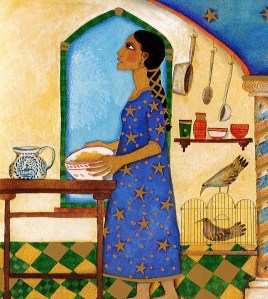
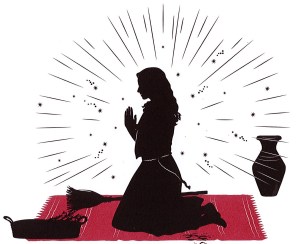

Mary of the Magnificat is the founder of all Christian theology. In the gospel according to Luke, Jesus begins his ministry with ‘the Nazareth manifesto’ – words he reads from the scroll of the Prophet Isaiah in his local synagogue. (Luke 4:16-22) Jesus starts his mission saying that he has been anointed to bring good news to the poor, and so we know that everything he subsequently says and does must be read through this lens. Because of the Nazareth Manifesto we also know that if the church today is not preaching and demonstrating release to the captives, recovery of sight to the blind, freedom for the oppressed, then its proclamation is not ‘gospel’, is not good news. But decades before Jesus spoke in the synagogue Mary had already provided the key to what God is doing in messianic time: overturning the status quo; destroying the old so that the new can come.
The Magnificat is prophecy. In it Mary sings of things already done: God had scattered the proud, brought down the powerful, lifted up the lowly, filled up the hungry, and sent the rich away empty. In her song, modelled on the song of Hannah, the mother of Samuel (1 Samuel 2:1-10) Mary says that God has ‘helped his servant Israel, in remembrance of his mercy, according to the promise he made to our ancestors, to Abraham and to his descendants for ever.’ Yet Mary is singing in a country under Roman occupation. The proud and powerful are still very much in control. And the author of the gospel in which the Magnificat is recorded knows that the Jewish rebellion against Rome had resulted in utter defeat and the destruction of Jerusalem, including the Temple in which Zechariah had served. Mary singing the Magnificat in these circumstances is as bizarre as it would be for a Palestinian Christian sheltering from the IDF in the Holy Family Church, Gaza, to sing it this Christmas.
Yet this is what Mary sings. She is so certain, so open to the coming justice of God, that she can sing about it as though it had already happened. Mary has recognised what prophets and saints and martyrs have demonstrated throughout the ages: the powers of injustice might seem to be strong, but the power of God is always stronger. Mary can see that in Jesus’ birth, as in Jesus’ death and resurrection, God is defeating death and hopelessness. Mary sings, ‘The Mighty One has done great things for me’ and in the great things that God has done for Mary, we see the great things that God had done, is doing, and will continue to do for the entire world.
Mary’s song sings of the overturning of the power structures of this world, and the encounter between Elizabeth and Mary shows us an example of that overturning in action. The lowly, the barren, and the young, women, peasants, have been lifted up, while the well-born priest Zechariah has been left mute until Elizabeth names their son. (Luke 1:57-66) What God has done for Elizabeth and Mary anticipates what God is going to do for all the lowly, the hungry, the poor and the powerless. Mary’s song assures us that this will happen, because it has already happened to her. As the angel Gabriel tells Mary, ‘nothing will be impossible with God’.
This is normally where I would end a Reflection on the Annunciation and the Magnificat, looking forward with hope to the overturning of the world about which Mary sings. I cannot do that this year. This year the Magnificat’s reversals worry me. Mary sings that God has scattered the proud in the thoughts of their hearts; has brought down the powerful from their thrones; has sent the rich away empty, and while if you are lowly and hungry such reversals seem like an excellent thing we are currently seeing how dangerous mere reversal can be.
I recently listened to an interview that Canadian Jewish professor and author Naomi Klein gave, in which she described the form of Zionism currently dominant in Israel as creating, after centuries of Christian antisemitism, ‘a fortress state that enables Jews to put a gun to the heads of anti-Semites’. Klein says that the extreme Israeli response to the unquestionably horrific Hamas attacks on October 7 is an attempt to re-establish this idea of the fortress; the idea that it is possible for Israel to have security without a peace process with the Palestinians. And Klein says that when she eavesdrops on Zionist members of her family their justification for Israeli war crimes is that if they lift the boot from the neck of Palestinians, Palestinians will ethnically cleanse Israelis as Israelis are currently ethnically cleansing them. It does not help when Hamas leaders tell the media that that is exactly what they intend to do. As Klein puts it, “It does not get to be Hamas’ turn to ethnically-cleanse the Jews; that is not the vision of justice”. Both Israel’s Likud government and the Hamas leadership seem to want a situation in which the people who have been oppressed can become the oppressors. We know that this is not justice, but the Magnificat comes uncomfortably close to such a vision.
When the simple reversals of the Magnificat trouble me I need to remind myself that the God whom Mary praises for showing strength with his arm entered history as a vulnerable baby. I must remember that when Jesus defeated all the powers of darkness and death he did it by dying on the cross. Down the ages Christians have tried to bring out God’s kingdom on earth through violence and military means, but that is not the way that God’s kingdom will come. Tomorrow we will celebrate Christmas and give thanks to God that with the birth of Jesus we see the beginning of the new world of justice to which Mary looks forward in her song. But as our souls magnify the Lord and our spirits to rejoice in God our Saviour we need to remember that the mystery of the only wise God is that God came to earth in vulnerability, and won victory through defeat.
Remembering this, we can join Mary in singing with hope, trusting in God’s justice and love, and sharing God’s peace, joy, and love with the world. Amen.

 Rev Doc Geek
Thank you Avril. Troubled times 2000 years apart, where the pursuit of power with violence have achieved not much at all.
Peace
Iris
Pingback: The Magnificat and Micah: Love Through Justice | Rev Doc Geek