Reflection for North Balwyn Uniting Church
The Sixth Sunday after Pentecost, 9th of July 2023
Romans 7:15-25a
Matthew 11:16-19, 25-30
Sometimes I read the writings of the Apostle Paul and all I can say in response to them is: ‘Yes!’ Sometimes Paul just gets it – and today is one of those days. When Paul writes: ‘I do not understand my own actions. For I do not do what I want, but I do the very thing I hate,’ and ‘For I do not do the good I want, but the evil I do not want is what I do,’ all I can do is nod my head in sad agreement. Paul is right. And he was not alone in saying this. In this part of his letter to the Romans Paul is echoing something that was a commonplace in the ancient world. The Roman poet Ovid wrote the most famous version of it: ‘I see the better way and I approve it; but I follow the worse.’ It is just part of what it means to be human. We know what we should do; but we do not do it. We want to be good and obey God’s law, but we find that we fail. It is a universal problem.
It is almost impossible not to wonder whether in writing this Paul was talking about himself. The ‘I’ is strong in this reading: ‘I do not understand my own actions … I do not do what I want … I do the very thing I hate … I do what I do not want … I know that nothing good dwells within me … I can will what is right, but I cannot do it … I do not do the good I want, but the evil I do not want is what I do’. It sounds as though it must be autobiographical, and so people down the centuries have wondered what sin it was to which Paul was prone. But we know that in his other letters Paul claimed that ‘as to righteousness under the law, [he was] blameless’. (Philippians 3:6) Paul the individual sinner is not writing about his own sinfulness; we are hearing from Paul the human being among other human beings, Paul the representative of all fallen humanity. Paul is not giving us a piece of his own autobiography; instead, he is trying to convey to us in the strongest way possible how impossible it is for anyone to live a good life under the law.
It is impossible for any of us to live a good life under the law because of sin. For Paul Sin with a capital ‘S’ is the force that opposes God. The world is not in the state of glory for which God created it because of Sin. When Paul talks about the ‘sin that dwells within me’ he is reminding us that we are all part of a world that is not the way it should be. Whenever we talk about bad things happening to good people we recognise that the world is not now as it was when the Creator looked at it and saw that it was good. When we see the devastation caused by floods and cyclones and earthquakes and tsunamis we know that something is not right. When people die untimely deaths we see that something has gone wrong. When children starve while billionaires shoot rockets into space we are certain that humanity, like sheep, has gone astray. When those made in the image of God reject each other on the basis of race and sex and sexuality and nationality and class we see that God’s image in us has been defaced. This is what it means for us to live in a state of Sin; we are living in a world that is not the way God made it, nor the way God wishes it to be. Sin with a capital ‘S’ is challenging God.
This does not mean that our individual sins do not contribute to this state of Sin. Paul is not trying to suggest that because the problem is Sin with a capital ‘S’ that we are somehow innocent – that it is ‘Sin’ that does the bad stuff and not us. Yes, racism and sexism and homophobia are all structural sins, but individuals still benefit from those structures. There is still an ‘I’ that chooses to go along with the structures that benefit us. But Paul is saying that by ourselves and in our own strength we have no choice; we are trapped. There are two forces in our lives, in conflict with each other: the law of God, seen in the law given to Moses, and the ‘other law’, the ‘law of Sin’. We cannot defeat the ‘law of Sin’ by ourselves, by simply trying to follow the law of God.
Paul argues that it is impossible for us to try to change our moral failings by ourselves. It is no use trying to fix ourselves by attempting to live up to an external code, by trying to obey the law of God when the law of Sin is within us. In that case, the law just adds to the problem, because it tempts us into believing that we can go it alone, that we can fix ourselves through our own energy and strength. We try to live good lives simply through willpower, and when we fail the law adds self-condemnation and self-hatred to our sins. Frustratingly, to believe that our sins are so many and so weighty that God cannot possibly forgive us is in itself a sin. Alternatively, when we do manage to live up to God’s good commands, we think that we have succeeded on our own terms and in our own strength and fall into the sin of pride. We cannot win!
Paul is being completely counter cultural. By talking about us as ‘captive to the law of sin’ he offends against our sense of ourselves as free and autonomous human beings. By suggesting that there is some evil power in creation he offends against our idea of a rational universe. By talking about a divided self unable to do the good it wants to do he offends against our belief in self-determination. Paul is telling us that we cannot save ourselves and in our therapeutic, self-help, society that is blasphemy.
Paul’s message initially sounds incredibly depressing. He tells us that if, in our ethical struggles, we try to go it alone we will fail. We will not do the good we want, but the evil we do not want is what we will do. It does not matter how hard we try to obey God’s good law. We will fail. If that were where Paul’s message ended it would be bad news. But Paul is sharing the gospel, and gospel literally means ‘good news’. The good news is that we have not been left alone, working desperately to obey God’s law by ourselves. We do not need to force ourselves to be good by obeying commandments, not even the otherwise good commandments of the Law of Moses. ‘Who will rescue me from this body of death?’ Paul asks. And he answers himself: ‘Thanks be to God through Jesus Christ our Lord!’ One commentator on this passage writes: ‘When Paul could do nothing, God did everything for him, and all that was left for him to do was to give thanks’.[1]
Paul reminds us that Christianity is not about positive thinking. Jesus is not a life coach. We do not come to church because it will help us to have the self-control and willpower to be our best selves. We gather here to worship God. And in Jesus Christ God has intervened: to rescue us; to set the cosmos free from bondage; to defeat the powers of sin and death; to give us life in abundance. We are not Christians because our lives are perfect, and we are admirable people and examples to our neighbours. Frequently we are Christians exactly because our lives are a mess, and we know that we cannot fix ourselves. The good news is that we do not need to try to fix ourselves. God loves us, and in Jesus Christ God’s love has set us free from the sin that dwells within us and from the body of death. And if we give God the glory when we are able to do the good that we want to do, then we will also escape the temptation to pride and arrogance.
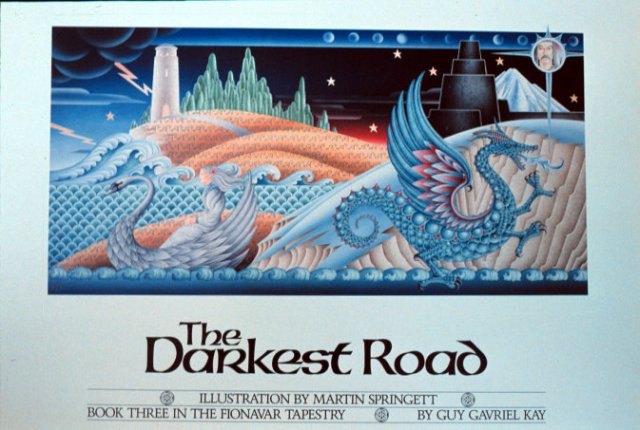
Before I finish I want to quote to you from one of my favourite fantasy novels, because I have found in fantasy one of the best descriptions of what Paul’s theological point feels like. It is from a book called The Darkest Road by Canadian author Guy Gavriel Kay, and it describes the moment after the evil power, Rakoth Maugrim the Unraveller, has been defeated by self-sacrifice and love:
Dave heard the last scream of Rakoth Maugrim, and then he heard the screaming stop. There was a moment of silence, of waiting, and then a great rumbling avalanche of sound rolled down upon them from far in the north. He knew what that was. They all did. There were tears of joy in his eyes, they were pouring down his face, he couldn’t stop them. He didn’t want to stop them. And suddenly it was easy. He felt as if a weight had been stripped away from him, a weight he hadn’t even know he was bearing – a burden he seemed to have carried from the moment he’d been born into time. He, and everyone else, cast forth into worlds that lay under the shadow of the Dark.[2]
In our world, Jesus defeated the Dark. And that means that our burdens have all been lifted. Jesus said: ‘Come to me, all you that are weary and are carrying heavy burdens, and I will give you rest. Take my yoke upon you, and learn from me; for I am gentle and humble in heart, and you will find rest for your souls. For my yoke is easy, and my burden is light.’ As Paul rejoices: ‘Thanks be to God through Jesus Christ our Lord!’ Amen.
[1] C. H. Dodd quoted in Feasting on the Word, p. 209.
[2] Guy Gavriel Kay, The Darkest Road (London: Unwin Paperbacks, 1986), p. 368.

 Rev Doc Geek
Pingback: Sermon: In which Avril confesses her besetting sin | Rev Doc Geek