Reflection for North Balwyn Uniting Church
2nd of July, 2023
Genesis 22:1-14
What on earth can we do with today’s reading from the Book of Genesis, the binding of Isaac? The Revised Common Lectionary, which leaves out other stories in Genesis like the rape of Dinah and the revenge taken by her brothers (Genesis 34:1-31), the attempt by the men of Sodom to rape two of God’s messengers (Genesis 19:1-11), and the incest between a drunken Lot and his two daughters that was the origin of the people of Moab and Ammon (Genesis 19:30-38), includes this passage of attempted child sacrifice for our instruction. The Bible has many stories that are distinctly unedifying, I am completely unsurprised that a parent tried to get it banned from a school in Utah as unsuitable for children, but the lectionary passes over most of them in silence, and we never hear them read out in church. Why is this story part of the lectionary? I would argue that child murder, even when prevented at the last minute, is at least as abhorrent as rape and incest. There is little on which I agree with celebrity atheist Richard Dawkins, but I do mostly agree with his comment in The God Delusion that: ‘this disgraceful story is an example simultaneously of child abuse, bullying in two asymmetrical power relationships, and the first recorded use of the Nuremberg defence: “I was only obeying orders”. Yet the legend is one of the great foundational myths of all three monotheistic religions.’ Where I differ from Dawkins is on the latter point. He suggests that Jews, Christians, and Muslims blithely read this story as foundational, thus accepting child abuse, bullying, and blind obedience as part of our faith. The absolute opposite is true.
The story of the binding of Isaac is part of the Hebrew Scriptures, and so Jewish scholars have spent even more time questioning it than Christians have. Most Jewish Midrash says that of course God never intended Isaac to be sacrificed, God had deliberately created the ram to be the substitute offering. But not all Jewish responses to this story are so exculpatory of God. A Yiddish folk tale asks: Why did God not send an angel to tell Abraham to sacrifice Isaac? God knew that no angel would take on such a task. Instead, the angels said to God, ‘If you want to command death, do it yourself.’ Yiddish folktales are full of pithy wisdom.
Christians believe that Abraham is our ancestor in the faith. For the Apostle Paul, Abraham was the supreme example of someone saved by faith, rather than by the Law. In his Letter to the Romans, Paul used the story of Abraham as an argument that it is faith that leads to right relationship with God, and not works. But the story Paul quoted in Romans is from earlier in Genesis, when the Lord promises the childless Abraham that he will be the ancestor of as many descendants as there are stars in the sky, and Abraham believes him. Paul makes no mention of Abraham’s later act of faith in God, binding his beloved son Isaac to the wood of the burnt offering. The only mention made of that story in the New Testament is in the Letter to the Hebrews, where the author says of Abraham: ‘He considered the fact that God is able even to raise someone from the dead—and figuratively speaking, he did receive him back.’ (Hebrews 11:19) The author of Hebrews, writing post-resurrection, seems to be explaining this story by saying that Abraham could also have been looking forward to resurrection. But that seems to me to be a very retroactive justification.
Are we meant to see in Abraham’s willingness to bind Isaac an act of faith as memorable and exemplary as his willingness to believe that he would have many descendants, despite being childless and elderly? Is this a story of the lengths to which faith in God is meant to take the faithful? Can we read it that way?
Abraham followed God in faith, both in leaving his home to journey to the country that God promised him and in believing that he would have descendants, despite all the circumstances that seem to make it impossible. But Abraham did not always trust God. Twice he lied about Sarah being his wife, claiming that instead, she was his sister, because, as he explained to her on one occasion: ‘I know well that you are a woman beautiful in appearance; and when the Egyptians see you, they will say, “This is his wife”; then they will kill me, but they will let you live. Say you are my sister, so that it may go well with me because of you, and that my life may be spared on your account.’ (Genesis 12:11-13) These are not the actions of someone who has complete faith in God. Maybe God does need to test Abraham, to be sure that He has made a covenant with the right human family. We read back into this story the belief that God knows everything, and so must have known what Abraham would do, but that is not the way this story tells it. It is told as a real test; God does not know beforehand how it will end.
This test is a harder one than the command to Abraham to leave his home or the promise that he will have a son. Three times Abraham’s previous possible heirs have been rejected. His nephew Lot has moved away (Genesis 13:12); God has rejected Abraham’s servant Eliezer as a possible heir (Genesis 15:2); and Abraham’s other son, Ishmael, has been lost to him (Genesis 21:8-19). Abraham is being asked to sacrifice the only heir he has left and the most beloved one, Isaac. It is easier to have faith when you are being offered a new beginning, a new land or a son. It is harder to have faith when you are being asked to give up all hope. And yet Abraham obeys God’s command in faith. Does Abraham believe that God will provide a substitute for Isaac? One commentator I read argues that Abraham trusts in God to save Isaac, that ‘God will find a way through this dark moment’. But most others agree that Abraham believes that he will have to kill Isaac.
Then, at the last minute, the reprieve happens. The angel of the Lord stops Abraham before the killing blow; Abraham has proved his faith. There, in the thicket, is a lamb; God has provided the sacrifice. Abraham acted with complete faith in God, and the God who demanded everything of Abraham up to and including his beloved son, provided Abraham with everything he needed. We could read this as a story about the depths to which faithfulness and righteousness can be pushed, and the suffering that can go with the struggle of faith. We could read it as a reminder that God will be God and that we owe God everything. We could read it as reassurance that even in our darkest hours God will provide. That would be one way of dealing with this story.
But I do not want to do that. I do not want to overcome the horror of this story to find a moral message for us about faith and providence. For Christians, the binding of Isaac foreshadows the story of the crucifixion and resurrection of the beloved son, the son of Abraham, the son of David, the Son of God. Maybe, seeing in this story the echo of the crucifixion, we are too ready to accept the possibility of a father sacrificing a son. I prefer a Jewish reading articulated by Rabbi Hyim Shafner, the Rabbi of Bais Abraham Congregation in St. Louis, Missouri, who, like me, cannot accept any of the usual analyses of this story. He writes:
I concluded that none of the apologetic paths were satisfactory and that the real test was for Abraham to confront God as he did at Sodom, thus teaching his children ‘righteousness and justice’ and ultimately to say ‘no’ to God. Perhaps, on some level in the narrative of the Akedah, Abraham failed the test. I would suggest this is why God never speaks to Abraham after commanding him to take Isaac as a burnt offering. In the end of the story an emissary angel speaks to Abraham – but where is God? Why doesn’t God just speak directly to Abraham? … Perhaps if we begin to see the Akedah as a test in which the right answer is to protect an innocent child rather than sacrifice him in obedience to God, our world might be a bit different, perhaps for the better.
Past-President of the Uniting Church, Andrew Dutney, has said there are four things we can do when the Bible seems to say something impossible. We can argue that the Bible is actually saying something else and that we miss the message if we read it literally. So, for instance, the message of the creation story in Genesis 1 is not that God created the world in seven days, no matter what Creationists might argue. Or we can say that that part of the Bible has been superseded by the gospel of Jesus Christ, as the Apostle Paul did over circumcision and dietary laws. Or, we can argue that new information or new insights mean that we must read that part of the Bible differently, as Jews and Christians have done over slavery. Or, finally, we can accept that the Bible means what it says and that we have to listen to it even if we do not want to, as we do when Jesus tells us to love our enemies, or to sell all we have and give the money to the poor.[1]
Can we take the first option? Is the Bible saying something else in this story? Are we missing the message if we read this as a test by God of Abraham’s faith that he passed? I am with Rabbi Hyim Shafner. Abraham failed the test by failing to show compassion to his son, by failing to argue back when God demanded Isaac’s death. The message of this story is not that our faith in God must be unquestioning, willing to sacrifice even those we love most when God seems to demand it. The message is that all our children are infinitely beloved and to be protected. How about the second option? We can also argue that the command that we show unthinking obedience to God, even when what God demands is appalling, has been superseded by the gospel of Jesus Christ. If we are to love God with our minds, as well as our hearts, souls, and strength (Mark 12:30), then we are never to simply obey orders. God gave us minds to use. The third option could also apply. We have received, over time, new information and new insights that show us that the patria potestas, the power of life and death a Roman father had over members of his household, was a bad thing. Fathers do not have the right to kill their children today, whatever might once have been the case. There are many arguments we can make that will stop us from reaching the fourth of Dutney’s options, accepting that this story means what it says, and we must listen to it.
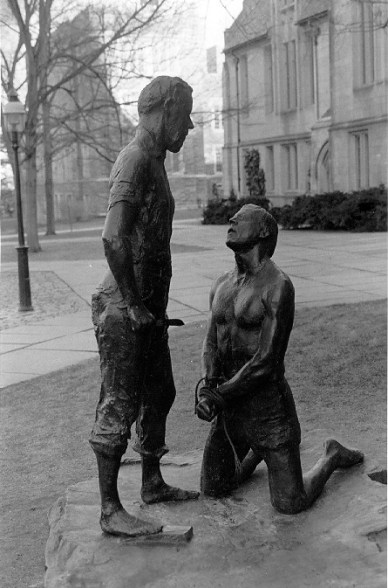
Abraham and Isaac: In Memory of May 4, 1970, Kent State University,by George Segal, Sculptor
Richard Dawkins is right; this is a disgraceful story. Let us prove him wrong by not taking it as foundational, or at least not in the way he means. The sculpture by George Segal in the grounds of Princeton University called ‘Abraham and Isaac’ is a memorial to the four killed and nine wounded on the campus of Kent State University when the Ohio State Guard opened fire on a group of unarmed student protesters in 1970. It reminds us that we live in a world that does not protect all children, even though it should. Let the horror that this story of the binding of Isaac provokes in us remind us that the sacrifice of children is never justified. Let our answer to every such ‘test’ be to protect the innocent, even when the powers that be tell us they must be sacrificed. That is the only responsible reading of this story, and the only way in which it can be foundational for our faith.
[1] Andrew Dutney, Angels in the Wilderness: Reflections on the Journey of the Uniting Church in Australia (Unley: MediaCom Education, 2020), pp. 74-5.

 Rev Doc Geek