Reflection for North Balwyn Uniting Church
25th of June, 2023
Hebrews 13:1-8
John 17:20-26
‘I ask not only on behalf of these, but also on behalf of those who will believe in me through their word, that they may all be one. As you, Father, are in me and I am in you, may they also be in us, so that the world may believe that you have sent me.’
Today we celebrate the 46th anniversary of the Union of the Congregational Union of Australia, the Methodist Church of Australasia, and the Presbyterian Church of Australia, the birthday of the Uniting Church. Appropriately, the gospel reading suggested for today’s celebration is the ‘ecumenical prayer’ from Jesus’ Farewell Discourse in the Gospel according to John, which speaks of unity in the service of mission. The twentieth-century ecumenical movement, of which the Uniting Church is a product, developed from the missionary movement of the nineteenth century. Missionaries sent by European churches to various mission fields discovered that divisions between different churches were experienced by those to whom they preached as a scandal. How could people hearing about Jesus Christ for the first time believe the gospel when those proclaiming the good news were in competition with each other? How could Jesus Christ be ‘the same yesterday and today and for ever’ if there was a Catholic Christ, a Presbyterian Christ, an Anglican Christ, a Methodist Christ, a Congregationalist Christ? The 1910 Edinburgh Conference brought representatives of the missioning churches together to determine how far the churches could become one so that the world might believe. From that meeting came the modern ecumenical movement, the World Council of Churches, and, in 1977, the Uniting Church in Australia.
I have frequently preached on this part of the Farewell Discourse, particularly on the anniversary of Union, with a sense of achievement and pride. Look at what we have done, I proclaim. Not only did we unite three different denominations in ways seen in few other countries, but we were so aware that Union was not the end of the journey that we decided to call ourselves ‘Uniting’, unlike, say, the United Church of Christ in the Philippines or the United Church of Canada. After decades of discussion and debate the uniting denominations managed to overcome the things that divided them and create a new church through an organic union. As members of this new church, we have done and continue to do our best to overcome the scandal of division that is so often a stumbling block to belief, and thus we can hear Jesus’ prayer and pat ourselves on the back, while of course committing ourselves to further ecumenical work and to continuing to make unity our great desire. So my ‘Anniversary of Union’ sermons often go. Not this year.
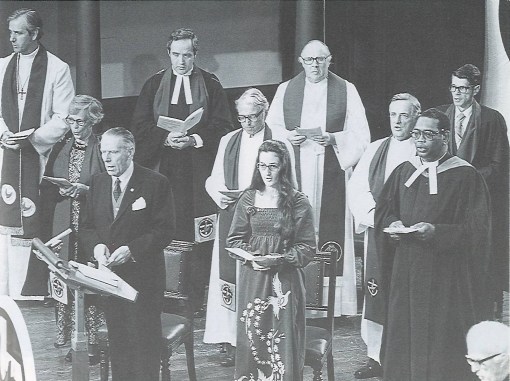
Back row: Ian Tanner (SA), Chris Mostert (TAS), Ron Allardice (VIC), Ron Wilson (WA); Middle Row: Lilian Wells (NSW), Graeme Bucknell (Northern), Rollie Busch (Qld), Front Row: Rupert Grove, Christine Gapes (Bible Reader), Phillip Potter (WCC)
This year I read Jesus’ prayer with trepidation. It seems to me to be quite frankly terrifying that one of the ways in which the world will come to know God is by looking at us, a responsibility up to which we cannot possibly live. I am, as you know, completely happy to say that in the man Jesus we have seen the God who created the cosmos; that the world has come to know the deep love of God for humanity through the life, death and resurrection of the Son. I happily preach that on all possible occasions. I do not, however, feel that I can say with equal confidence that God’s love for the world is revealed in our lives, that we so imitate God’s love that we reflect God’s glory. And yet that is what Jesus is calling us to do.
It is terrifying to think that non-Christians judge the credibility of the faith we proclaim by our behaviour, but it happens. People judge the possible truth of Christianity by the lives of Christians. That is not currently going well for us. I have often remarked that here in Australia we live in a post-Royal Commission world. Any Australian who pays even the slightest attention to the news knows that churches and religious bodies were the worst institutions in the country when it came to covering up child sexual abuse. The Royal Commission found that there were abusers in every institution: schools, sporting clubs, the Scout Movement. But it was in churches that leaders systematically protected abusers. We can say, of course, ‘Not in the Uniting Church,’ but non-Christians do not distinguish between denominations like that, and abuse did happen in Uniting Church schools and institutions.
Another contemporary challenge to the credibility of the faith is most Australians’ belief that churches are wealthy. This is sometimes a simple misunderstanding; in Australia property usually equals wealth and churches do have lots of property. When I ministered in Williamstown people used to think that the Catholic, Anglican, and Uniting Church congregations must be incredibly rich to be able to worship in such beautiful, century-old, bluestone churches, while most of our very small income was being used just to keep the doors open and the lights on. Sometimes the belief that churches are wealthy comes from deliberate campaigns to confuse the issue. As a minister, I was accused of not paying tax by someone handing out how-to-vote cards at the federal election. Churches are exempt from many taxes, but ministers are absolutely not exempt from income tax, as I quite loudly told my interlocutor. But sometimes the accusations that churches are not ‘free from the love of money’ are justified, as when Catholic religious orders try to use legal trickery to avoid compensating survivors for abuse, or Pentecostal churches provide their pastors with watches, luggage, and custom skateboards worth thousands of dollars. Again, it is not enough for us to say, ‘Not in the Uniting Church’. We do have more property than we need. We know that selling off half our churches would free up huge amounts of time and money for mission, we know that the church is not a building, and yet we are so very committed to our buildings. I may not love money, but I have loved each and every church building in which I have ministered, and it would break my heart to see any of them sold.
As we behave, so others will believe, which means we need to be incredibly careful about how we behave. For too long it was assumed that Christians could simply be trusted not to do the wrong thing. If Christians all loved one another as Jesus commanded then churches surely did not need the legislation, codes of conduct, or HR Departments that manage other institutions. The Royal Commission told us in appalling detail that that was not true. We need only watch The Kingdom, the documentary about Hillsong that is currently available on SBS On Demand, to see what happens when a church lacks appropriate governance structures. Christians behave no better than other people, and sometimes we behave worse.
The author of the Letter to the Hebrews knew that it was not enough just to say, ‘let mutual love continue’. They spell out in detail exactly how that mutual love is to be demonstrated: by showing hospitality, exercising solidarity with prisoners and those being tortured, living sexually continent lives, keeping free from the love of money, and respecting and imitating the community leaders who taught the faith. The authors of all the Pastoral Epistles were aware that the implications of ‘Love one another as I have loved you’ needed to be spelled out for faulty human beings. Similarly, good church governance does not assume that church members will always love one another; it puts in place protections for the times when that does not happen. If any part of the credibility of Christianity depends on how we behave as Christians, and I have been arguing in this Reflection that it most definitely does, then churches need even more restraints against misbehaviour than other institutions, not fewer. There is a reason the Uniting Church has a Constitution, and Regulations, and a Code of Ethics for ministers, and a Code of Conduct for Lay Leaders, and Culture of Safety Units, and requirements around Working with Children Cards, and so on, and so forth.
I may have argued that the love commandments are not sufficient in themselves to ensure that churches are ethical and safe, that we also need robust governance structures, but I am still going to argue that the love commandments are the core of Christianity. Of course I am. At the beginning of the Farewell Discourse Jesus told his disciples, ‘I give you a new commandment, that you love one another. Just as I have loved you, you also should love one another. By this everyone will know that you are my disciples, if you have love for one another.’ (John 13:34-35) Then at the centre of the Farewell Discourse he said, ‘This is my commandment, that you love one another as I have loved you. No one has greater love than this, to lay down one’s life for one’s friends.’ (John 15:12-13) Now, at the very end of the Farewell Discourse, the disciples overhear the Son saying to the Father, ‘I made your name known to them, and I will make it known, so that the love with which you have loved me may be in them, and I in them.’ Just as the Father has loved the Son, so the Son has loved the disciples, and the disciples are to imitate Jesus’ love for them so that they will be known to belong to him, and so that the world will believe in God’s love. Of course love is at the core of our faith! It is just that since we are faulty human beings and not God our love will always be imperfect and so we need help to live out our love as well as we possibly can.
One thing that helps us to live out our love is that when we love we are participating in the community of love that is the triune God. We are being welcomed into the Trinity, so that we may be one, as the Father and Son are one, Jesus in us and the Father in the Son, so that we may all become completely one. This unity in love is a gift, as well as a calling. When I was ordained the vows I made had what I called a ‘get out of jail free’ clause; when I was asked things like, ‘Will you announce the good news of God in Christ to those outside the community of faith, stand alongside those who suffer, and work for justice and peace in the world?’ the answer was ‘With God’s help, I will’. Ministers are not expected to exercise our ministry through our gifts and skills alone; that would be impossible. We are called to do it with God’s help, and at the end of the vows the congregation reminds us, ‘Faithful is God, who has called you and who will not fail you’. This is true not just for ministers, but for all members of the church. God calls none of us into the church community without giving us the help we need to live out that calling. Faithful is God, who has called the Uniting Church into being and us into membership of it, and who will not fail us.
I said at the beginning of this Reflection that it would not be one of my usual ‘Yay us!’ anniversary sermons. But that is still how I want to end. Of course the Uniting Church is not perfect. Of course we have, individually as church members and collectively as a church, made mistakes in the past. Undoubtedly we are making some now on which we will look back with regret. Despite that, I am proud of the Uniting Church, of the courage that led to Union and the faithfulness of the people who have been a part of it from 1977 until now. Most of us, most of the time, have done our very best to live out God’s love in congregations, community service agencies, with our partners overseas, in aged care, and in the world. We have done this not in our own strength, but because in his own strange way Christ has made us into a community through which he can work and bear witness to himself. That is what we celebrate today, the faithfulness of God who called the Uniting Church into being forty-six years ago, and who is with us here and now. May we live our lives in such a way that they witness to the love God has for the world. Amen.

 Rev Doc Geek