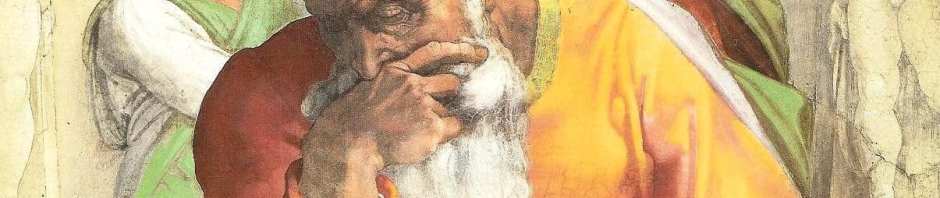
Reflection for North Balwyn Uniting Church
24th of August, 2025
Jeremiah 1:4-10
Over the past few weeks, we have been hearing from a series of Jewish prophets as they have watched the destruction of the nations of Israel and Judah. First, we heard from the prophets Amos and Hosea, who warned the northern kingdom of Israel that the Assyrians were coming to destroy it. The prophets were right: Israel fell to the Assyrians around 720 BCE, and the Assyrians sent some of the Israelite population into exile, and settled others from the Assyrian Empire into the land where they intermarried with the remnant. Their descendants became the Samaritans. Then we heard prophecies from Isaiah of Jerusalem, made after the fall of Israel, about the dangers facing the southern kingdom of Judah. At the very end of First Isaiah’s career, in 701 BCE, Assyria invaded Judah, causing widespread destruction, leaving only the city of Jerusalem intact.
Now we are hearing: ‘The words of Jeremiah son of Hilkiah, of the priests who were in Anathoth in the land of Benjamin, to whom the word of the Lord came in the days of King Josiah son of Amon of Judah, in the thirteenth year of his reign. It came also in the days of King Jehoiakim son of Josiah of Judah, and until the end of the eleventh year of King Zedekiah son of Josiah of Judah, until the captivity of Jerusalem in the fifth month.’ (Jeremiah 1:1-3) Jerusalem was taken captive by the Babylonians in 587 BCE, after the Babylonian Empire had overthrown the Assyrian Empire. Like the Assyrian Empire, the Babylonian Empire took many of the land’s inhabitants into exile. Although the introduction states that the word of the Lord came to Jeremiah until the captivity of Jerusalem, it is evident that the Book of Jeremiah continued to be written and rewritten during the exile itself, reflecting on that event.
Often when I talk about lectionary readings, I advise you to go home and read the entire book. I am frustrated that the lectionary only gives us two readings from the Books of Ruth and Jonah, for instance, when the books are so wonderful. I am not going to suggest you go home and read the entire Book of Jeremiah. For one thing, it is one of the longest books in the canon, second only to the Psalms. For another, it is a book that makes no chronological sense. It switches from speaker to speaker and from image to image. It includes poetry, prose sermons, and biographical pieces about Jeremiah, all mixed together. Appallingly, some of it describes the nation and the city of Zion as a lustful woman: ‘On every high hill and under every green tree you sprawled and played the whore’. (Jeremiah 2:20) ‘How lightly you gad about, changing your ways! You shall be put to shame by Egypt as you were put to shame by Assyria’. (Jeremiah 2:36) How will the nation be put to shame? By being metaphorically sexually assaulted: ‘And if you say in your heart, “Why have these things come upon me?” it is for the greatness of your iniquity that your skirts are lifted up, and you are violated.’ (Jeremiah 13:22) The lectionary readings avoid this imagery, and in this case I agree with the lectionary.
There are three things that I think make the Book of Jeremiah worthy of its place in the canon, despite its chronological confusion and the awfulness of some of its imagery. The first is that this is obviously a book in which a traumatised people are coming to terms with their trauma. When trauma happens, it challenges the way people make meaning in their lives. Most people have a basic, unspoken, understanding that the world is a benign place and that it makes sense, that there is a connection between what we do and what happens to us. Trauma can destroy that. The people of Judah believed that they were the people of God and that God had given them the land on which they lived. The defeat by Babylon, the destruction of the Temple, and the exile of many of the community’s most prominent members challenged all that. They needed to find a way of dealing with the loss of their political and religious institutions, the loss of their territorial integrity, and the loss of an unquestioned national identity. I have said before that I am not a fan of one of the ways they made sense of this, by deciding that everything that was happening to them was God’s punishment for their sin – ‘Your ways and your doings have brought this upon you’ (Jeremiah 4:18) – but it did enable them to keep identifying as the people of God, even in exile. And the prophecies of Jeremiah include not only warnings of doom, but offerings of hope. If God caused the exile, God could also relent and allow the exiles back home.
The second thing I appreciate about the Book of Jeremiah is its laments. Jeremiah complains so much about what is happening to him that there is an English word, jeremiad, which means ‘a long, mournful complaint or lamentation; a list of woes’. The life of the Prophet Jeremiah, as seen in the Book of Jeremiah, is a lived parable of what is going to happen to the people of Judah. As they will be, he is abused and destroyed. We see the beginning of this in today’s reading, when God calls Jeremiah, and Jeremiah pleads not to be a prophet. The words, ‘Before I formed you in the womb I knew you, and before you were born I consecrated you,’ may read to us as reassurance; God has known us before we were even conceived! But for Jeremiah they are more like a threat.
Jeremiah has a dreadful life, as most true prophets do. The people around him do not want to listen to someone who has been appointed to pluck up and to pull down, to destroy and to overthrow. Jeremiah is so persecuted by the rulers and priests of Jerusalem that at one point he cries out:
Cursed be the day on which I was born! The day when my mother bore me, let it not be blessed! Cursed be the man who brought the news to my father, saying, ‘A child is born to you, a son’, making him very glad. Let that man be like the cities that the Lord overthrew without pity; let him hear a cry in the morning and an alarm at noon, because he did not kill me in the womb; so my mother would have been my grave, and her womb for ever great. Why did I come forth from the womb to see toil and sorrow, and spend my days in shame? (Jeremiah 20:14-18)
Joel Rosenberg says that Jeremiah’s ‘sharp departure from prophetic tradition and custom in setting forth his complaint so elaborately is wholly his own innovation, and there is nothing else quite like it in biblical prophetic literature.’[1] If we ever feel that we should be stoic under oppression, meekly folding our hands and saying, ‘these things are sent to try us,’ the Book of Jeremiah, like the psalms of lament, gives us permission to cry out with all the anger and pain that we feel.
The third reason I am glad that the Book of Jeremiah is in the canon is because of the explanation Jeremiah gives for the destruction of Judah and Jerusalem, for God’s judgement on the nation. Walter Bruggemann says that Jeremiah, descended from the priests who were in Anathoth, will have noticed the mantra, ‘widow, orphan, alien,’ ‘widow, orphan, illegal immigrant,’ throughout the Torah. This mantra is the social safety net by which the Lord ensured that the people of God cared for those who were often invisible, those without social power, those without social utility who could contribute nothing of their own to the community’s well-being. [2]
So, Jeremiah follows one of the Lord’s instructions, stands at the gate of the Lord’s house, the Temple, and preaches an excoriating sermon. He proclaims God’s words: ‘if you truly amend your ways, if you truly act justly one with another, if you do not oppress the alien, the orphan, and the widow, and shed innocent blood in this place, and if you do not go after other gods to your own hurt, then I will dwell with you in this place, in the land that I gave of old to your ancestors forever and ever.’ (Jeremiah 7:5-7) The people of God are only the people of God, and will only be able to live in the land the Lord gave them, if, if, if, if. The Lord is appalled that his people ‘have become great and rich, they have grown fat and sleek. They know no limits in deeds of wickedness; they do not judge with justice the cause of the orphan, to make it prosper, and they do not defend the rights of the needy.’ (Jer 5:28) And so: ‘Shall I not punish them for these things? says the Lord, and shall I not bring retribution on a nation such as this?’ (Jeremiah 5:29) Bruggemann writes, ‘How astonishing, to attribute the loss of the city to maltreatment of widows and orphans!’
We do not need to believe that the actions of the Babylonian Empire were God’s punishment on an unjust society to take seriously the idea that what God wants from God’s people is justice. There is much discussion today about the right of nation-states to exist. What a difference it would make in the world if we agreed with the Hebrew prophets that only those nations whose citizens act justly one with another, those nations that do not oppress the alien, the orphan, and the widow, those nations that do not shed innocent blood, have the ‘right’ to dwell peaceably in their lands.
Over the next two months, we will continue to hear from the prophecies of Jeremiah, and we will have weeks of judgement before we reach the prophecies of hope. There is a lot of plucking up and pulling down, destroying and overthrowing, before the time comes to build and to plant. As we listen to the terrifying warnings of destruction, it is important to remember that we know how God wants us to live. In the words of the Prophet Micah, which we heard at the beginning of this liturgical year, ‘He has told you, O mortal, what is good; and what does the Lord require of you but to do justice, and to love kindness, and to walk humbly with your God?’ (Micah 6:8) Amen.
[1] In Robert Alter and Frank Kermode, The Literary Guide to the Bible (London: Fontana Press, 1987), p. 187.
[2] Walter Bruggemann, Disruptive Grace: Reflections on God, Scripture and the Church (London: SCM Press, 2011), pp. 105-8.

 Rev Doc Geek
Pingback: Sermon: “Stop all the clocks …” | Rev Doc Geek
Pingback: Sermon: Crazy brave hope | Rev Doc Geek
Pingback: Sermon: No one deserves this | Rev Doc Geek
Pingback: Sermon: The true light has come to the world! | Rev Doc Geek