Reflection for North Balwyn Uniting Church
The Seventh Sunday after Pentecost, 27th of July 2025
Luke 11:1-13
The prayer that we call the Lord’s is the most important and familiar prayer of the Christian faith. We use it here every week; many Christians pray it every day; and from the earliest centuries, the entire church through time and space has prayed the version in the Gospel according to Matthew. We Protestants add a doxology or words of praise to the end of that biblical prayer: ‘For the kingdom, the power, and the glory are yours, now and for ever. Amen.’ If you have ever said the Lord’s Prayer in a Catholic church, you will undoubtedly have found yourself still praying when the rest of the congregation is silent.
Most of us grew up with the traditional version of this prayer that came from the 1662 Book of Common Prayer, with trespasses rather than sins. There were regional versions; my Scottish mother still prays, ‘Forgive us our debts, as we forgive our debtors’. She says that this is because there was no law of trespass in Scotland; I say it is because the worst thing a Scot can imagine is owing or being owed money. Since 1980 Uniting churches have used a modern version translated by the international English Language Liturgical Consultation. I was seven when we started using that version, I remember learning it in Sunday school, and I am reasonably sure there were sweets involved. The ELLC version is a better translation of the original Greek than the traditional version, as well as being easier to say for those of us not brought up with thees and thous.
The Lord’s Prayer became our shared sacrament when I was studying at the World Council of Churches’ international Ecumenical Institute at Bossey in Switzerland. We came from so many different traditions that, sadly, we could not share the Eucharist together; I think that remains the one holy catholic and apostolic church’s greatest scandal. But we could say the Lord’s Prayer together, and we did, each softly in our first language, so the different languages blended together into communal praise and petition.
It is strange how imperative the petitions of this prayer are. They are actually demands; the verbs are in the Greek imperative mood used for orders and commands. We do not pray, please may your name be hallowed, please may your kingdom come, please may you forgive our sins …’. We pray: Be hallowed! Come! Give! Forgive! Do not! It is a remarkable way to address the Creator of the cosmos. The prayer does begin by addressing God as ‘Father,’ not king or judge or lord, but it was first prayed in a culture in which fathers were literally the rulers of their families and households, not people of whom demands could be made. Yet it is being taught by the one who tells us that God is like a father who shamelessly runs to greet an erring son when he returns from spending all his wealth in dissolute living. (Luke 15:11-24) This Father does not stand on his dignity.
So we begin the prayer by affirming God’s transcendence: ‘in heaven’ and God’s closeness: ‘Father’. Just as Jesus calls God by the intimate name of ‘Abba, Father,’ so we can use that name too. Paul says, ‘When we cry “Abba, Father” it is that very Spirit bearing witness with our spirit that we are children of God’. (Romans 8:15b-16) We are God’s beloved children, and as God’s children we can cry out to him.
Next come two ‘your’ statements in Luke’s version and three ‘your’ statements in Matthew’s version. Because we have both versions, we know that ‘your will be done, on earth as in heaven’ is parallelism, like those verses in the psalms where the psalmist says the same thing in two different forms: ‘The heavens are telling the glory of God; and the firmament proclaims his handiwork’. (Psalm 19:1) What we beloved children demand in this first part of the prayer is that God’s holy realm of love, justice, and peace will be present among us. ‘Hallowed be your name’ simply means, may you, God, be recognised as the holy one, and God’s holiness is a holiness of justice and of love.
The second part of the prayer is made up of petitions to God to meet our basic and deepest needs: the necessities of life; forgiveness for what we do wrong; protection from times that challenge our faith and strength to endure them. I want to focus on the first of these today. The word commonly translated ‘daily,’ about our bread, is only used twice in the whole Bible, in the Lord’s Prayer in the gospels according to Matthew and Luke. ‘Daily’ is one possible translation, but so is ‘necessary’ and ‘tomorrow’s’. In this petition, we are praying collectively that everyone in the world will have the necessary bread that every human being needs each day for their entire lives. We are praying not that God will give those of us in North Balwyn croissants and ciabatta, but that God will give the starving around the world emergency rations, and unhoused people in Australia nutritious meals in ways that respect their dignity.
It has been hard to think about daily necessary bread this week, while seeing the images of skeletal children starving in Gaza. I will not show them to you, because they are simply too graphic for church. Charities have been warning the world of this impending human-created disaster for months; now Palestinians are dying daily of hunger. More than a thousand Palestinians have been killed trying to access the Gaza Humanitarian Foundation, whose name is bitterly ironic. In the words of the Guardian: GHF is ‘a startup organisation with no experience of distributing food in complex conflict zones, [that] employs US mercenaries at [its four] sites, which opened in May. They replaced 400 non-militarised aid points run under a UN system that Israel claimed had to be shut down because Hamas was diverting aid from it. No evidence for this has been provided.’
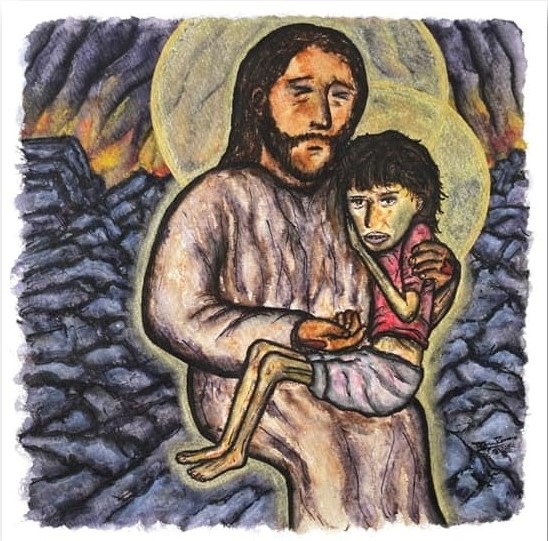
‘For I was hungry’ by Ramone Romero
The reason Gazans need access to food aid is not just because Israel is preventing most food from entering Gaza. It is also because up to seventy per cent of tree crops and more than seventy per cent of Gaza’s greenhouses have been damaged by bombs, according to satellite imagery. As well, the Israeli newspaper Haaretz reports that since the attacks on Gaza began, dozens of Gazans have been shot dead while in the water, most of them while fishing. Israel has warned Gazans that entering the sea is forbidden, and anyone who violates that order is putting their life at immediate risk. Israel is making it impossible for Gazans to feed themselves.
And so nineteen-year-old Saba Nahed Alnajjar, who had received a scholarship to study medicine in Algeria before the attacks on Gaza started, tells the BBC she now weighs 35 kilograms. Noura Hijazi, a widowed 29-year-old who stays in a tent in the west of Gaza City with her two children, has told the BBC that her toddler daughter has been motionless for four days, no longer moving or talking. The horror stories are legion.
In the Lord’s Prayer, we demand that God’s future comes into our present. We do not ask that we go to God’s kingdom; we pray that God’s kingdom comes to us. We cannot pray this with integrity if we do not care about the world’s most vulnerable, most persecuted, and most deprived.
It seems impossible that our prayers can make a difference in the world, but Jesus offers us a parable. The translation is not helpful. It reads ‘Suppose one of you has a friend, and you go to him at midnight and say to him, “Friend, lend me three loaves of bread; for a friend of mine has arrived, and I have nothing to set before him.”’ But what Jesus is saying is more along the lines of, ‘Could you imagine having a friend who would not help you offer hospitality to a traveller?’ and the answer to that in a culture in which friendship and hospitality are sacred obligations would be, ‘Of course not; that would never happen!’ But Jesus says that even were such a thing to happen, that a friend ignored their sacred obligations, they will finally get out of bed and supply bread if their friend keeps asking.
We are not to think that God is like the friend in bed, someone we need to persistently petition to be heard. The meaning of this parable is more like that of the second, mini, parable in today’s reading, that ends, ‘If you then, who are evil, know how to give good gifts to your children, how much more will the heavenly Father give the Holy Spirit to those who ask him!’ In the same way, if an inhospitable person in bed will finally get up and give his friend whatever he needs, how much more will our loving Father give us what we need when we ask for it?
We must always remember that our actions may be how God answers the prayers of those asking for their necessary bread. As Saint Teresa of Avila wrote in the sixteenth century, ‘Christ has no body but yours, no hands, no feet on earth but yours. Yours are the eyes with which he looks compassion on this world, yours are the feet with which he walks to do good, yours are the hands with which he blesses all the world. Yours are the hands, yours are the feet, yours are the eyes, you are his body. Christ has no body now but yours.’ Amen.
.

 Rev Doc Geek
Pingback: Sermon: Lead us not into the temptation of violence | Rev Doc Geek