Reflection for North Balwyn Uniting Church
The Fifth Sunday of Easter, 18th of May 2025
Revelation 21:1-6
I have a confession to make. Although I am Scottish Australian, I absolutely adore the song ‘Jerusalem,’ the early nineteenth-century poem by William Blake that Sir Hubert Parry put to music in the early twentieth century. I blame the joy I take in hearing about ‘England’s green and pleasant land’ on the film Chariots of Fire, which was released when I was eight years old and in which my cousin had a role playing Eric Liddell’s brother Rob. If you have not seen Chariots of Fire, and you do not know who Eric Liddell was, that is your homework for the week. The soundtrack of Chariots of Fire, including ‘Jerusalem,’ is carved into my memory.
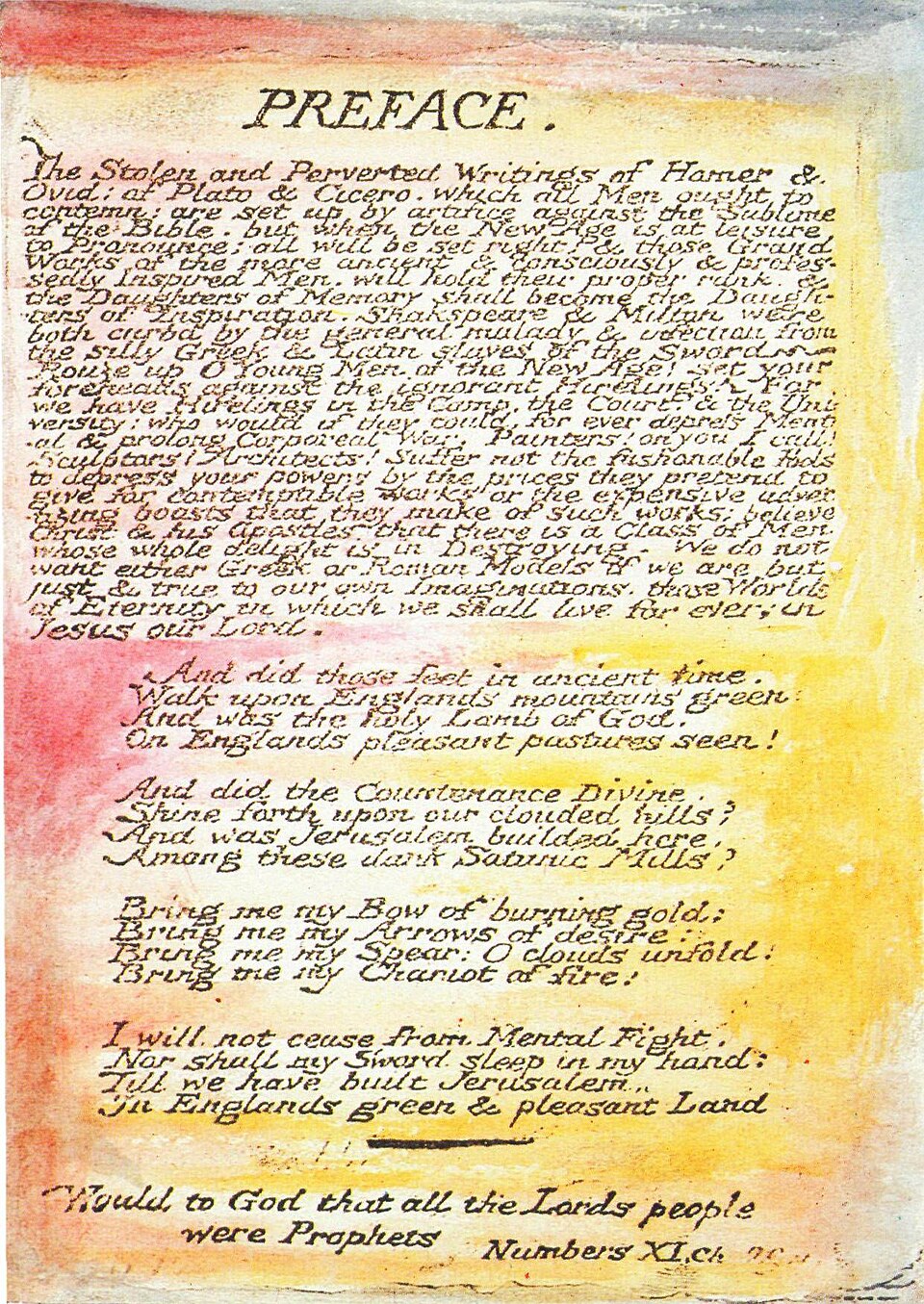
Blake, in writing his poem was drawing on the passage from Revelation that we hear today. As you know, once the Roman Empire became Christian, John’s simple, if coded, message of resistance to the Roman imperial cult became complicated. All the poetic language in which John described the need to resist Rome instead began to be used to justify violence or celebrate war. This still happens today, in the more extreme fringes of Christianity. If you want to be truly terrified, ask your internet search engine, ‘Is war in Israel a sign of the end times?’ and read the results.
In today’s passage, John is drawing deeply on the Hebrew Scriptures in his description of the Christian alternative to Roman rule. The new heaven and new earth are drawn from the prophecies of Isaiah. (65:17, 66:22) The removal of the sea draws on the first creation story (Genesis 1:1-2) in which the waters represent the chaos before God begins to create. Bridal imagery for the new Jerusalem again draws on Isaiah’s vision of Israel’s relationship with God being that of a rejected wife now reconciled to her husband. (Isaiah 50:1, 62:4-5) God will live in the new Jerusalem with mortals in the same way that God walked and talked with the man and the woman in the garden in Eden. (Genesis 2:15-25) But humanity is not to return to that garden but to become citizens of a city, a community that draws people of many different sorts from many different places, a place that only survives if everyone cooperates for its welfare. In this vision, the end of time is not a return to the past; it is a new beginning.
We often hear these words at funerals. I frequently read the promise that ‘God himself will be with them and be their God; he will wipe every tear from their eyes. Death will be no more; mourning and crying and pain will be no more, for the first things have passed away’ then. But if we only hear this promise at funerals, it can seem very much like ‘pie in the sky when you die.’ For people who do not believe it can sound like yesterday’s hope; old, failed promises that take our attention away from the realities of life. But the vision of a new heaven and a new earth only distracts us from the world in which we are living if we let it. What John intends is much more what William Blake’s poem encourages us to do. We are to build Jerusalem in the lands in which we live.
Revelation describes resurrection faith. Jesus was executed by the powers of the Empire, but the Lamb that was slaughtered is now at the centre of heaven’s worship. John is telling the tiny Christian communities within the great Roman Empire that they have no need to fear, because Jesus has already conquered Rome through his self-sacrifice, and God is already with them. In the resurrection of Christ, a new day has dawned, and Revelation reveals what the new day looks like: one in which the thirsty are given water as a gift from the spring of the water of life, and there is no longer be mourning and crying and pain. This is not optimism, the belief that without God or us doing anything, everything will turn out okay. This is resurrection hope, the faith that the Alpha and the Omega has shown us in the resurrection of Jesus what is intended for all creation, including us.
Our call is to live as citizens of the New Jerusalem. There are right ways and wrong ways of doing this. The wrong way is to try to impose the New Jerusalem on others through violence. During the Reformation, in the words of historian Diarmaid MacCulloch, ‘some radicals [believed] that they needed force to usher in the Last Days. They heard Jesus say, “I have come not to bring peace, but a sword,” and they wanted to help God fulfil his political programme in the Book of Revelation.’ The German city of Munster, which had been experiencing a normal Lutheran Reformation, fell into the hands of radical Anabaptists in 1532. They declared it to be the New Jerusalem and made both rebaptism and polygamy compulsory. Their final leader, John of Leyden, ‘lived as their king in insane luxury, surrounded by his harem, as his followers starved and died defending him.’.[1] That ‘New Jerusalem’ was overthrown after a siege in 1535, and subsequently both Catholics and Lutherans persecuted Anabaptists, even those who simply celebrated believers’ baptism without violence, polygamy, and luxurious living. Munster shows us how not to live in the New Jerusalem.
We live as citizens of the New Jerusalem when we work to make the world a better place. Knowing God’s ultimate intentions, we do not accept injustice, war, and poverty as just ‘the way things are.’ Knowing God’s universalism, we do not limit our compassion to our families, friends, and those like us, those of the same race, faith, or nationality. We are not afraid of speaking out, standing up, or even sitting down and refusing to be moved when those things are called of us. We know that even if we die, God wins. In the very last sermon Martin Luther King Jr gave, at the Mason Temple church in Memphis on April 3, 1968, the day before he was assassinated, he said:
It’s all right to talk about ‘long white robes over yonder,’ in all of its symbolism. But ultimately people want some suits and dresses and shoes to wear down here. It’s all right to talk about ‘streets flowing with milk and honey,’ but God has commanded us to be concerned about the slums down here, and his children who can’t eat three square meals a day. It’s all right to talk about the new Jerusalem, but one day, God’s preacher must talk about the New York, the new Atlanta, the new Philadelphia, the new Los Angeles, the new Memphis, Tennessee. This is what we have to do.
And he finished his sermon, ‘I’m happy tonight. I’m not worried about anything. I’m not fearing any man. Mine eyes have seen the glory of the coming of the Lord.’[2]
Dr King had a resurrection faith. But even as he preached that last sermon, he was depressed. A new generation of Black activists thought him yesterday’s man and argued that nonviolent resistance was useless. On the other side, seventy-five per cent of Americans disapproved of him because he was speaking about economic, not just racial, injustice. Hopefully, none of us will ever be assassinated, but if we live as citizens of the New Jerusalem, particularly if our faith takes us to the streets, we will have people on one side telling us that our actions are useless, and on the other side telling us that even peaceful protest is violence. There has never been a campaign for justice that most people supported at the time. Today it is unlikely that anyone would doubt the morality and effectiveness of the sporting boycotts of apartheid South Africa, for instance, but at the time of the protests against the Springbok tour in 1971 the headline in the Canberra Times was ‘Protesters Harass Tourists’[3] and arguments were made that rugby players could not be blamed for the actions of their government.
This brings me back to Blake’s poem. It is a preface to his epic poem Milton, referencing the myth that Joseph of Arimathea visited England after the crucifixion, which is how the Holy Grail ends up in Arthurian mythology. It has been assumed that the ‘dark satanic mills’ were those created by new industries in which men, women, and children slaved. The Bishop of Durham, N. T. Wright, has said that they were not ‘as some imagine, the cotton-mills and steel-mills of the new, noisy, and smoky industrial revolution. They were the great churches, like Westminster Abbey and St Paul’s Cathedral’ that Blake believed did not care for the poor. In 1915 Sir Hubert Parry was asked to put the poem to music for a pro-World War One campaign meeting. Sir Hubert did so, but then became disillusioned with the cause, and in 1917 he withdrew his support and almost withdrew the song from public use. What saved it was Millicent Fawcett of the National Union of Women’s Suffrage Societies asking if it could be sung be at a Suffrage Demonstration Concert in 1918. Sir Hubert was delighted and assigned the copyright to the NUWSS. When suffrage was achieved, and the NUWSS was wound up in 1928, Parry’s executors reassigned the copyright to the Women’s Institutes. The teeth have been taken out of ‘Jerusalem,’ but it was a radical poem and it is a radical song.
God says to us, ‘It is done! I am the Alpha and the Omega, the Beginning and the End. To the thirsty I will give water as a gift from the spring of the water of life.’ Let us live as citizens of the New Jerusalem, as those who drink from the spring of the water of life. Amen.
[1] Diarmaid MacCulloch, A History of Christianity (2009), pp. 623-4.
[2] James M. Washington, I Have a Dream: Writings and Speeches that Changed the World (1992), pp. 198, 203.
[3] ‘Protesters harass tourists,’ The Canberra Times, Friday, 2 July 1971, p. 3.

 Rev Doc Geek
Pingback: Sermon: Universalism means universal love | Rev Doc Geek