Reflection for North Balwyn Uniting Church
16th of February 2025
Jeremiah 17:5-10
Luke 6:17-26
Jesus liked to teach through parables. The Gospel according to Luke contains some parables that are recorded nowhere else, parables without which the entire world would be different: the parable of the Prodigal Son; the parable of the Good Samaritan; the parable of the Rich Man and Lazarus. In the teaching we hear today, though, Jesus is not speaking in parables. He is, if anything, only too clear. We middle-class Australians living in the green and leafy eastern suburbs of Melbourne are, in world terms and in terms of human history, profoundly rich. We enjoy a level of luxury that for most of human history only royalty could aspire to. And in the Sermon on the Plain Jesus says bluntly, ‘Woe to you who are rich, for you have received your consolation’. Why could he not have told a parable about a nasty rich man dressed in purple and fine linen and living in luxury who refuses to give the leftovers from his table to the beggar covered with sores crouching at his gate? (Luke 16:19-31) Then we could console ourselves with the thought of our charitable giving – we do not leave Lazarus languishing. But Jesus is not speaking in parables today.
So radical, so scandalous, is the teaching that we call the Sermon on the Plain that Matthew immediately spiritualised it. In Matthew’s version, the Sermon on the Mount, Jesus is quoted as speaking about the ‘poor in spirit,’ not the poor, and ‘those who hunger and thirst for righteousness,’ not the hungry. (Matthew 5:1-12) Luke is much blunter. We may be more familiar with Matthew’s version than with Luke’s because Matthew’s version is longer and goes into more detail, but I suspect we are at least partly more familiar with the Sermon on the Mount than the Sermon on the Plain because Luke’s version is more radical. Within the first few centuries of Christianity, the church went from being a persecuted minority to being the official religion of the Roman Empire. The church became ‘the rich’. ‘Woe to you who are rich’ became a difficult word.
Jesus’ radical teachings were just as difficult to his contemporaries. We heard two weeks ago about what happened when Jesus spoke at his local synagogue. He only just escaped being killed for his presumption. (Luke 4:21-30) Between that time and this, Pharisees and teachers of the law have been scandalised by his claim to be able to forgive sins, (Luke 5:17-26) Pharisees and their scribes have complained to Jesus’ disciples because he eats and drinks with tax collectors and sinners, (Luke 5:27-31) Pharisees have been horrified that Jesus has healed on the Sabbath. (Luke 6:1-11) The Pharisees ‘were filled with fury and discussed with one another what they might do to Jesus,’ (Luke 6:11) and immediately afterwards we are told that Jesus has chosen twelve of his disciples whom he has named apostles. As the religious leaders of Israel begin to reject him, Jesus prepares for their replacement. There will be a new Israel in place of the nation descended from the twelve sons of Jacob, and this new Israel will begin with the Twelve that Jesus has named. (Luke 6:14-16)
It is immediately after calling these Twelve, the nucleus of the new Israel, that Jesus gives today’s teaching on the level place, but he is not speaking to them alone. Luke tells us that the crowd around Jesus was large and mixed. It includes the Twelve, and the larger group of disciples from which the Twelve have been chosen. It also includes the people who have come to Jesus to be healed of their diseases and freed from unclean spirits, both Jews from Judea and Jerusalem and Gentiles from Tyre and Sidon. In the Nazareth Manifesto Jesus said that he had come to bring good news to the poor, proclaim release to the captives and recovery of sight to the blind, let the oppressed go free, and this is what he has been doing, proclaiming the year of the Lord’s favour to everyone who needs to hear the good news. It is in this context that he begins to speak to the disciples, surrounded by those who have sought him out of their need.
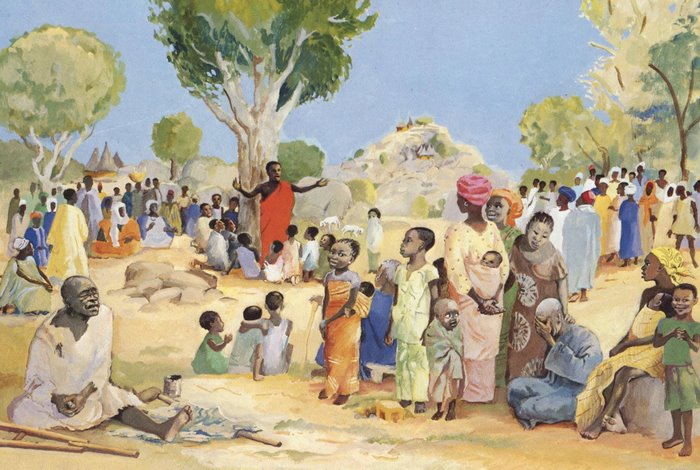
Jesus is speaking in a world in which it was taken for granted that the rich were more important than the poor. Wealth was considered a sign of God’s favour and poverty a sign of God’s displeasure. It was the rich who were blessed, members of the wealthy upper class, people with many possessions. Do the right thing, trust in God, and you will be blessed with the good things of life, said Jewish Wisdom. The first part of today’s reading from the Prophecies of Jeremiah seems to be an example of that Wisdom Tradition. Those who trust in the Lord will be blessed; they will be like trees that stay green and bear fruit in times of drought, for they will be planted in God as a tree is planted beside water. But those who trust in human beings, whose hearts turn away from the Lord, will be cursed. They will be like shrubs in the desert, that spring up quickly and just as quickly die. Turn your hearts to the Lord and the Lord will take care of you, seems to be Jeremiah’s message.
Jesus takes this understanding and turns it upside down: ‘Blessed are you who are poor, for yours is the kingdom of God. Blessed are you who are hungry now, for you will be filled … woe to you who are rich, for you have received your consolation. Woe to you who are full now, for you will be hungry’. It is the poor, not the wealthy, who are blessed; the sad, not the happy; those excluded and reviled, not those of whom everyone speaks well. They are blessed because God is turning the world upside down. In the Magnificat Mary sang of the Lord bringing down the powerful from their thrones, lifting the lowly, filling the hungry with good things, sending the rich away empty. (Luke 1:46-55) If God is going to turn the world upside down then of course it is better to be on the bottom now, because soon the bottom will be the top, the first will be last and the last first.
Would the Prophet Jeremiah have been as scandalised by Jesus’ teaching as the Pharisees? Would he have wanted Jesus to distinguish between the deserving poor who trust in the Lord and the undeserving poor who are poor because they have put their trust in mere mortals? Might he have wanted to argue with Jesus that wealth and laughter and the praise of others are simply the fruits of living the right way? Maybe, if we read only the first part of today’s reading from Jeremiah’s prophecies. But then we come to the second part, which is so different that some commentators think that this chapter is a collection of sayings with no connection to one another. After talking about the disposition of people’s hearts, turning to the Lord or away, with predictable results, we hear, ‘The heart is devious above all else; it is perverse—who can understand it? I the Lord test the mind and search the heart, to give to all according to their ways, according to the fruit of their doings.’ If the heart is devious and perverse, if only the Lord can understand it, how can we be sure that our heart is in the right place? How can we know whether we are a tree planted by water or merely a shrub in the desert?
Maybe the point is that we cannot know. Maybe we are both. Maybe during the times when we are most proud of our virtue, when we congratulate ourselves on our good behaviour, our charities, the love we show to others, our devious hearts are deceiving us. Maybe when we are most worried that we are failing to love and to live as Jesus commands, our contrite hearts are acceptable to God. Maybe the division that Jesus makes in his Sermon between the poor and the rich, the hungry and the filled, those who weep and those who laugh, those who receive praise and those who are rejected, is not just a distinction between two groups of people. Maybe this division is also within us. Maybe we are both the tree planted by water and the shrub in the desert. Maybe the Lord is the only one who can test our minds and search our hearts and know which we are at any time – in which case we need to be much less ready to judge others.
The Sermon on the Plain is deeply material. We should never conflate Luke’s version of the gospel with Matthew’s and spiritualise the beatitudes. The woes are part of today’s reading. We do need to remember that Jesus challenged the idea that the rich are blessed, the poor are cursed, and that wealth is a sign of God’s favour. As Christians we must always work and pray for a more equal world. But as we join the crowd that gathers on the level place we also know that Jesus is speaking both blessings and woes to us. We are both blessed and troubled. So let us, like that crowd, continue to seek out Jesus, asking him to heal us of all the deviousness and perversity hidden in our hearts, knowing that he has the power to bring peace to our anxious minds. Amen.

 Rev Doc Geek