Reflection for North Balwyn Uniting Church
Christmas Day 2024
I am a ‘religious’ watcher of the Doctor Who Christmas Specials. For many other Australians Boxing Day is about cricket but for me, on those years when the television gods bless us with these specials, Boxing Day is all about the Doctor. The 2007 Christmas Special, which starred our very own Kylie Minogue, gave me one of my favourite descriptions of Christmas. The alien Mr Copper explains to his group of time-travelling alien tourists:
I shall be taking you to Old London Town in the country UK, ruled over by Good King Wenceslas. Now human beings worship the great god Santa, a creature with fearsome claws, and his wife Mary. And every Christmas Eve the people of UK go to war with the country of Turkey. They then eat the Turkey people for Christmas dinner, like savages.
When the Doctor asks Mr Copper whence he got his information the alien proudly says, ‘I have a first-class degree in Earthanomics’.
Marvel’s Guardians of the Galaxy has an equally violent understanding of Christmas. In the 2022 Holiday Special an alien sings that:
If you act nice, sleep through the night,
and don’t jump on your bed
Santa comes with sugarplums
and hurls them at your head.
But if you’re on his naughty list
he shoots missiles at your toe.
He might just roast your chestnuts
with his powerful flame throw – er.
Fictional aliens apparently find Earth Christmas very confusing.
We can get our Christmas lore equally mixed up. For many people the birth of Jesus in Bethlehem is a fairy-tale, set once upon a time, possibly in an enchanted forest or a galaxy far, far away. I love singing ‘O little town of Bethlehem’ (TIS 316) and ‘Once in royal David’s city’ (TIS 312) but it is perfectly possible to sing both carols without giving a single thought to the actual Bethlehem, a city in the Palestinian West Bank. After all, the message of the first carol is that ‘in this world of sin/where meek souls will receive him, still/the dear Christ enters in’ and the message of the second is that ‘Not in that poor lowly stable/with the oxen standing by/we shall see him: but in heaven/set at God’s right hand on high’. If we are to encounter Jesus in our own hearts or in heaven, then maybe we do not need to worry about the Bethlehem of today.
The message of Christmas is that through the coming of Jesus even Australians, born almost 2000 years later on the other side of the world, can encounter God directly. In a somewhat surprising reading for Christmas Day we hear from the Apostle Paul’s letter to Titus, whom he has left behind in Crete as a bishop. I think the lectionary gives it to us for Christmas Day because it encapsulates the gospel. In Jesus, writes Paul, the grace of God has appeared, bringing salvation to all. This is the first angel’s message to the shepherds: ‘Good news of great joy for all the people: to you is born this day in the city of David a Saviour, who is the Messiah, the Lord.’ In the birth of Jesus God has come to dwell among us, and although we are still waiting ‘for the blessed hope and the manifestation of the glory of our great God and Saviour, Jesus Christ,’ the dear Christ has entered all our hearts. And not our hearts alone.
The song the collected angels sing to the shepherds is, ‘Glory to God in the highest heaven, and on earth peace among those whom he favours!’ In Jesus’ time many believed that those whom God particularly favoured were the people of Israel. That was not what Luke believed. The message of the Gospel according to Luke is that the peace brought about by the birth of Jesus is inclusive and universal; that those whom God favours are not only Jews but Gentiles; not only men but women; not only those with settled homes but nomads, shepherds ‘living in the fields,’ people we would now call Bedouin.
After all, it is these people, shepherds, outsiders, not those with great status or those who receive special privileges, who see the veil between heaven and earth temporarily lowered. ‘And suddenly there was with the angel a multitude of the heavenly host, praising God’ – these ordinary people going about their ordinary business find themselves participating in the heavenly liturgy. The shepherds then go with haste but, rather than finding God in the inner sanctuary of a Temple that only priests like Zechariah can enter, (Luke 1:5-233) they find ‘the child lying in the manger’. The angels showed the shepherds the glory of the Lord, but now they find God not in another scene of glorious splendour but in an animal feeding box; a pragmatic solution to the lack of shelter for a new-born baby. Luke is clear that this is ‘good news of great joy for all the people,’ but especially for the poor and the outcast.
One of the reasons I think the Titus reading is unusual for Christmas Day is that it is filled with admonitions on how to behave. In Jesus God’s glory has come to us, and this means, according to Paul, that we can renounce impiety and worldly passions, and live lives that are self-controlled, upright, and godly. I do not know about you, but self-control is not the virtue I most conspicuously display at Christmas time. Paul may feel he needs to make this point because of who the Cretans are; at the beginning of the letter he writes, ‘It was one of them, their very own prophet, who said, “Cretans are always liars, vicious brutes, lazy gluttons.” That testimony is true.’ (Titus 1:12-13) My apologies to any people from Crete who may be listening; it is not me saying this, but Paul. Paul is reminding us that it is not enough to celebrate Christmas. Christmas should also influence the way we behave.
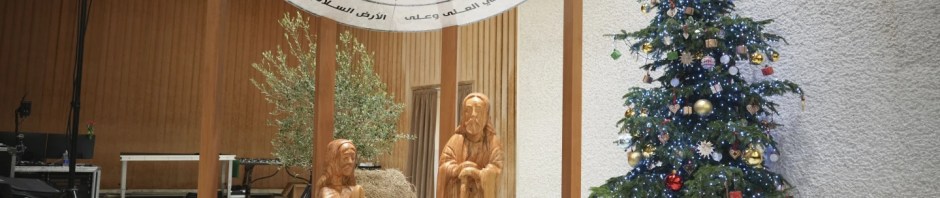
It will probably not surprise you that I believe we can only celebrate Christmas with integrity if we honestly seek ‘on earth peace’ for everyone. If we are to live lives that are ‘upright and godly’ then we cannot forget the real Bethlehem or ignore what is happening in the rest of the Holy Land. Earlier this year I saw footage of a Jewish American woman who wants to settle in Gaza in which she said that what she wanted to happen to Palestinians was not ethnic cleansing because ‘Palestinian isn’t an ethnicity. It’s an ideology, and it’s an ideology that says they want Jews dead’. Bans on the keffiyeh in Australian schools and protests over the nativity scene in the Vatican that had Jesus lying on a keffiyeh suggest that many people believe this – that ‘Palestinian’ is simply another word for ‘antisemitic terrorist’. But as Christians we still have a duty to speak up against war crimes, racism, and injustice, even if that means we are accused of antisemitism or of being on the side of terrorists. If we are to celebrate Christmas and sing carols with integrity then we must speak up against all violence in the Holy Land, even if our calls for peace are misinterpreted or misrepresented.

Nativity Scene from Bethlehem in the Vatican
So I will end with words sung this Christmas by the choir of the Ramallah Friends School, a Quaker-run school in the West Bank that has been teaching Palestinian children since 1869:
The universe celebrates while we are here.
Fear and hunger fill the world.
Oh sky, surge with care and peace,
bring love and compassion,
let the war end and peace prevail,
A sky, stars and peace.Peaceful night, holy night,
children’s dreams, shining bright.
In our hearts let kindness grow,
end the wars let peace flow,
end the war, the fears, the pain
end the war, the fears, the painFear and hunger, a hurting child,
filled the world with sorrow and tears.
Dreaming of hope, for the war to end,
no day passes without destruction.
A sky, stars and safety,
a sky, stars and peace.Quiet skies, calm and clear,
love and hope conquer fear.
Every child deserves to be
safe at home and living free.
End the war in Gaza’s night
let the kids see the light.

 Rev Doc Geek