Reflection for North Balwyn Uniting Church
10th of November, 2024
Ruth 3:1-5, 4:13-17
Today we hear the second of our two readings from the biblical Book of Ruth. Last week, you will remember, Elimelech, his wife Naomi, and their two sons Mahlon and Chilion left Bethlehem for Moab to find food in a time of famine. The sons married Moabite women, Orpah and Ruth. After all three men died, Naomi decided to return to Judah. Orpah went back to her mother’s home, but Ruth insisted on accompanying her mother-in-law in words that have become justly famous.
In between that reading and this one, Ruth has been gleaning in the fields of a man who turned out to be ‘a kinsman on [Naomi’s] husband’s side, a prominent rich man, of the family of Elimelech, whose name was Boaz’. The poor, including widows, were permitted by the law to glean in the fields of the wealthy, but Boaz did more than was necessary: telling Ruth to stay in his fields, where he had ordered the young men not to bother her; allowing her to drink the water his young men had drawn up; sharing his meal with her; and, most importantly, telling his workers, ‘Let her glean even among the standing sheaves, and do not reproach her. You must also pull out some handfuls for her from the bundles, and leave them for her to glean, and do not rebuke her.’ But when today’s reading starts the harvest is almost over, and Boaz has done nothing to indicate that his protection will continue.
Naomi tells Ruth, ‘Now wash and anoint yourself, and put on your best clothes and go down to the threshing-floor; but do not make yourself known to the man until he has finished eating and drinking. When he lies down, observe the place where he lies; then, go and uncover his feet and lie down; and he will tell you what to do.’ What is Naomi seeking to do? It reads to me as though she is sexually exploiting Ruth. Does she intend Boaz to marry Ruth, or is she simply hoping that he will pay for Ruth’s time in his bed with more grain? Or is Naomi seeking to sexually exploit Boaz? One commentator suggests that Naomi is hoping that when Boaz wakes up, having been befuddled by alcohol, and finds a strange woman in his bed, he will assume that he took her there and feel compelled to marry her. Either way, this part of Ruth’s story sits uncomfortably with me. Throughout history we have excused it by assuming that Ruth and Boaz are attracted to each other and Naomi is simply nudging two people who want to be together, but we are never told that. And as I said last week, there is no equivalently ardent declaration between Ruth and Boaz to compare with the one made by Ruth to Naomi and the word ‘love’ is only used of Ruth’s feelings for Naomi, not her feelings for Boaz.
The lectionary skips the next part of the story, when Boaz wakes up to find a strange woman in his bed, and asks her who she is, and Ruth proposes to him by saying, ‘I am Ruth, your servant; spread your cloak over your servant, for you are next-of-kin.’ Boaz replies, ‘May you be blessed by the Lord, my daughter; this last instance of your loyalty is better than the first; you have not gone after young men, whether poor or rich.’ Boaz, it seems, is not young, not the sort of man to immediately attract a woman. He believes that Ruth has approached him on Naomi’s behalf, not on her own. But it turns out that Naomi was either lying or mistaken when she said Boaz was her next-of-kin. Boaz says to Ruth, ‘though it is true that I am a near kinsman, there is another kinsman more closely related than I. Remain this night, and in the morning, if he will act as next-of-kin for you, good; let him do so. If he is not willing to act as next-of-kin for you, then, as the Lord lives, I will act as next-of-kin for you.’
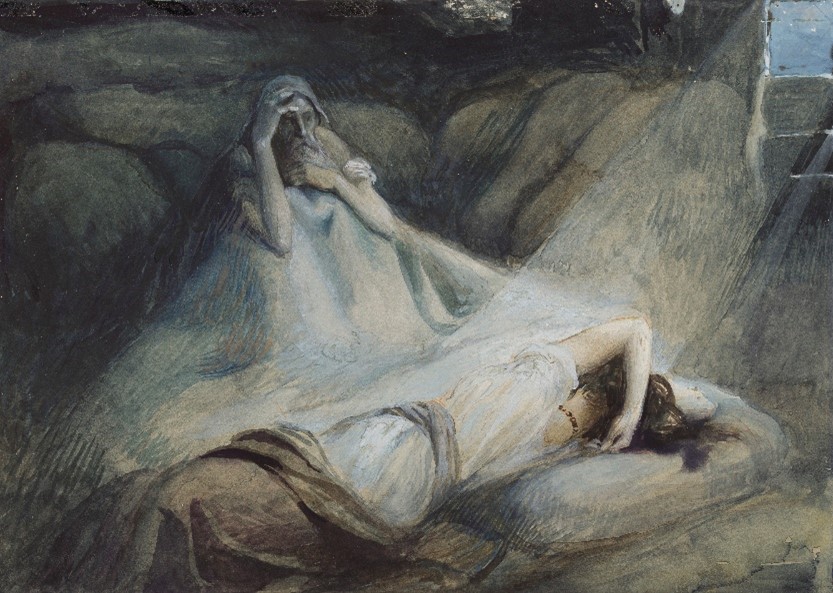
‘Ruth and Boaz’ by James Jacques Joseph Tissot (1836-1902).
Boaz, more concerned for Ruth’s reputation than either Ruth or Naomi, sends her away in the morning ‘before one person could recognize another; for he said, “It must not be known that the woman came to the threshing-floor.”’ He then approaches the actual next-of-kin, telling him ‘Naomi, who has come back from the country of Moab, is selling the parcel of land that belonged to our kinsman Elimelech’. This is the first we have heard of any piece of land that Naomi can sell to support herself and Ruth. Why has Ruth been gleaning in the fields all this time, if there is an alternative? Does the field exist at all, or has Boaz simply made it up to see off this alternative redeemer? Had Elimelech decided not to trouble his wife with knowledge of his business affairs, assuming that their two sons would look after her? At first the next-of-kin, whose name we never learn, agrees to buy the land to keep it in the family. But then Boaz tells him that with the land will come Ruth: ‘The day you acquire the field from the hand of Naomi, you are also acquiring Ruth the Moabite, the widow of the dead man, to maintain the dead man’s name on his inheritance.’ This means that it shall be Ruth’s eldest child who will inherit the parcel of land, in the name of Ruth’s late husband, Mahlon. Since he will not be able to keep the land if he acquires it, the next-of-kin replies, ‘I cannot redeem it for myself without damaging my own inheritance. Take my right of redemption yourself, for I cannot redeem it.’
Commentators agree that Boaz is making up this requirement for the next-of-kin to take Ruth to raise heirs for Mahlon and Elimelech. Only brothers were required to do this under the Torah. Jewish midrash says that we do not learn the name of the next-of-kin because he refused to establish the name of Mahlon, but this is as unfair as the midrash that said Orpah was the ancestor of Goliath. Orpah and this unnamed next-of-kin are behaving both reasonably and lawfully. The point is that they are being compared with Ruth and Boaz, who do much more than the law requires. Ruth has put herself at risk going gleaming alone, something that Boaz recognises when he tells her not to glean in another’s field, but to stay in his field where she will be safe. She has followed Naomi’s instructions even when they put her in definite danger, seeking Boaz out alone at night in compromising circumstances. Because she does more than the law requires, Ruth is first able to feed Naomi, and then to give her a son to replace the two lost in Moab. Boaz tells his men to pull out handfuls of grain for Ruth to glean, he accepts her marriage proposal when she appears in his bed, and now he agrees ‘to maintain the dead man’s name on his inheritance’. We see the Lord’s approval of Ruth and Boaz’s extra-judicial kindness. Ruth and Mahlon had been married for ten years without producing children; Ruth conceives as soon as Boaz ‘enters her’ which is the meaning of the Hebrew that the NRSV politely translates as ‘they came together’. Ruth’s pregnancy is the only act that the narrator of the book explicitly attributes to the Lord, maybe because it was unlikely – Boaz seems to have been old and Ruth seems to have previously been barren.
Today’s reading ends with a chosen, non-biological, family. When Ruth and Boaz have a son, the son is named not as theirs, nor as Mahlon’s, not even as Elimelech’s, but as Naomi’s. It is Naomi who takes the child and nurses him, and it is the women of the neighbourhood who name him, Obed, one who serves. It is Obed who will serve as Naomi’s next-of-kin, a restorer of her life and a nourisher of her old age. This is why the women tell Naomi that Ruth, who has provided Naomi with a redeemer, ‘is more to you than seven sons’. Some commentators have seen this ending as displacing the Moabite mother and replacing her with a good Judean one, but it also replaces the wealthy male Boaz with the previously impoverished widow Naomi as head of this strange family. The Book of Ruth is profoundly counter-cultural.
The Lord seldom appears in the Book of Ruth. After the famine that sent Elimelech and his family to Moab, Naomi hears ‘that the Lord had had consideration for his people and given them food’. Does this mean that the Lord had previously sent the famine? Noami describes what has happened to her in Moab as the Lord’s fault: ‘I went away full, but the Lord has brought me back empty; why call me Naomi when the Lord has dealt harshly with me, and the Almighty has brought calamity upon me?’ Naomi blesses Orpah and Ruth in the name of the Lord; Ruth makes her vow in the name of the Lord; when he encounters her in his field Boaz tells Ruth, ‘May the Lord reward you for your deeds, and may you have a full reward from the Lord, the God of Israel, under whose wings you have come for refuge’; Naomi, on hearing that Ruth has gleaned in Boaz’s field exclaims, ‘Blessed be he by the Lord, whose kindness has not forsaken the living or the dead!’; Boaz again tells Ruth when he finds her at his feet in the night ‘May you be blessed by the Lord, my daughter’ – but in none of these cases is the Lord said to have been acting. Ruth’s pregnancy is the only act that the narrator of the book explicitly attributes to the Lord. The Book of Ruth is a book about how people are to behave when God is absent, or at least when God seems to be so. They are to overstep prescribed legislation and customs; they are to break down barriers with ‘bad behaviour’ that comes from concern for the marginalised, impoverished, and foreign. Whether it is the many ways in which the Moabite Ruth cares for Naomi, or the social boundaries that Boaz ignores when he gives Ruth water, grain, marriage, and a child, in the Book of Ruth abundant life comes from people doing more than the law requires, even doing what the law tells them not to do.
The product of all this hesed, loving-kindness, and boundary-breaking is not just life in its fullness for Naomi and Ruth. The child that Ruth and Boaz give Naomi becomes the father of Jesse, the father of David. Through the actions of Naomi, Ruth, and Boaz, Israel receives its greatest king. Because of their hesed, the entire nation experiences abundant life. Since Ruth is one of the four women Matthew names in his genealogy of Jesus, (Matthew 1:5) we too have received fullness of life from Naomi, Ruth, and Boaz’s willingness to challenge the expectations and prejudices of their day.
The Book of Ruth’s advice for us is that if we cannot see God acting in the world, we should widen our gaze. God may be acting through unlikely people: boundary-breakers who ignore the rules that tell them to care only for those like them; penniless foreign widows the law wants to deport. Or it may be that God is waiting to act through us, waiting for us to imitate the hesed of Ruth and Boaz. In times of difficulty and danger, when the world is terrifying and God seems absent, God is still present. To quote Saint Teresa of Avila: ‘Christ has no body but yours; no hands, no feet on earth but yours; yours are the eyes with which he looks compassion on this world; yours are the feet with which he walks to do good; yours are the hands, with which he blesses all the world.’ Of course God is not absent! God is in us. Amen.

 Rev Doc Geek