
Reflection for North Balwyn Uniting Church
20th of October 2024
Hebrews 5:1-10
Mark 10:35-45
‘In the days of his flesh, Jesus offered up prayers and supplications, with loud cries and tears, to the one who was able to save him from death, and he was heard because of his reverent submission.’
You will remember, because I am sure that you have memorised all my Reflections, that on the fifth Sunday in Lent this year we had the second half of today’s reading from the Letter to the Hebrews. I want to quote something I said on that Sunday, about what it means that the author of the Letter to the Hebrews says that Jesus ‘offered up prayers and supplications, with loud cries and tears’. I believe that the author is telling us that the only necessary high priest, the sole mediator between God and humanity, the one who offers prayers and sacrifice to God on humanity’s behalf, also brings to God the grief of the world. We often look at a world ruled by violence and feel anguish and isolation and anger. In this reading we are shown God in Jesus grieving the world’s violence with the same passion that we feel.
So often when we are confronted by the world’s evil we cry out, ‘Where is God?’ The Letter to the Hebrews tells us that in Jesus God protests the evil of the world with loud cries and tears, so that when we cry out in angry repudiation we are doing that with God.
This past week has been a time for crying out in angry repudiation at the inhumanity of humanity. I am not going to describe what happened in Gaza early on Monday morning, because I know that some of you are limiting your exposure to news for good reasons. And we have known for a year that Israel is committing genocide, we do not need to know the specifics to know that what is happening is evil. Like every other war crime and crime against humanity throughout history, this genocide forces us to ask: Where is God when human beings are slaughtering other human beings? Why does God not stop it? Does God even care?
I have returned to reading the works of the German theologian Jürgen Moltmann, who died earlier this year. According to the World Council of Churches Moltmann is one of the most widely read Christian theologians of the past eighty years, so I am not alone in turning to him. Moltmann’s faith was born out of his experiences during World War Two. He was in an anti-aircraft battery during the British bombing of Hamburg in July 1943, in which tens of thousands of people died, including the friend standing next to him. Moltmann says that his question then was not, ‘Why has God let this happen?’ Instead, it was: ‘My God, where are you? Where is God? Is he far away from us, an absentee God in his own heaven? Or is he a sufferer among the sufferers? Does he share in our suffering? Do our sufferings cut him to the heart too?’[1]
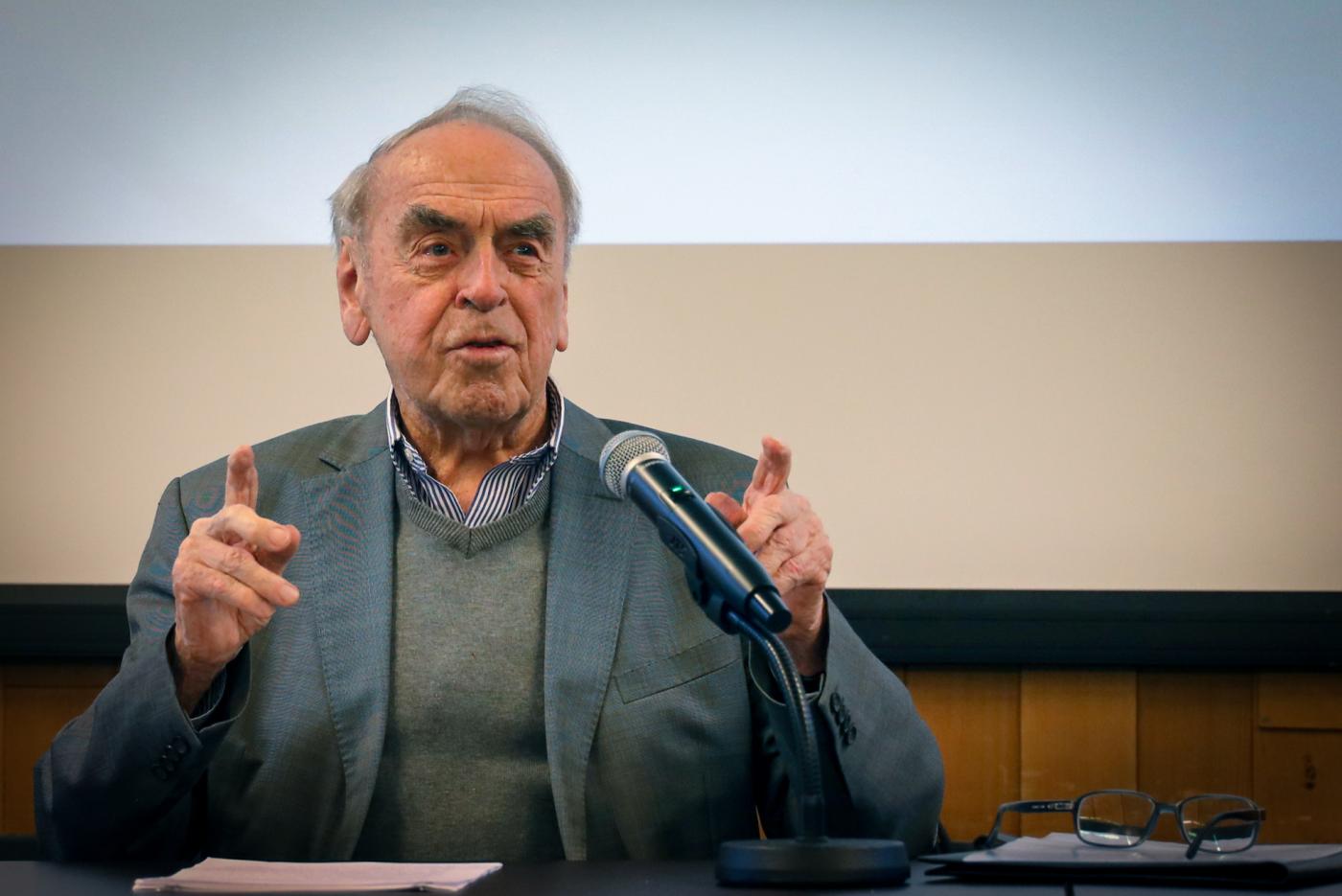
Jurgen Moltmann at Bossey, 2019.
In 1945 Moltmann surrendered to the first British soldier he met on the front lines, and until 1948 he was held in various British prisoner-of-war camps. In a camp in Scotland photographs of the Buchenwald and Bergen-Belsen concentration camps were nailed up in the prisoners’ huts. At first the prisoners believed that the photos were propaganda, but that defence could not last, and they had to learn to live with the truth. Moltmann said that he encountered God in the god-forsakenness of those camps, that ‘I never decided for Christ, as is often demanded of us, but I am sure that, then and there, in the dark pit of my soul, he found me.’[2]
In his theology Moltmann describes Christ as:
The passionately loving Christ, the persecuted Christ, the lonely Christ, the tortured Christ, the Christ who suffers under God’s silence – this is our brother, the friend to whom we can entrust everything because he knows everything and has suffered everything that can happen to us, and more even than that.[3]
And because the historical Jesus who died as a blasphemer and a political rebel, abandoned and rejected by the God he knew as Father, is also himself God:
There is no suffering which in this history of God is not God’s suffering; no death which has not been God’s death in the history on Golgotha. Therefore there is no life, no fortune and no joy which has not been integrated by his history into eternal life, the eternal joy of God.[4]
Moltmann was ‘doing theology after Auschwitz’.[5] We are still living ‘after Auschwitz’ and now we are watching some of the descendants of those who suffered in Auschwitz repeating it. At this moment I hold on to what Moltmann said about Jesus’ abandonment by his Father on the cross:
Anyone who suffers without cause first thinks that he has been forsaken by God. God seems to him to be the mysterious, incomprehensible God who destroys the good fortune that he gave. But anyone who cries out to God in this suffering echoes the death-cry of the dying Christ, the Son of God. In that case God is not just a hidden someone set over against him, to whom he cries, but in a profound sense the human God, who cries with him and intercedes for him with his cross when man in his torment in dumb.[6]
When God became human in Jesus, God not only experienced human suffering: in his death on the cross God also experienced god-forsakenness. In Jesus God did not die a natural death, but the violent death of a criminal, a death of complete abandonment by God.[7] Because in Jesus God took on everything that godless and godforsaken humanity suffer, in Jesus all the godless and the godforsaken can experience communion with God.
Moltmann does not simply leave us with the crucifixion. The other side of the crucifixion is resurrection; the other side of suffering is hope. Faith in the resurrection, Moltmann says, ‘is the great hope which consoles us and gives us new courage’.[8] Resurrection provides the hope and promise of eternal life amid death. It does more; it inspires us to work with God to bring life from death. ‘Resurrection,’ Moltmann writes, ‘is not a consoling opium, soothing us with the promise of a better world in the hereafter. It is the energy for the rebirth of this life’.[9] When we watch crucifixion, we know that God intends every crucifixion to be followed by resurrection, and we have a role to play in making that happen.

Jurgen Moltmann and Elizabeth Moltmann-Wendel in 1970
In today’s gospel reading we hear Jesus referring to his forthcoming death, ‘Are you able to drink the cup that I drink, or be baptized with the baptism that I am baptized with?’ He tells his disciples that ‘the Son of Man came not to be served but to serve, and to give his life a ransom for many.’ In Jesus we see the God who is willing to serve, to suffer and die for humanity. As we watch innocents suffer and die, as we feel helpless in the face of evil, the one thing of which we can be certain is that the God revealed in Jesus is suffering and dying with them. They are not alone. That is, of course, not enough, but I do hope that it helps at least a little, as we walk the road that we have faith will end in resurrection.
[1] Jürgen Moltmann, Jesus Christ for Today’s World (Minneapolis: Fortress Press, 1994), p. 31.
[2] Jürgen Moltmann, The Source of Life: The Holy Spirit and the Theology of Life. (Minneapolis: Fortress Press,1997).
[3] Jesus Christ for Today’s World, p. 36.
[4] Jürgen Moltmann, The Crucified God, (London: SCM Press, 1974) p. 255.
[5] The Crucified God, pp. 283, 287.
[6] The Crucified God, p. 261.
[7] The Crucified God, p. 286.
[8] Jesus Christ for Today’s World, p. 72.
[9] Jesus Christ for Today’s World, p. 81.

 Rev Doc Geek