Reflection for North Balwyn Uniting Church
13th of October 2024
Hebrews 4:12-16
Mark 10:17-31
‘The word of God is living and active, sharper than any two-edged sword, piercing until it divides soul from spirit, joints from marrow’. Did today’s gospel reading scare you? It scares me. Every time I hear the story of the rich man who sadly leaves Jesus because he has many possessions, I feel as shocked as he was and as astounded as the disciples. I hear Jesus’ words: ‘go, sell what you own, and give the money to the poor’ as a command that I am failing to obey; his statement: ‘It is easier for a camel to go through the eye of a needle than for someone who is rich to enter the kingdom of God’ as a dreadful warning. I live a relatively modest life by Australian standards, but Australians do not live modest lives by world standards. I do give some money, but I am far from selling what I own and giving the money to the poor. My enormous library and Lego collection both convict me, and this reading alarms me.
I am obviously not alone in this, because for centuries Christians have tried to soften Jesus’ statement. I love the children’s picture book, The Little Gate.[1] I happily read the story of the very proud camel trying to get through the very small gate in Jerusalem’s wall, finally only able to get through the gate when divested of all his rich trappings and on his knees. It is a great interpretation. Sadly, there is no evidence that there ever was a narrow gate in the walls of Jerusalem known as the Eye of the Needle, and no evidence of this interpretation of the passage until the ninth century. Nor does it help us to change one letter in the Greek word and turn a camel into a rope. This is not a saying about a camel trying to get through a gate or a rope being threaded through a needle. It is a saying about a camel trying to get through the eye of a needle, which is impossible. That is the point.
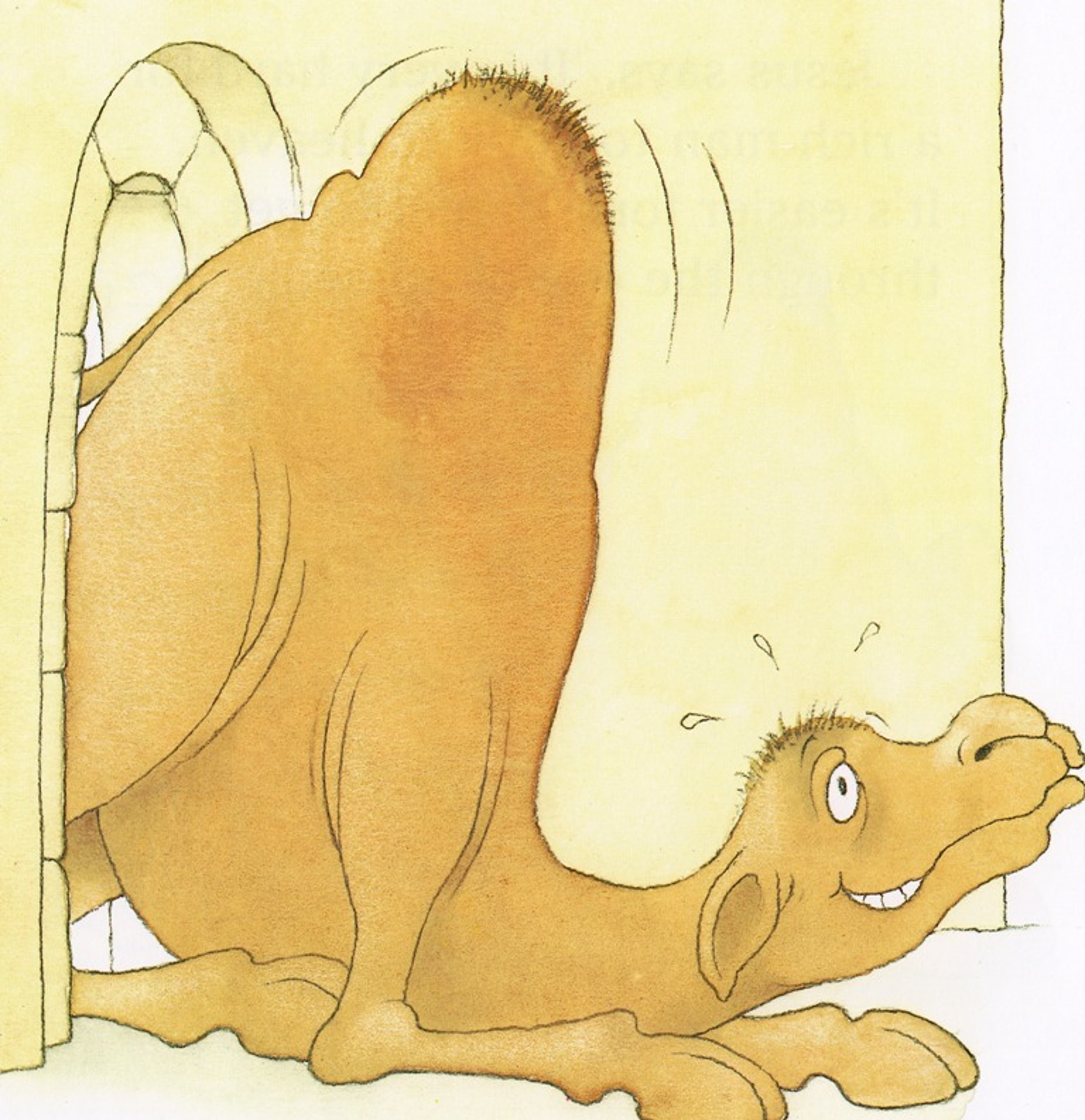
By Mick Inkpen from The Little Gate.
A man approaches Jesus: ‘Good Teacher, what must I do to inherit eternal life?’ Jesus responds with a list of commandments. These commandments come from the second part of the Ten Words; they are the ones that govern our relationships with our neighbours. Except for the last one, honouring father and mother, they are all negative commandments. They are all about things people are not to do. The man realises that just not doing something is not enough. Simply managing not to kill someone is a low threshold to qualify to be an authentic follower of Jesus. The man tells Jesus: ‘Teacher, I have kept all these since my youth,’ yet he is still on his knees before the Teacher seeking the secret of eternal life.
This is the only call that Jesus issues in the Gospel according to Mark that is answered with a ‘no’. Jesus invites the man to follow him, after selling all he has and giving the proceeds to the poor. The man goes away grieving, for he has many possessions. This is the first time in the story that we hear that he is rich, and it seems to prevent him from answering Jesus’ call. It could be, of course, that he goes away grieving because he is planning to sell all that he has, and that is painful. I know that if I had to sell my library there would be tears. But Jesus’ words to his disciples suggest that he knows that man is not going to manage it: ‘How hard it will be for those who have wealth to enter the kingdom of God!’
The disciples are understandably puzzled by this. Wealth was understood as a sign of God’s favour. With very few exceptions (the Book of Job, for instance) it was believed that the righteous prospered and the wicked were unsuccessful. More than that, the wealthy had the opportunity to give alms, to share what they had with the poor, to make donations in the Temple. They had the leisure to pray and to study the scriptures. It should therefore be easier for them to enter the kingdom of heaven than it would be for the poor, who had nothing to share and little time for religious pursuits. That was just common sense.
Once again, as in last week’s reading, Jesus is overturning the status quo and radically reordering society’s priorities. Last week it was the role of women and children in a patriarchal society. Women were not to be cast off and left homeless and without support because their husbands found something objectionable about them. Children were not to be kept away from important men, because it was to such as them that the kingdom of God belonged. This week Jesus overturns the status quo by saying that there is a greater source of security than money and that the rich are not especially favoured by God. He also reminds the rich man that God alone is good, and reassures his disciples that for God all things are possible. And those last two statements are what we need to remember as we listen to this story.
Last week, we heard of children being brought to see Jesus. During that story, Jesus told the people: ‘Truly I tell you, whoever does not receive the kingdom of God as a little child will never enter it.’ In this week’s reading we have a man who did not hear what Jesus said. Instead of being willing to receive the kingdom like a child, he wants to earn his place in it. The trouble is that no one can earn their place in the kingdom. As Jesus rebuked him at the beginning of their encounter, God alone is good, and no one can be good enough to inherit eternal life.
It is not just the wealthy who will find it hard to enter the kingdom. The disciples realise this. They are astounded to find that it will be harder for the rich to enter the kingdom than for the poor, but they also say to one another, ‘Then who can be saved?’ How then can anyone inherit eternal life, if it is not possible to earn it? Jesus answers them with the good news: ‘For mortals it is impossible, but not for God; for God all things are possible.’ Salvation cannot be earned, but it has been given. It is to those who are like little children that the kingdom belongs, to those who receive it as unmerited gift.
Does this mean we do not have to worry about obeying commandments, and that we can relax when we hear about that camel? Not according to the biblical commentators. We cannot earn eternal life through our actions, but our actions are still important. As one commentator on this passage says: ‘the tension of this radical text resists resolution in any way that removes its pressure on all disciples relative to wealth’.[2] As I have said before, what we do with money is a spiritual matter and wealth, rather than being a simple sign of God’s favour, is an ethical issue. Jesus calls his disciples to a new and radical world in which the ordinary social standards no longer apply, and in which security comes from God and not from material possessions. Relying on God and embracing the radical new way of life to which Jesus invites us may free us from the obsession with wealth that makes it so hard for us to give up possessions.
Brendan Byrne, who taught me New Testament and so on whom I am prone to rely, writes: ‘Despite its conclusion on a positive note, this section of Mark’s gospel presents perhaps the most radical challenge for contemporary readers.’[3] Nothing I say can in any way soften or explain away that challenge. This is a difficult, puzzling, frightening, text, particularly for many of those of us in Australia, rich in world terms simply by virtue of where we live. It challenges us to be honest about our priorities and how it is that we live. As today’s reading from the Letter to the Hebrews has it, ‘the word of God … is able to judge the thoughts and intentions of the heart. And before God no creature is hidden, but all are naked and laid bare to the eyes of the one to whom we must render an account.’ God knows what our attitude to our wealth is, and whether we are sharing it with the poor on God’s behalf, or using it to cushion and isolate us from the needs of the world.
But as today’s reading from Hebrews also reminds us ‘we do not have a high priest who is unable to sympathize with our weaknesses’. God knows how we are tempted, and when we give in to temptation God sympathises with us because in Jesus God went through the same testing. God’s mercy and grace are certain, no matter how we fail and fall short. Today’s texts challenge us; they also reassure us that we can ‘approach the throne of grace with boldness’. For God, all things are possible, including saving us. Thanks be to God. Amen.
[1] Nick Butterworth and Mick Inkpen, The Little Gate (Candle Books, 2008).
[2] Lamar Williamson, Jr. Mark, p. 188.
[3] Brendan Byrne, A Costly Freedom, p. 165.

 Rev Doc Geek
Hi ,
(Mark 10 : 25) states:‘It is easier for a camel to go through the eye of a needle, than for a rich man to enter into the kingdom of God.’
The verse is propounded nicely in this article.
This is the explanation in brief
about :
The camel going through the eye
of a needle.
‘The eye of a needle ‘is the metaphoric statement of Jesus.You will get its picture in web ( No. 1) by writing at the top: ” The picture of eye of a needle .
The “Sheep Gate”is the gate in Jerusalem that camels had to crawl through. At this time, Jesus was in Jerusalem. This is stated in (Matthew 19: 1) :‘ Jesus departed from Galilee, and came into the coasts of Judaea beyond Jordan.’
And, Jerusalem is located within
the historical region of Judaea.
[The verse (Mark 10 :25) is stated also in ( Matthew 19:24) ]
This is the verse about the”Sheep Gate” in Jerusalem ._:
(John 5 : 1-2) :
‘After this there was a feast of the Jews, and Jesus went up to Jerusalem. Now there is in Jerusalem by the Sheep Gate a pool, in Aramaic called Bethesda.’
<><><><><><><><>