Reflection for North Balwyn Uniting Church
18th of August, 2024
Ephesians 5:15-20
Make ‘the most of the time, because the days are evil.’ Give ‘thanks to God the Father at all times and for everything in the name of our Lord Jesus Christ.’ The author of this Letter is telling the members of the church in Ephesus how to live, now that these Gentiles have joined Jewish followers of Jesus in a new community. The author seems a little confused. The Ephesians are living in evil days, but they are still to give thanks to God at all times for everything. What does the author mean?
In today’s passage the Ephesians are given two instructions: live wisely; allow yourself to be filled with or by the Spirit. Many biblical authors remind their readers of the importance of being wise, rather than foolish. Jesus himself is recorded as talking about a wise man who builds his house on the rock and a foolish one who builds his house on the sand; (Matthew 7:24-27) and about wise bridesmaids who take enough oil for their lamps and foolish bridesmaids who take no extra flasks. (Matthew 25:1-13) But Jesus also said, ‘I thank you, Father, Lord of heaven and earth, because you have hidden these things from the wise and the intelligent and have revealed them to infants’ (Matthew 11:25) and Paul wrote: ‘Where is the one who is wise? Where is the scribe? Where is the debater of this age? Has not God made foolish the wisdom of the world? … For God’s foolishness is wiser than human wisdom, and God’s weakness is stronger than human strength.’ (1 Corinthians 1:20-25) The instruction, ‘Be careful then how you live, not as unwise people but as wise,’ will not mean living in the way that the surrounding culture thinks of as wisdom.
To live a wise life, according to this author, is to make right use of the time that is available. The author is certain that the world contains evil and darkness, and equally certain that Christians are to live in the light. Knowing both that every day we have is a gift from God, and that our days will end, we are to make appropriate use of the days we have been given. We are to do the will of the Lord: living as God’s beloved children; participating in the new community that Jesus has created out of the previously divided Jews and Gentiles; doing justice and demonstrating love.
The author’s warning that the Ephesians should ‘not be foolish’ is a reminder that there are dangers to faith and that following the will of the Lord does need discernment. Many people claim to know what the will of the Lord is, and some such claims are foolish, while others are dangerous. The over-arching theme of this Letter is the reconciliation between previously opposed groups, so we know that anything that has as its goal the division of Christians is foolish. Divisions sadly do happen, when Christians disagree on matters they consider fundamental, but it is much worse when Christians deliberately divide the church. This happened in Nazi Germany in 1933 when the General Synod of the Prussian Union of Churches adopted the ‘Aryan paragraph’ as church law, expelling all pastors and church employees of Jewish or Slavic descent. Even earlier, in 1910, the South African Dutch Reformed Church had established separate churches for Black and white South Africans, and the denomination continued to support apartheid until 1986. In both cases, we see churches whose members were ‘unwise people’ submitting to the evil of the day.
In today’s passage the Ephesians are also told to live lives of ‘sober inebriation,’ as the Church Fathers of the early centuries put it. Rather than becoming inebriated with wine, Christians are to become inebriated with the Spirit. As someone who comes from a background of dour Scottish Presbyterianism, I find the idea of being drunk in the Spirit slightly off-putting. But remember the accusation made of the disciples at Pentecost, that they were filled with new wine, and Peter’s defence that, no, they were sober, because it was only nine o’clock in the morning. (Acts 2:13-15) There is a long history of Christians being so filled with joy and ecstasy that they seemed to unsympathetic bystanders to be drunk.
When Christians are under the influence of the Spirit, filled with or by Her, certain activities flow. Singing together as a community is the first that the author lists: ‘sing psalms and hymns and spiritual songs among yourselves’. All human beings sing. Babies pay more attention to people singing than speaking, and people with dementia can still sing long after they have stopped speaking. When people sing together, not only do they start to synchronise their breathing, they also start to synchronise their heartbeats. So it is no wonder that singing is at the heart of communal worship. Saint Augustine said that those who sing pray twice, in music as well as in words, and observed that, ‘Apart from those moments when the scriptures are being read or a sermon is preached, when the bishop is praying aloud or the deacon is speaking the intention of the litany of community prayer, is there any time when the faithful assembled are not singing?’[1]
John Wesley told the Methodists, ‘Sing lustily and with a good courage. Beware of singing as if you were half-dead, or half-asleep; but life up your voice with strength … Sing modestly – do not bawl so as to be heard above or distinct from the rest of the congregation that you may not destroy the harmony, but strive to unite your voices together so as to make one melodious sound.’ I seldom sing in church because I cannot sing in tune, and I am afraid of putting the rest of you off. The only worship I have experienced where people have sung joyfully out of tune was at the World Council of Churches’ ecumenical institute in Switzerland. My African colleagues reminded me that the Psalms tell us to make a ‘joyful noise’ to the Lord, (Psalms 66:1, 95:1, 98:4, 100:1) not necessarily a tuneful noise. But, as I said earlier, my heritage is Scottish Presbyterian, not African, and I save singing lustily for the car or the shower.
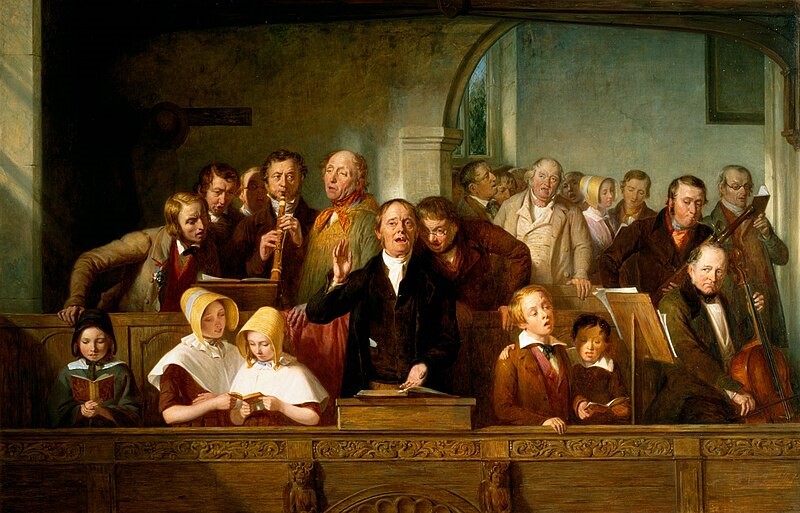
‘Village Choir’ by Thomas Webster (1847)
I cannot claim that by not singing aloud in church I am following the instruction from today’s reading to sing and make melody ‘to the Lord in your hearts’. ‘In your hearts’ does not mean silently. We should sing from our hearts, from the core of our being, bringing our whole selves into our song. Both our heads and our hearts are engaged when we praise God in song and we need not fear music making us emotional. That is part of the ‘sober inebriation’ the Church Fathers recommended. But we still need to be wise in our choice of music. There is a reason every army in the world uses music to encourage its troops; music can overcome our rational minds and lead us to commit acts that we would not otherwise do. Until 1996 the UK classified bagpipes as weapons of war, not because the British government lacked musical taste and was unable to appreciate the beauty of the pipes, but because after the Battle of Culloden the Court of Exchequer argued that since Highlanders never marched without a piper the bagpipe, in the eye of the law, must be an instrument of war. We must never allow our psalms and hymns and spiritual songs to become instruments of war rather than peace, or hatred rather than love.
Filled by the Spirit, singing in community, singing with our whole selves, body, mind and heart, we are to give ‘thanks to God the Father at all times and for everything in the name of our Lord Jesus Christ’. We know that our days on this earth are limited and that it can be difficult to live wisely in a world in which there is so much evil: hatred; family violence; war; greed; homelessness; children dying of starvation while billionaires take rockets into space. Yet there is so much for which we can give thanks. That we are here, together, on this day the Lord has made is gift enough for thanks. That we are able, most of us, (not me) to sing to the music of our wonderful organ as played by Bruce, is gift enough for thanks. That when this service is concluded we will continue to worship God by gathering over cups of tea and coffee, is gift enough for thanks. That Jesus has called us into community and so we know that we are not alone, is gift enough for thanks. Our thanksgiving may not be so exuberant that bystanders think we are drunk on wine, but as we give thanks to God the Father in the name of our Lord Jesus Christ we join with every other Christian throughout time and space who does that same, we are united with them in the Spirit, and that certainly is gift enough for thanks. Thanks be to God the Father, and to the Lord Jesus Christ, and to the Spirit who fills us with joy. Amen.
[1] Don. E. Saliers, ‘Singing Our Lives’ in Dorothy C. Bass (ed.), Practicing Our Faith: A Way of Life for a Searching People (1997), p. 183.

 Rev Doc Geek