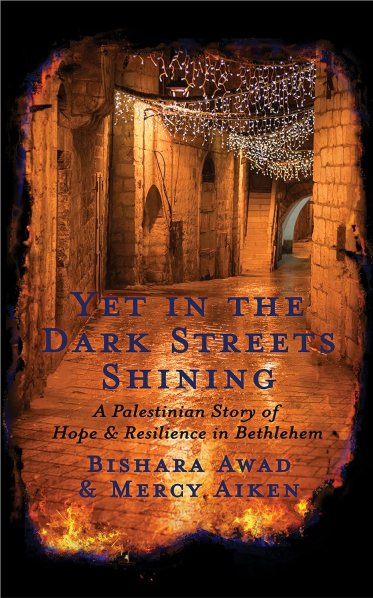
Bishara Awad and Mercy Aiken, Yet in the Dark Streets Shining: A Palestinian Story of Hope and Resilience in Bethlehem, Cliffrose Press, 2021, paperback, 217 pp.
The death of one man is a tragedy; the death of millions is a statistic, as Josef Stalin probably did not say. When it comes to the Israel-Palestine conflict the attitude of the Western world seems to be that the death of a single Jewish Israeli is a tragedy; the deaths of thousands of Palestinians are the unfortunate results of a necessary war.
This story of the family of Elias Awad, descended from Maronite Christians, and his wife Huda Kuttab, born into a Greek Orthodox family but supported by evangelical Protestant missionaries after the death of her father, gives human faces to Palestinian statistics. Bishara Awad, the founder of the Bethlehem Bible College, was born on the day World War Two began. He was eight when an Israeli sniper shot his father during the violence that Jewish Israelis call the War of Independence and Palestinians call the Nakba, the Catastrophe. After Elias’ death, the Awad family fled their home in West Jerusalem, assuming that it was only for a little time. Seventy-six years later they are still unable to return.
Since his saintly mother forgave her husband’s killers, Bishara pretended to do the same. ‘Wanting to be a good Christian, I would spend the first half of my life unconscious of my anger, putting a smile on my face that would hide my wound even from myself.’ It took years for Bishara to recognize his own rage, his hatred of Israelis, and his deep sorrow that the world’s Christians ignored the oppression of Palestinians. Only after acknowledging the truth of his trauma was Bishara able to experience the compassion of Christ for both Palestinians and Jewish Israelis. Daily Bishara now chooses to forgive, to look into the darkness with hope and love, desiring God’s best for Palestinians and Israelis alike.
Bishara writes that three issues make it difficult for Western Christians to listen to Palestinians: guilt over Christian antisemitism; belief in Israel as an ally of the West; and, most potently, Christian Zionism, the belief that the State of Israel is the fulfilment of prophecy and a harbinger of the eschaton. Of the three, it is probably the first that keeps members of the Uniting Church silent on the question of Palestine. Bishara’s story makes it clear that Western Christians must not assuage our own guilt at the expense of Palestinians.
Parts of this story are profoundly hard to read while watching the destruction of Gaza. Bishara has a lyrical description of falling in love with his wife Salwa there, in a rich agricultural land filled with groves of citrus and other fruit trees, where flowers climbed on buildings and jasmine scented the air. Bishara’s description of his family’s situation during the Nakba mirrors the images we now see of Gazans desperately seeking safety in Rafah. Most members of the Awad family now live overseas; will this happen to today’s internally displaced Gazans?
Bishara ends his book with a plea to Christians around the world to help Palestinians work for justice, to help end the suffering of both Palestinian and Israeli people. Will we have the courage to do so?

 Rev Doc Geek