Reflection for North Balwyn Uniting Church
14th of January, 2024
John 1:43-51
1 Corinthians 6:12-20
We think that we have chosen to follow Jesus, but it is Jesus who has chosen us as his followers. We think that we made the decision to come to church today to worship God, but we arrived here at God’s initiative. Last week, when we celebrated the Epiphany, I said that what was true for the magi is still true for us; we believe that we are the ones seeking God, but all our lives God has been seeking us. We see this confirmed in today’s story from the Gospel according to John, in which Jesus calls some of his first disciples.
The lectionary splits this story across multiple years. On the Second Sunday of Epiphany last year the Gospel reading had John the Baptizer sending two of his own disciples to follow Jesus. Those two addressed Jesus as Rabbi, teacher, and asked him where he lived, to which he replied, ‘Come and see’. After spending time with Jesus one of those disciples, Andrew, found his brother Simon and told him that they had found the Messiah. Jesus then named Simon ‘Cephas,’ Peter, the rock on whom Jesus would later build his Church. (John 1:35-42)
That is the context of today’s gospel reading. When it says, ‘The next day Jesus decided to go to Galilee,’ it is immediately after the day on which two of the disciples of John the Baptizer had become followers of Jesus and one, Andrew, has also brought his brother. We can see that John’s story of the calling of Jesus’ first disciples is very different from the stories Mark, Matthew, and Luke tell, all of which talk of Jesus calling fishermen from their boats and nets, and in none of which John the Baptizer is mentioned. With John the Evangelist we are in the world of symbolism, not necessarily of historic fact, and so we need to read today’s story symbolically. It is a story about who Jesus is and where Jesus comes from, on at least two different levels.
Jesus is going to Galilee of the Gentiles, which might be why he finds Philip, who has a Greek name and comes from Bethsaida, a predominantly Gentile town. There is no mention that Philip is looking for a teacher; all the initiative comes from Jesus. Philip then finds Nathanael, who is understandably sceptical when Philip tells him that they have found ‘him about whom Moses in the law and also the prophets wrote’ in the person of a man from Nazareth. In the story of the Epiphany, we heard the chief priests and the scribes tell Herod and his court that the Messiah would come from Bethlehem in Judea, the town to which Naomi had returned with Ruth after spending time in Moab, the town in which the great King David had been born. Nowhere in the Jewish scriptures or writings had Nazareth even been mentioned, let alone named as the place from which the Messiah would come. It is understandable that Nathanael asks, ‘Can anything good come out of Nazareth?’ Philip’s answer is simple, and the same that Jesus gave Andrew and the other disciple of John the Baptizer: ‘Come and see.’ Coming and seeing is the way people enter discipleship. To invite someone to come and see is the invitation to an epiphany.
It was Jesus who had found Philip; we now find that although it is Philip who has brought Nathanael to him, Jesus already knows him, too. He describes Nathanael as ‘an Israelite in whom there is no deceit’ and can explain to Nathanael that he knows this because he saw Nathanael under the fig tree before Philip called him. This foreknowledge and inner knowledge of Nathanael’s character is enough for Nathanael to address Jesus as ‘Son of God’ and ‘King of Israel,’ messianic titles. Apparently something good can come out of Nazareth, although we know, having read John the Evangelist’s Prologue, that Jesus has also come from God, and the beginning of Creation. Jesus then tells Nathanael that he will see greater things than these.
So much Johannine symbolism. We hear echoes of the story of Jacob, the first man to be given the name ‘Israel’. Nathanael is ‘an Israelite in whom there is no deceit,’ the complete antithesis of Jacob, son of Isaac, who was full of deceit. Nathanael is being presented as the model Israelite, able to overcome his prejudice against Nazareth to ‘come and see,’ and then to recognise Jesus as Messiah. He does not become one of the Twelve, but after Jesus’ death and resurrection we are told that he is one of the group of men who go fishing with Simon Peter, and so he participates in the miraculous catch of fish and the breakfast on the beach. (John 27:2) Nathanael, the representative of what it means to be an Israelite now that the Messiah has come, is present at the beginning and the end.
Since John so loves his symbolism it is probably no accident that Nathanael was under a fig tree when Philip approached him, and Jesus saw him. According to the prophet Micah sitting under a fig tree was a sign of the messianic age: a time would come when ‘nation shall not lift up sword against nation, neither shall they learn war any more; but they shall all sit under their own vines and under their own fig trees’. (Micah 4:3-4) The prophet Zechariah said that one day, ‘you shall invite each other to come under your vine and fig tree.’ (Zechariah 3:10) Nathanael is sitting under a fig tree and the Messiah has come.
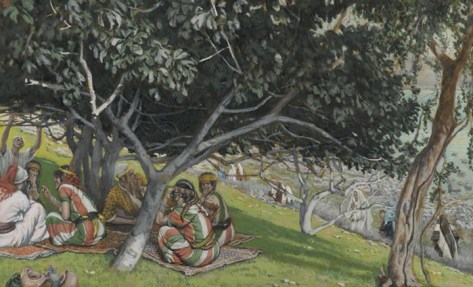
‘Nathanaël sous le figuier’ by James Tissot (1886-1894). Photo: Brooklyn Museum. Used with permission.
When the Trickster Jacob, having deceived his father and brother (Genesis 27), was on his way to his Uncle Laban, there to be tricked himself (Genesis 29:16-30), he slept and ‘dreamed that there was a ladder set up on the earth, the top of it reaching to heaven; and the angels of God were ascending and descending on it’. (Genesis 28:12) God spoke to Jacob in the dream and when he woke he said ‘“Surely the Lord is in this place—and I did not know it!” And he was afraid, and said, “How awesome is this place! This is none other than the house of God, and this is the gate of heaven.”’ (Genesis 28:16-17) Now Jesus foretells heaven opening and ‘the angels of God ascending and descending upon the Son of Man’. Jesus is now the ladder between heaven and earth; it is in his life, death, and resurrection that humans and God will encounter each other face to face.
In today’s story Jesus is the one to whom the law and prophets bear witness; Rabbi or Teacher; Son of God; King of Israel; Son of Man. Jesus is all these things, and he is the son of Joseph, from Nazareth. Jesus is both the Word that existed before Creation, and the man that comes from an unremarkable town of some three hundred people. The glory of God has been revealed in a human person of flesh and blood. In Jesus divine and human encounter each other in mutual intercourse, like angels ascending and descending. We may seek God, reach out to God in longing, but God is also seeking us, reaching out to us with just as much longing. And so God has come to us in Jesus of Nazareth, who is also God.
It is that inter-mingling of divinity and humanity, of God’s glory revealed in the human person, which explains the extract from Paul’s First Letter to the Corinthians that we hear today. Paul is dealing with things that Chloe’s people have reported to him (1 Corinthians 1:11), to which he is responding not to make the Corinthians feel ashamed, but to admonish them as his beloved children. (1 Corinthians 4:14) The original has no punctuation so we can only guess, but we think that ‘All things are lawful for me,’ is what the Corinthians were saying to justify them doing whatever they wanted. Paul would agree; we have been made right with God by faith and have peace with God through Jesus. (Romans 5:1) We do not need to follow the Law. All things being lawful does not mean, though, that all things are beneficial. Furthermore, Paul’s understanding of bodily resurrection means that what the Corinthians do with their bodies matters. The Corinthians believe that they can do anything they like because God will ultimately destroy their bodies. Paul says that this is not true: ‘God raised the Lord and will also raise us by his power. Do you not know that your bodies are members of Christ?’
We do not need to believe in physical resurrection to take what Paul is saying seriously. We have strange ideas about our bodies. We love them and hate them; we pamper them and discipline them. A recent study in Australia found that nearly half the young people surveyed said that their dissatisfaction with their body had stopped them going to the beach, and more than a third said that it had stopped them from giving an opinion or standing up for themselves. Eighty per cent of women are dissatisfied with our bodies. Would it help us to think of our bodies as ‘members of Christ,’ ‘a temple of the Holy Spirit’ within us? Would we treat our bodies with more respect if we remembered that they are gifts to us from God, given to us to glorify God? I find it easy to think of my brain, broken as it sometimes is, as a gift from God to use in the service of God. I can even think the same thing about my money. To think of my body as a good gift of God is much harder, and yet that is what Paul is telling us to do: ‘glorify God in your body’. When God came to us in Jesus he came not just as the glorious Word, but as ‘Jesus son of Joseph from Nazareth’. In the incarnation, God is embodied. Bodies are good, and they matter.
I want to end this week’s Reflection as I did the last, with poetry. This time, a poem about the divine revealed in the ordinary and familiar, as God was revealed to Philip and Nathanael in Jesus of Nazareth.
‘In No Strange Land’ by Francis Thompson (1859-1907)
O world invisible, we view thee,
O world intangible, we touch thee,
O world unknowable, we know thee,
Inapprehensible, we clutch thee!Does the fish soar to find the ocean,
The eagle plunge to find the air—
That we ask of the stars in motion
If they have rumour of thee there?Not where the wheeling systems darken,
And our benumbed conceiving soars!—
The drift of pinions, would we hearken,
Beats at our own clay-shuttered doors.The angels keep their ancient places;—
Turn but a stone and start a wing!
’Tis ye, ’tis your estrangèd faces,
That miss the many-splendoured thing.But (when so sad thou canst not sadder)
Cry;—and upon thy so sore loss
Shall shine the traffic of Jacob’s ladder
Pitched betwixt Heaven and Charing Cross.Yea, in the night, my Soul, my daughter,
Cry,—clinging to Heaven by the hems;
And lo, Christ walking on the water,
Not of Genesareth, but Thames!

 Rev Doc Geek