Reflection for North Balwyn Uniting Church
Christmas Day 2023
Isaiah 52:7-10
Luke 2:8-20
‘How beautiful upon the mountains are the feet of the messenger who announces peace, who brings good news, who announces salvation, who says to Zion, “Your God reigns”.’
Christmas has been cancelled in Bethlehem this year. Ordinarily, Christmas is a peak tourism time as the ‘little town’ of about 30,000 people receives more than three million visitors from all over the world. Not this year. Many of Bethlehem’s residents, both Muslim and Christian, have family in Gaza. Before the Hamas attack against Israel on October 7 the IDF had killed more than 230 Palestinians in the West Bank, where Bethlehem is located; since October 7 about 300 Palestinians have been killed and more than 3000 have been injured there by soldiers and illegal settlers, though there are no Hamas fighters in the West Bank. Given all the violence the Patriarchs and Heads of the Churches in Jerusalem have asked all Palestinian Christians to forego any ‘unnecessarily festive’ activities. Instead, Christians there are invited to pray ‘fervent prayers for a just and lasting peace for our beloved Holy Land’.

Here in Australia we are celebrating Christmas in absolute safety. Our streets are covered with Christmas decorations, and politicians, retailers, and the media all strongly encourage us to participate in festive activities. But I have struggled to get in the Christmas mood. I have told you before that whenever I hear the word ‘peace,’ even in biblical prophecy, even when angels are singing it to shepherds, I am reminded of the lines that the Roman historian Tacitus gave a Scottish chieftain: ‘To ravage, to slaughter, to usurp under false titles, they call empire, and where they make a desert, they call it peace’. That line has been on my mind more than ever this year, because so many people have claimed that there was ‘peace’ between Israel and the Palestinians before the Hamas attack. Anyone who has ever visited the Occupied Territories, as I have, who has walked down the streets of Hebron, visited the Ayda refugee camp, or seen the Separation Wall, knows that there was little peace in the Holy Land before October 7. Now there is none.
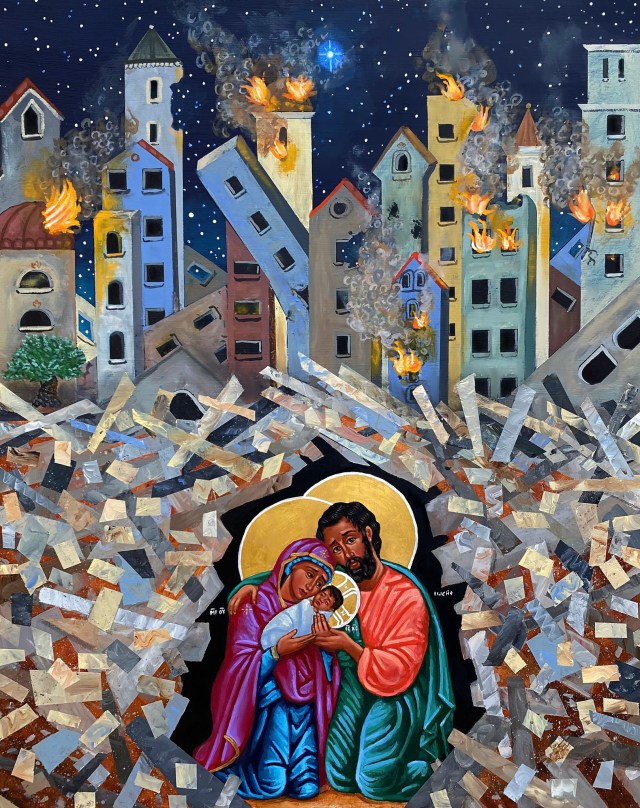
Palestinian Christians are not celebrating Christmas, but they are certainly commemorating it. After all, the Christmas story includes people under occupation, a mother displaced as she is about to give birth, and the slaughter of the innocents by Herod. The version in the Gospel according to Luke begins with a small family obeying the unjust demand of an occupying power, a registration that will tell the Roman Empire which people are to be taxed and which are eligible to serve in its armies. Mary and Joseph then find that there is no place for them in the caravanserai, the local public building that provides strangers to the city with somewhere to gather in safety. So instead Mary puts Jesus in a ‘manger’, a place where food is put for animals to eat, a convenient shelter for a new-born baby when there is nothing else. Luke tells us that the Son of God was born on the margins of the town, to a couple far from family and home.
The good news of the arrival of this Son of God is proclaimed to ordinary shepherds. In the Roman Empire poets and orators typically declared peace and prosperity at the birth of an heir to the Emperor, but here those declarations are made not by poets but by angels, not in a palace but out in the fields, to the poor and lowly. This is Luke’s message. The peace that comes with the birth of Jesus is not the Pax Romana. It is the peace that comes from God and God’s love for humanity. It is born from a couple who are transients, temporarily homeless, making do with whatever shelter they can find. It is announced to shepherds, the lowest of all the labourers, out in their fields. It is a gift to all humanity, to everyone, but especially to the poor and the outcast, the world’s lowly and despised.
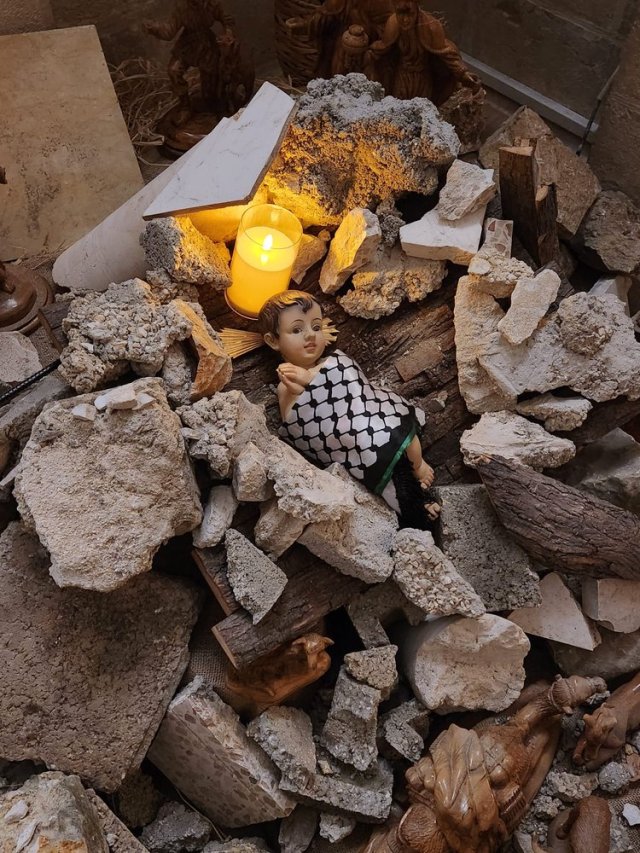
Baby Jesus in the Rubble, Nativity display at the Evangelical Lutheran Church in Bethlehem.
Dr Mitri Raheb, rector of Dar al-Kalima University in Bethlehem, says that ‘The Christmas story is a Palestinian story par excellence.’ Reverend Dr. Munther Isaac, Pastor of the Evangelical Lutheran Church in Bethlehem, has created a nativity scene that shows Jesus in the rubble. He says that:
The nativity scene this year 2023 has expressed the reality of children being killed under the rubble, as well as the destroyed homes and displaced families, while the world continues to justify the killing of these innocent children. Therefore, our message in this time is a message of solidarity with the oppressed people, a message in which we affirm that God is with us, in our pain, sorrows, and suffering, even if Christ will be born under the rubble in Gaza.
I may feel uncomfortable about celebrating Christmas this year, when the birthplace of Jesus is in such anguish, but we must remember and retell the Christmas story. At a time when nations and peoples have gone mad, and are justifying the murder of children and civilian adults, and politicians are telling us that more violence and increased use of weapons of war are necessary for ‘peace’, we need to speak of the God who enters the world as a vulnerable baby among the despised and displaced. We need to speak of a peace that is born of love, not hate.


It is important for us as Christians to do this, because Christianity is so profoundly implicated in the violence in Israel and Palestine. One of the reasons that many Jewish Israelis believe that their state must be a fortress is because of the centuries of Christian antisemitism the culminated in the twentieth century in the Holocaust. And one of the reasons that the United States government provides Israel with weapons is because of the strength of Christian Zionism in the USA. Bishara Awad, the founder of the Bethlehem Bible College, an Evangelical university college, writes of an occasion in the nineteen-eighties:
Sometime during this era, I was invited to a meeting with an American friend of the college, a minister who supported us from our early days. I might have been the only Palestinian at this meeting full of Christians from overseas; I do not recall.
“We need to pray for Israel in her time of struggle,” said my friend as she ministered from the stage. A murmur of amens rippled across the room. I was ready to pray for Israel; it was part of my practice. What I was not prepared for was what came out of her mouth next.
“The Lord is showing me that Israel needs more than our prayers. We need to put some actions to our prayers. Tonight, I believe the Lord is calling us to raise the money to buy a tank for the Israeli Defense Forces. Who is ready to give sacrificially to this cause?”
I could not believe what I was hearing. A tank? Like the vehicles that rolled down our streets and terrorized those who did not make it home before curfew?
Remember, world redemption depends on Jews being back in the land that God promised to them! Who will pledge ten thousand dollars? Who will pledge twenty thousand dollars? Some of you may only be able to afford five thousand dollars. God sees your sacrifice in these end times.”
Around the room, millionaires were raising their hands and standing up as they committed to give to the project.
As she spoke, various scenes flashed through my mind. I recalled how we taught our students that the way of Christ was not to pick up a stone or a gun, but instead to arm ourselves with the gospel of peace … What would another tank do except to encourage more violence on both sides? … Do any of these people understand that this tank may be used to kill their fellow Christians and other innocent people? I wondered.
Pain shot through my heart as I considered that even if they knew, it probably would not matter. They were more enamored with what they considered to be the fulfillment of biblical prophecy than with the fate of Palestinians, even if the Palestinians were their own brothers and sisters in Christ.
I felt very alone. My eye caught the door and I wondered if I should not attempt a graceful exit as a silent protest to the proceedings. Instead, I bowed my head and quietly prayed, my soul in anguish.[1]
There are few things more dangerous in the world than bad religion. We need to commit ourselves to a faith that promotes love, not hate; that works towards true peace, rather than justifying violence. Christmas tells us that when God in Jesus became one of us, God’s human life started and ended in weakness and humility: laid in a manger; executed on a cross. The God who loves us so much that they lived a human life and died a human death is not a God who wants us to honour them by buying a tank.
Nell, our Office Administrator, shared with me some new lyrics to the carol ‘O little town of Bethlehem’ and I want to end with the last verse.
O holy child of Bethlehem,
reveal to us the way
of justice, peace, and healing grace;
be born in us today.
We are the Christmas angels;
help us glad tidings tell.
O walk with us, shine forth through us:
each one, Emmanuel.
Let us be the Christmas angels, sharing ‘good news of great joy for all the people,’ today and always. Amen.
[1] Bishara Awad and Mercy Aiken, Yet in the Dark Streets Shining: A Palestinian Story of Hope and Resilience in Bethlehem (2021), pp. 145-6.

 Rev Doc Geek
Thanks Avril. The Word for our time.
Pingback: Sermon: Epiphany 2024 | Rev Doc Geek